Receiving a settlement check that covers only half of your contractor's estimate isn't a final decision. It's a valuation error that often stems from automated estimating software or a rushed inspection. When you realize your insurance claim settlement is too low to cover actual repair costs, the burden of proof shifts to you. You don't have to accept an offer that ignores entire rooms or miscalculates the difference between Actual Cash Value and Replacement Cost Value.
It's exhausting to fight for the funds you already paid premiums to protect. You likely feel the pressure of rising material prices after a fire or water loss while your adjuster relies on outdated regional databases. We understand the frustration of seeing critical structural damage dismissed as cosmetic wear. This guide provides the technical roadmap to challenge an underpayment and demand a full scope reconciliation.
Discover the specific steps to document hidden damage, interpret complex policy provisions, and utilize the appraisal process to resolve pricing disputes. You'll learn how to present evidence that forces a second look at your file. Take control of your recovery by moving from a point of distress to a position of professional empowerment.
Key Takeaways
- Learn to identify missing line items in your estimate and understand how the math between Actual Cash Value and Replacement Cost Value affects your final payout.
- Avoid signing "Full and Final" releases until you've investigated for hidden issues like smoke intrusion or moisture trapped behind drywall.
- Discover how to invoke the appraisal clause when your insurance claim settlement too low, allowing independent experts to resolve valuation deadlocks.
- Master the use of high-resolution imagery and thermal technology to provide the concrete evidence needed to prove the true extent of your property damage.
- Understand how a licensed public adjuster re-evaluates the entire scope of loss to help you secure a settlement that reflects current local repair costs.
Why Property Insurance Settlements Often Fall Short
Receiving an insurance estimate that doesn't align with reality is a common hurdle for property owners. Many people find their insurance claim settlement too low because the initial inspection was rushed or handled by an adjuster who missed critical details. This isn't a sign of a final verdict; it's a result of a high-volume system that often prioritizes speed over precision. You have to understand the mechanics of the estimate to fight back effectively.
Insurers rely on standardized software to calculate payouts. These programs use regional databases to determine the cost of drywall, paint, and lumber. However, these rates often lag behind real-world price spikes or local labor shortages. If your settlement check feels like it belongs in the previous decade, it's likely because the software hasn't accounted for current market conditions in your specific city.
RCV vs. ACV: The Math Behind Your Check
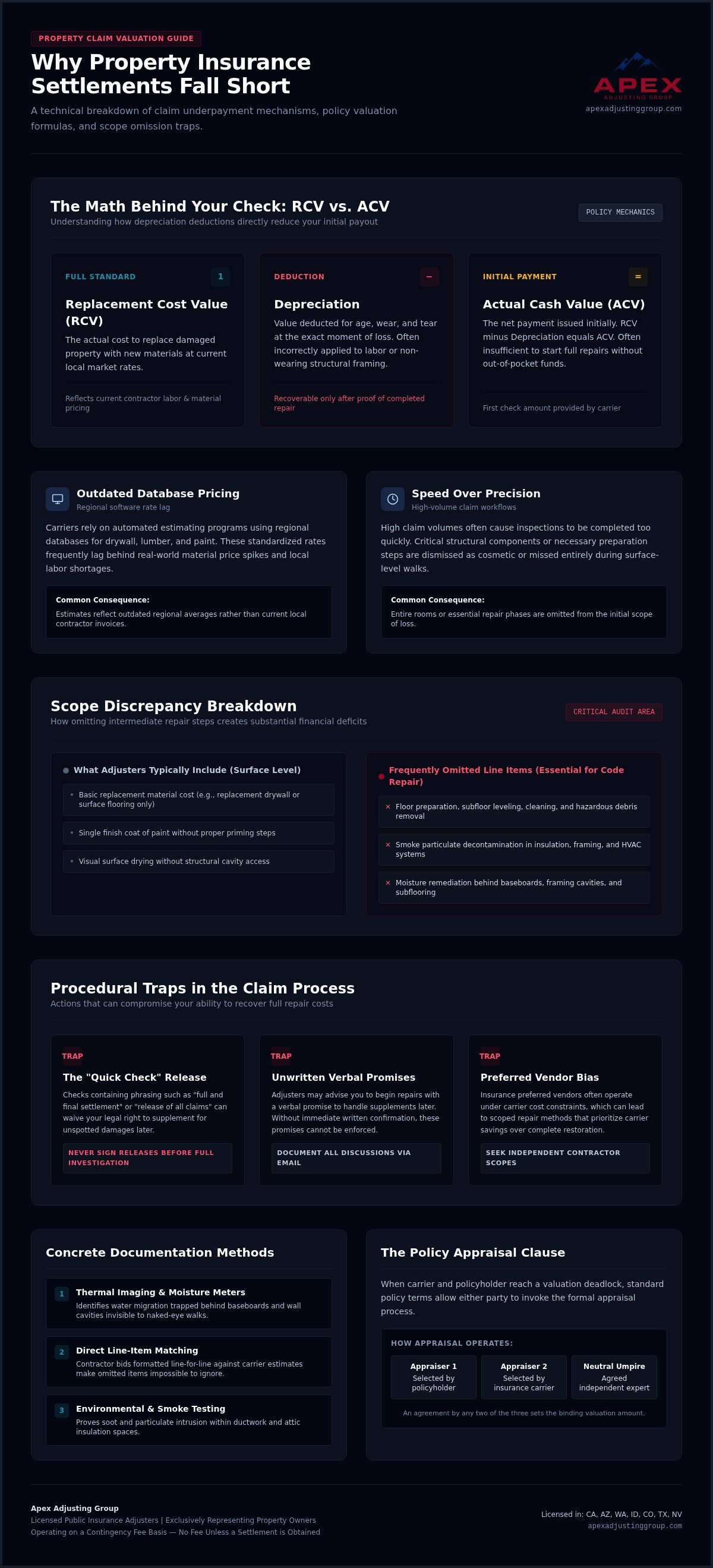
Your policy likely contains two different valuation methods. The actual cash value is defined as the replacement cost minus depreciation. This represents the value of your property at the exact moment of the loss. In contrast, Replacement Cost Value (RCV) covers the price of new materials at current market rates. Most modern policies allow you to recover the difference, known as recoverable depreciation, only after you provide proof that the repairs are complete. Adjusters often apply heavy depreciation to items that shouldn't be discounted, such as professional labor or structural components like framing that don't wear out like a roof or carpet.
Scope of Loss Discrepancies
A major source of underpayment is the missing scope. This happens when the insurance estimate omits necessary steps for a professional repair. For example, an adjuster might include the cost of new flooring but forget the line items for floor prep, subfloor cleaning, or debris removal. These small omissions add up to thousands in unpaid damages across a large project. It's vital to review your estimate line by line to catch these gaps.
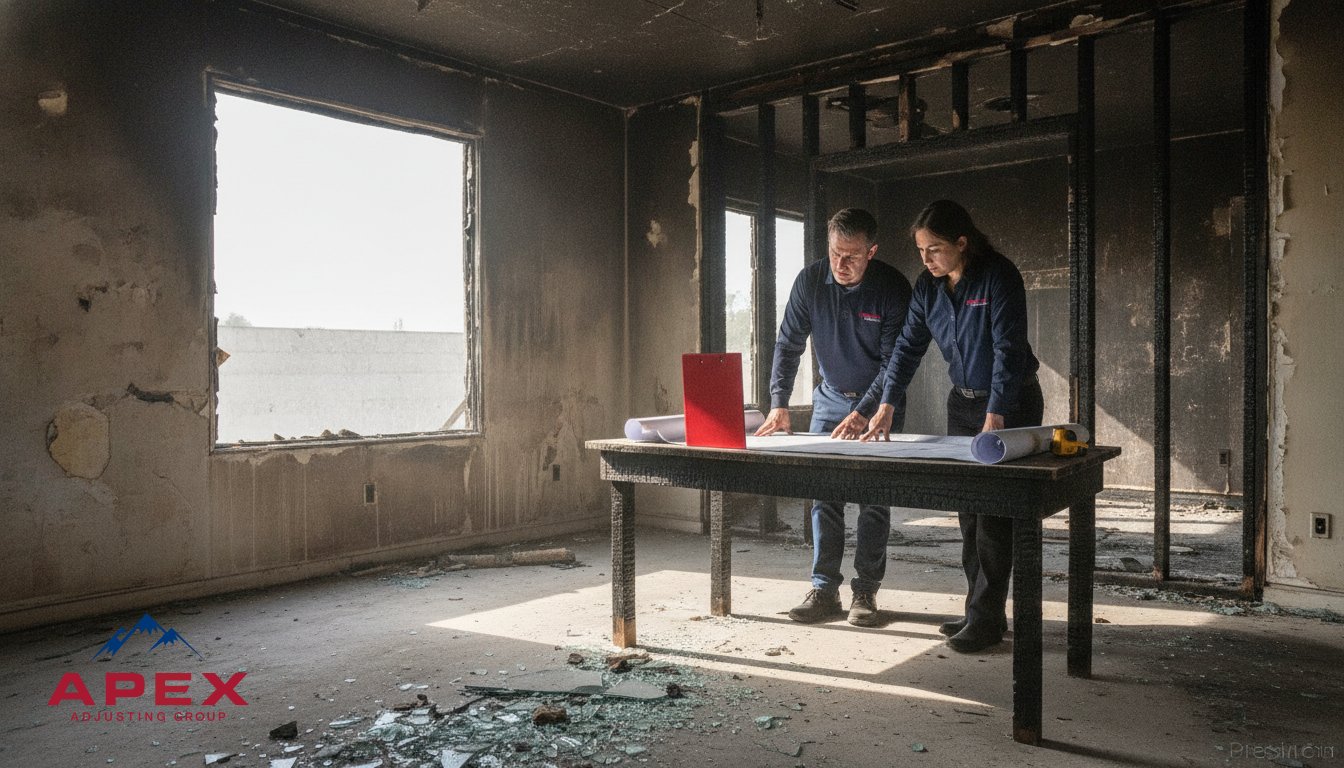
When filing residential claims, ensure your contractor's bid follows the same format as the insurance estimate. This allows for a direct comparison of quantities and unit prices. It makes it much harder for the carrier to ignore specific discrepancies in the scope of work. Demand that the adjuster justifies every missing line item that your contractor identifies as essential for a code-compliant repair.
Common Traps in the Insurance Adjusting Process
Speed is often the enemy of accuracy in the property claims world. Many owners find their insurance claim settlement too low because they fell for the "quick check" trap. An adjuster might hand you a payment within days of the loss, but that check often comes with a catch. If the document or the back of the check includes language like "full and final settlement" or "release of all claims," signing it could waive your right to seek additional funds later. Don't trade your long-term recovery for short-term liquidity.
Verbal promises are another common pitfall. An adjuster may tell you to "just start the repairs" and promise that the carrier will "take care of the rest" via supplements. Without these promises in writing, you have no leverage if the insurance company later denies the additional costs. Document every conversation. Confirm verbal agreements through email immediately to create a paper trail that protects your interest. If you're feeling overwhelmed by the paperwork, a professional claim evaluation can help identify these procedural traps before they cost you money.
Hidden Damage and Secondary Loss
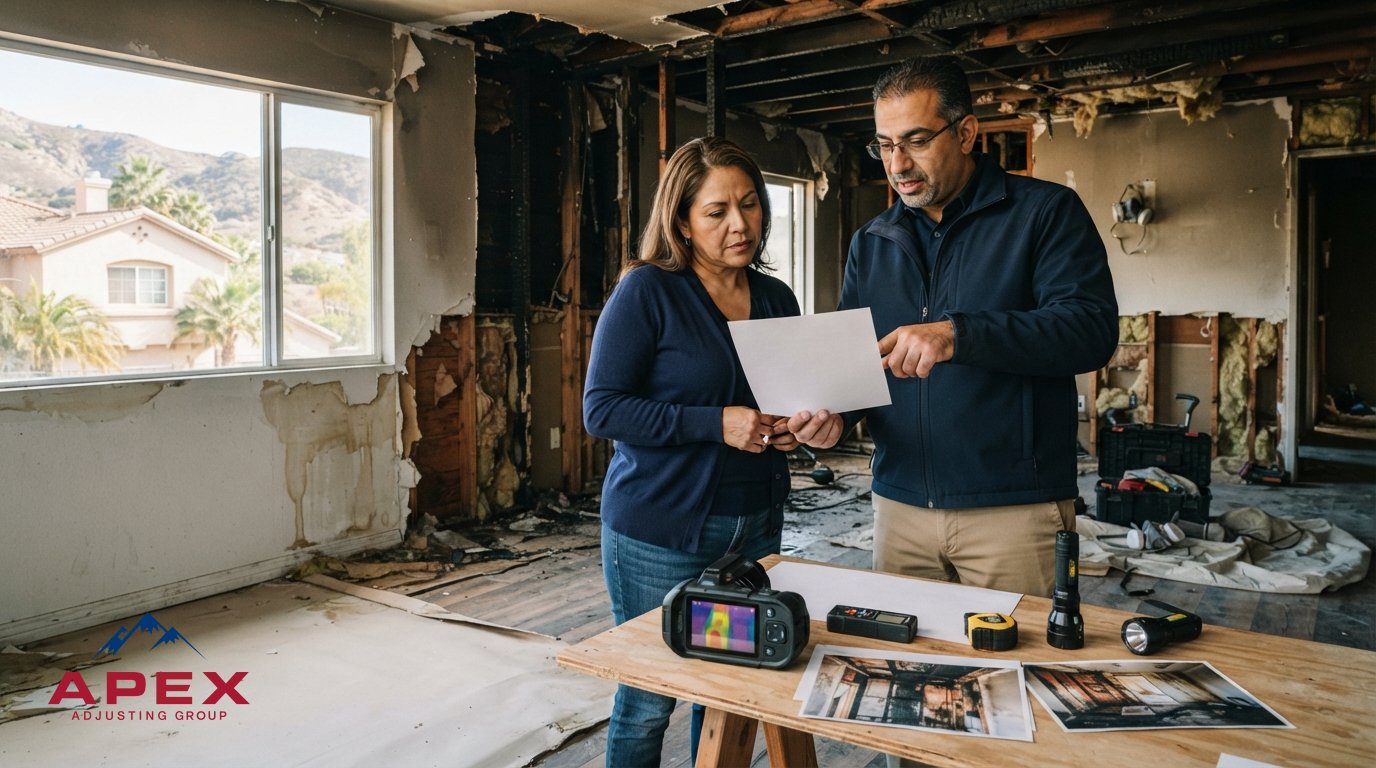
Visual inspections rarely reveal the full extent of the damage. For instance, water damage frequently hides behind baseboards and inside wall cavities where it can lead to mold growth if not properly dried. A standard adjuster might only look at the wet carpet while ignoring the moisture wicked up into the drywall. Similarly, a visual check is insufficient for fire damage because smoke particulates and soot can migrate into HVAC systems and insulation. These hidden issues require professional testing and specialized equipment like thermal imaging to prove the loss exists.
The Preferred Vendor Conflict
Carriers often push you toward their "preferred vendors" for repairs. While this sounds convenient, keep in mind that these contractors often have pre-negotiated rates with the insurance company. This relationship can lead to a conflict of interest where the vendor under-scopes the work to stay within the insurer’s budget. You have the right to choose your own independent contractor who answers only to you. This helpful industry resource on disputing low claim settlements confirms that you aren't required to use the carrier's suggested repair firm. Stand your ground and demand an estimate based on the actual local cost of high-quality materials and labor.
Utilizing the Insurance Appraisal Clause to Resolve Disputes
Receiving an offer that doesn't cover your contractor's bid is a common frustration. When your insurance claim settlement too low, you aren't forced to accept the initial check as a final answer. Most property policies contain a specific provision called the appraisal clause. This is a contractual mechanism designed to break a valuation stalemate without involving the court system. Use it when you and the carrier agree that damage occurred but cannot agree on the cost of repairs.
Triggering the Appraisal Clause
Look for the "Appraisal" heading in the Conditions section of your policy. It's vital to remember that the insurance appraisal process only addresses the amount of loss. It doesn't settle coverage disputes or determine if a specific peril caused the damage. If the carrier acknowledges the pipe burst but refuses to pay for the hardwood replacement, appraisal is your strongest weapon. In states like Texas, recent mandates under Texas Insurance Code Chapter 1813 require standardized appraisal provisions in residential policies to ensure disputes have a clear path to resolution.
Trigger this clause by sending a formal written demand to your insurance company. This move shifts the file from a standard negotiation into a structured technical evaluation. It stops the endless cycle of phone calls and forces a decision based on evidence. Reference this NAIC guide on filing an insurance complaint to understand the documentation required when escalating a dispute to your state regulator if the carrier resists the process.
The Appraiser and Umpire Hierarchy
The process requires both parties to select a "competent and disinterested" appraiser. This means your appraiser must be an expert in property damage valuation and have no financial stake in the outcome. States like Colorado and Texas have strict neutrality requirements; both appraisers and the umpire must remain impartial. These two appraisers then choose an umpire, a neutral third party who acts as a tiebreaker. If the two appraisers agree on a value, the case is closed. If they disagree, they submit their differences to the umpire.
An agreement signed by any two of the three creates a binding appraisal award. This award sets the final amount the insurance company must pay for the covered damage. You are responsible for the cost of your own appraiser and usually half the umpire's fee. This investment is often necessary when the gap between your contractor's bid and the adjuster's estimate is too wide to bridge through simple conversation. It moves the claim toward a resolution based on professional expertise rather than automated software databases.
Evidence and Documentation Needed to Increase Your Claim
Adjusters respond to data, not complaints. If your insurance claim settlement too low, the burden of proof rests entirely on your shoulders. You must provide a technical package that makes it impossible for the carrier to ignore the true scope of work. Start by capturing high-resolution video of the entire property, not just the obvious damage. This creates a visual baseline that prevents the insurance company from claiming the damage was pre-existing or minor.
Technical Evidence for Complex Claims
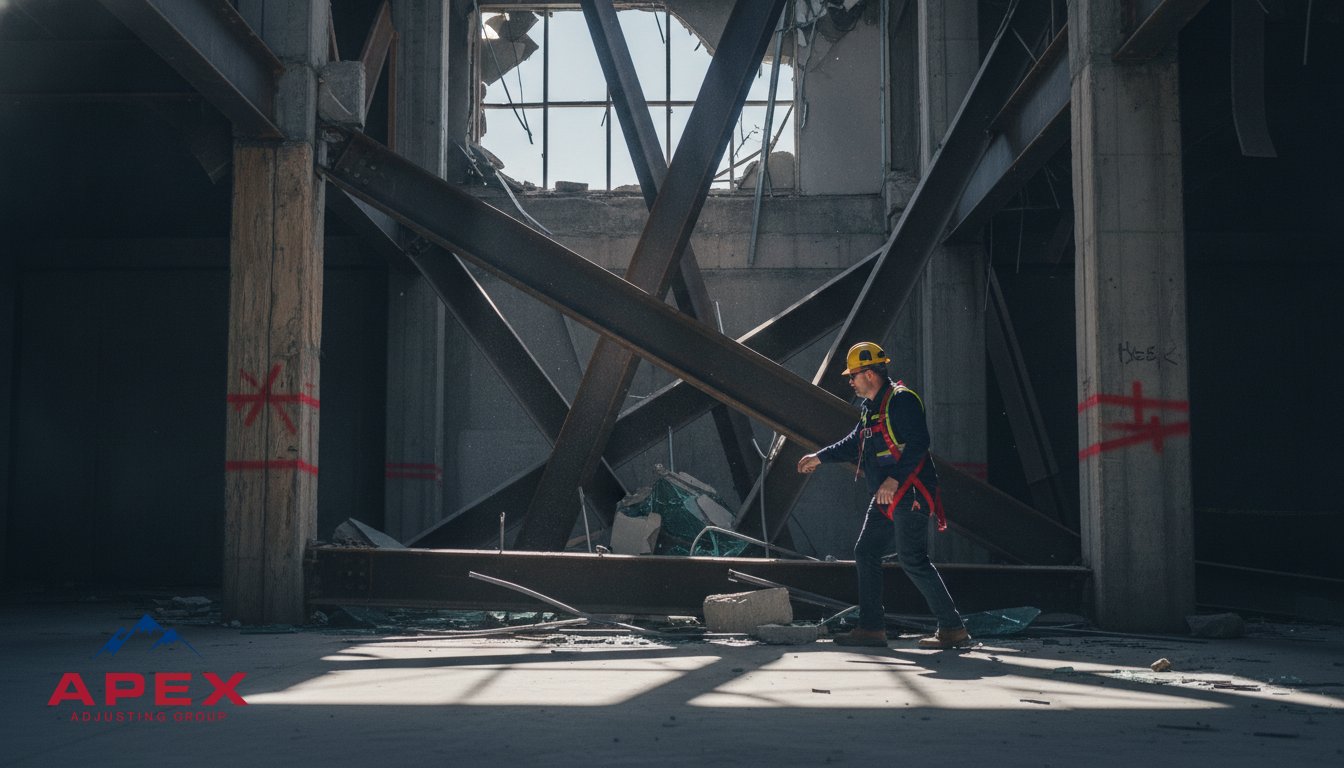
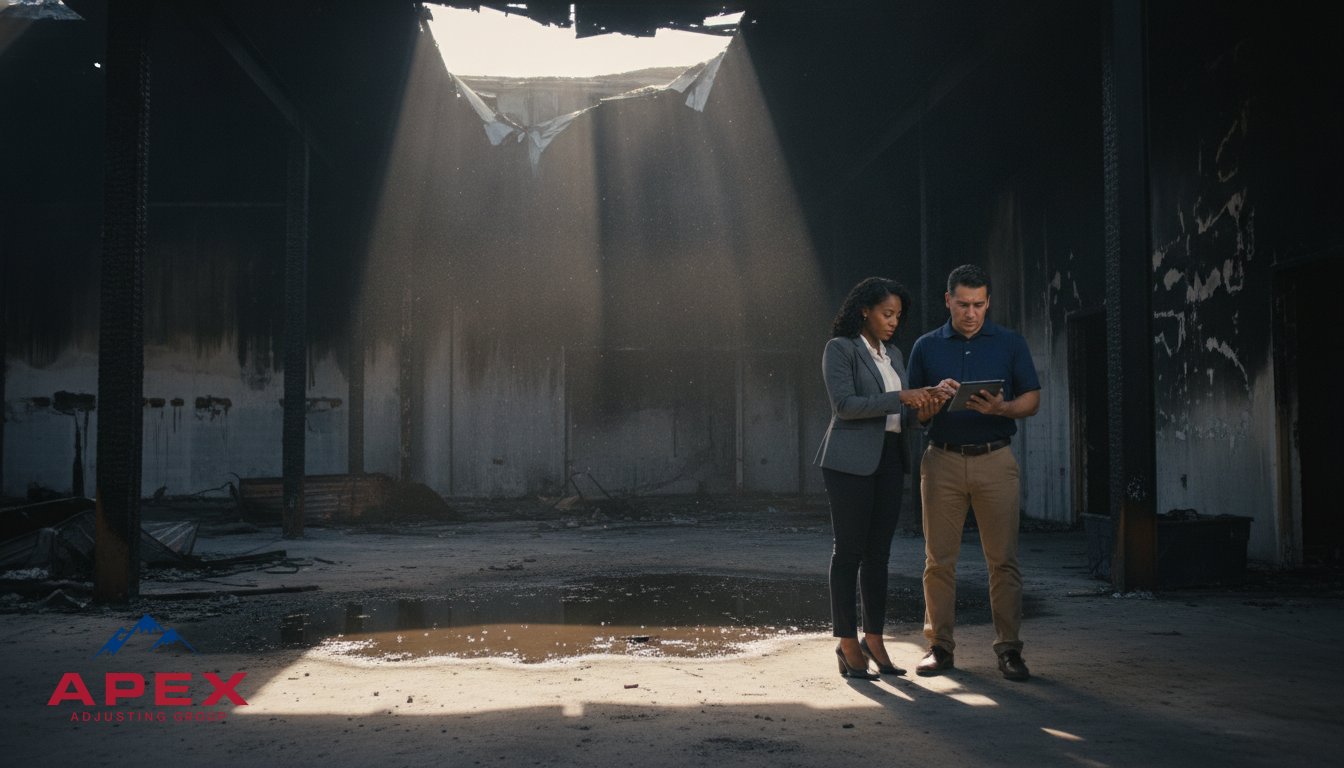
Standard photography often fails to capture the nuance of a large loss. Commercial property claims benefit significantly from Matterport 3D scans, which create an immersive digital twin of the facility. This technology prevents disputes over room dimensions or equipment placement. In cases of structural collapse, do not rely solely on the insurer's expert. Hire an independent structural engineer to provide a stamped report on the cause and extent of the failure. Lab testing for soot or mold provides the scientific proof needed to justify specialized cleaning costs that adjusters frequently omit.
The Paper Trail Checklist
Build a bulletproof administrative file. Adjusters are more likely to approve line items when they're supported by third-party documentation. Organize your digital files by room or damage category to make the review process efficient for the carrier. This level of organization signals that you understand the technical requirements of the claim process.
- Signed Proof of Loss documentation.
- Comprehensive inventory lists with brand names and purchase dates.
- Thermal imaging reports and moisture meter readings to prove hidden water migration.
- A communication log detailing every phone call and email with the carrier.
Understand your contractual duty to mitigate. You must take reasonable steps to protect the property from further loss immediately after the event. If your insurance claim settlement too low, ensure you've documented the costs of these emergency measures. Save invoices for tarping, board-ups, and water extraction. These are covered expenses that the carrier must reimburse as part of your total recovery.
How a Licensed Public Adjuster Maximizes Your Recovery
The insurance company's adjuster works for the carrier, not for you. Their primary objective is to settle the file quickly while adhering to the company's internal cost-containment guidelines. When you find your insurance claim settlement too low, you need a professional who speaks the same technical language as the carrier but carries a different set of priorities. A public adjuster is the only type of insurance professional licensed to represent the interests of the property owner exclusively.
Don't let a low initial offer dictate the quality of your repairs. Professional representation levels the playing field. It forces the insurance company to address the claim with the technical thoroughness it deserves, rather than relying on a surface-level inspection. You've paid your premiums for years; you deserve a settlement that reflects the actual cost of restoration.
The Advocate for the Property Owner
Unlike a company adjuster, a public adjuster has a duty to you. They conduct a comprehensive, independent assessment of the damage that often uncovers items the initial inspector overlooked. This includes a deep dive into local building codes and material costs specific to your market. Whether you need Los Angeles public adjusters for a complex fire claim or Phoenix public adjusters for storm damage, local expertise ensures your estimate reflects the actual labor rates in your neighborhood.
Contingency Fees and ROI
Most property owners worry about the cost of professional help when they're already facing a financial loss. Public adjusters operate on a contingency fee basis, where the fee is a pre-agreed percentage of the final settlement. This model aligns your interests perfectly; the adjuster only gets paid if they successfully secure a recovery for you. It's a "no recovery, no fee" commitment that removes the financial risk of seeking a second opinion. It ensures your representative is motivated to identify every single dollar of covered damage. Start with a free claim review to see if your current offer is missing critical line items.
Beyond the math, a public adjuster manages the entire administrative burden of the claim. They handle the phone calls, the document requests, and the technical meetings with the carrier's representatives. This allows you to focus on rebuilding your home or business while a seasoned expert fights the valuation battle. You don't have to face a massive insurance corporation alone. Put a steady hand in charge of your crisis and move toward a full recovery with confidence.
Take Control of Your Property Recovery
The check you received is a starting point, not a final verdict. Correcting a valuation error requires a technical approach that focuses on missing line items and current market labor rates. By documenting hidden damage and understanding your right to invoke the appraisal clause, you shift the leverage back to your side. You don't have to accept a situation where your insurance claim settlement too low to cover the actual costs of restoration.
Apex Adjusting Group provides the expert oversight needed to challenge underpaid claims across California, Arizona, Washington, Idaho, Colorado, Texas, and Nevada. Our team specializes in high-value fire and water losses, operating on a contingency basis so you never pay an upfront fee. We handle the technical negotiations so you can focus on returning your property to its pre-loss condition.
Secure the professional advocacy you deserve and ensure your settlement reflects the true scope of your loss. Our licensed adjusters are ready to review your file and provide the clarity you need to move forward with your repairs.
Frequently Asked Questions
What should I do if my insurance settlement is too low for repairs?
If your settlement doesn't cover actual repair costs, you should immediately gather independent contractor bids from local professionals in markets like Los Angeles or Phoenix. Compare their line items against the insurance estimate to identify missing scope or low unit pricing. Don't sign any full and final release forms. Provide the carrier with high-resolution photos and technical documentation to support your demand for a higher payout.
Can I still dispute my claim if I already cashed the insurance check?
Cashing a check is typically acceptable if it represents the undisputed amount of the loss. Most states allow you to accept this initial payment while continuing to negotiate for additional funds. However, you must carefully inspect the check and accompanying documents for language such as full and final release. If you find your insurance claim settlement too low, avoid signing any document that waives your right to seek supplemental payments.
Is a public adjuster better than an attorney for a low settlement?
Public adjusters are technical experts who specialize in the amount of loss and repair scope. Unlike other professionals, they focus entirely on the physical damage and policy provisions to maximize your recovery. They handle the administrative burden of the claim process, from documentation to negotiation. This expertise is particularly valuable for property owners in Orange County or Seattle who need a detailed re-estimate of fire or water damage.
How long do I have to dispute an underpaid insurance claim?
The timeframe to dispute an underpaid claim is governed by your specific policy and state laws in areas like Texas or California. Most policies include a Suit Against Us or Dispute Resolution clause that outlines these deadlines. It's vital to act quickly after realizing your insurance claim settlement too low. Delays can lead to the expiration of your right to invoke the appraisal clause or submit supplemental documentation for hidden structural damage.
What is the most common reason insurance companies underpay claims?
The most common reason for underpayment is missing scope, where the adjuster omits necessary repair steps like debris removal or floor prep. Insurers also rely on automated estimating software that may use outdated labor rates for cities like Sacramento or Las Vegas. These databases often lag behind the real-world price of materials and specialized labor. This technical discrepancy creates a gap between the insurance offer and the actual cost of restoration.
Do I have to use the contractor my insurance company recommended?
You aren't required to use a preferred vendor suggested by your insurance company. These contractors often have pre-negotiated price agreements with the carrier, which can lead to an under-scoped estimate. You have the right to hire independent, licensed contractors in your local market, such as San Diego or Houston. Choosing your own team ensures that the repairs meet local building codes and utilize high-quality materials rather than the cheapest options.
What happens if the insurance company denies my supplemental claim?
If a supplemental claim is denied, you must provide additional technical evidence to justify the added costs. This might include moisture meter readings, thermal imaging reports, or a stamped engineer's report for structural issues. If the carrier maintains their denial based on the amount of loss, you can invoke the appraisal clause. This moves the dispute to a panel of independent experts who will make a binding decision on the repair value.
How does the appraisal process differ from a lawsuit?
Appraisal is a contractual dispute resolution mechanism used exclusively to determine the amount of loss. It involves two independent appraisers and a neutral umpire rather than a judge or jury. This process is generally faster and less formal than other dispute methods. It focuses on technical valuation and repair scope rather than coverage interpretations. This makes it a highly effective tool for property owners in Reno or Spokane to resolve pricing deadlocks.
Need Help with Your Insurance Claim?
Our licensed public adjusters can help you get the maximum settlement you deserve. Contact us today for a free claim evaluation.
Related Articles