A low settlement offer is not the final word on your property damage claim. You've likely spent weeks back and forth with an adjuster who refuses to acknowledge the actual cost of your repairs. It's exhausting to feel stuck in a stalemate while your home or business remains damaged. You deserve a resolution that reflects the reality of your loss, not just a number on a corporate spreadsheet.
The insurance appraisal process exists specifically to break these deadlocks and resolve valuation disputes. By invoking this policy provision, you can move the conversation away from "he-said, she-said" arguments and toward a binding, professional decision. This article explains how the process works to secure a fair settlement for fire damage, water leaks, or storm destruction. You'll learn the roles of independent appraisers and umpires, what to expect during the timeline, and how public adjusting services protect your interests from start to finish.
Key Takeaways
- Force a resolution to valuation stalemates when an insurer's repair estimate fails to cover the actual cost of damage.
- Navigate the insurance appraisal process to leverage independent experts and secure a binding decision on your claim's true value.
- Avoid lengthy dispute tracks by utilizing a method designed specifically for fast and final valuation results.
- Master the five critical steps of a formal appraisal demand to ensure your documentation correctly reflects the full scope of repairs.
- Utilize professional appraisal experts for complex fire or earthquake claims to counter unfair depreciation and maximize your settlement.
When the Insurance Claim Settlement Is Too Low
Receiving a settlement check that covers only a fraction of your contractor’s estimate is a frustrating reality for many property owners. This gap often appears after devastating fire damage or complex water losses that require extensive restoration. You've likely spent hours on the phone with a desk adjuster only to be met with rigid resistance. Negotiating with a desk adjuster often hits a brick wall where they refuse to acknowledge the actual costs of your local market.
This is the point of diminishing returns where phone calls and emails no longer yield results. When these traditional methods fail, you need a different strategy to protect your investment. The insurance appraisal process functions as a formal alternative dispute resolution method built into most policies. It moves the decision-making power away from the insurance company's internal staff and places it into the hands of independent experts who focus on the financial value of the loss.
Identifying a Valuation Disagreement
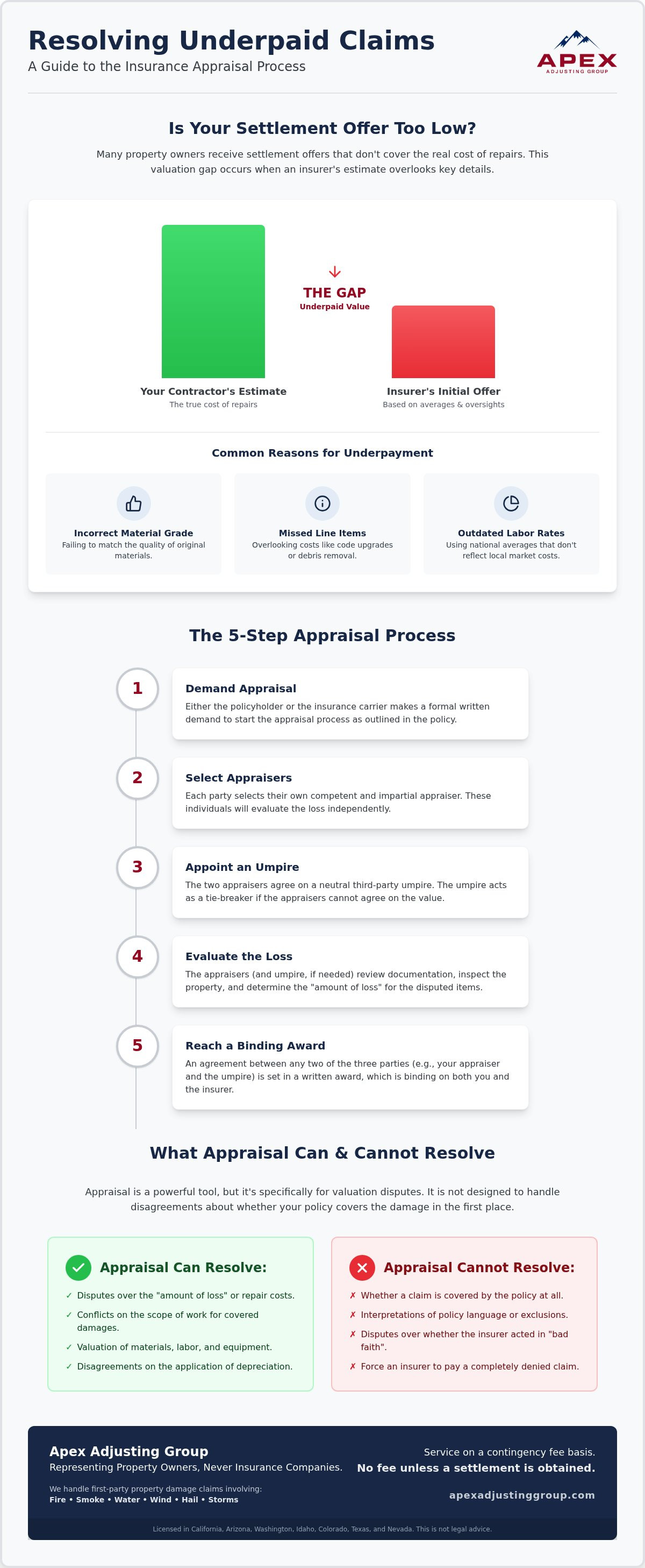
A valuation dispute exists when the insurance carrier agrees that the damage is covered but disagrees on the total cost to fix it. This isn't a "yes or no" argument about the claim's validity; it's a "how much" argument about the check's amount. Common friction points include the grade of materials required for a replacement or the labor rates charged by licensed contractors. These conflicts are particularly sharp in commercial property insurance claims, where disputes often expand to include business interruption and specialized equipment restoration.
Why Insurers Underestimate Property Loss
Insurers frequently use standardized estimating software that relies on national averages which don't reflect local realities. Adjusters often overlook critical details during their initial walkthrough, such as smoke odor in HVAC systems or structural damage hidden behind drywall. By invoking the insurance appraisal process, you challenge these software-driven estimates with real-world data. Missing line items for essential tasks like code upgrades or debris removal lead directly to underpaid claims that fail to capture the full scope of necessary restoration work. Every omitted detail is money out of your pocket.
Understanding the Insurance Appraisal Clause
The appraisal clause is a specific provision found in the 'Conditions' section of your insurance policy. Think of it as the rulebook for how valuation disputes are handled when negotiations hit a stalemate. Either you or the insurance carrier can demand appraisal in writing. It is a powerful tool designed to resolve disagreements without the high costs and long delays associated with other formal paths. The insurance appraisal process works for residential claims as well as complex commercial property claims.
This process is designed to be less formal than legal proceedings. It avoids the rigid structure of a courtroom while still providing a definitive result. By moving the dispute to a panel of experts, you bypass the typical back-and-forth with a desk adjuster who may not have the authority to increase your settlement. It is a direct route to a binding decision on what your repairs should actually cost.
How the Policy Provision Works
The clause establishes a clear structure for resolving the file. Once appraisal is demanded, each party has a specific window to select a competent and disinterested appraiser. These two appraisers then select an umpire to act as a tie-breaker. This three-person panel evaluates the property damage independently of the insurance company's original estimate to reach a fair valuation.
Financial responsibility is split down the middle. You're responsible for paying your chosen appraiser; the insurance company pays theirs. Both parties share the cost of the umpire equally. Before starting, review your policy language to determine if the appraisal is mandatory or permissive. Mandatory clauses require both parties to participate if one demands it. If you're unsure how your specific policy applies to your loss, a free claim review can clarify your options.
Amount of Loss vs. Coverage Disputes
A critical distinction often missed by property owners is the difference between "scope" and "coverage." Appraisal is strictly limited to determining the 'amount of loss' for damage that the insurer has already admitted is covered. It cannot be used to determine if a specific event is actually covered by the policy terms. It doesn't have the power to interpret law or policy language regarding exclusions.
If the insurance company denies your claim entirely, the insurance appraisal process isn't the correct first step. In those cases, a public adjuster may be needed to re-evaluate the denial and establish coverage first. Once the insurer admits the damage is covered, appraisal can then be used to fight for the correct repair costs. Understanding this boundary prevents you from wasting time on a process that lacks the authority to overturn a total denial.
Comparing Appraisal to Other Dispute Methods
Property owners often feel trapped when a claim stalls. You have several options to break a stalemate, but they are not created equal. The insurance appraisal process is often the fastest route to a fair payout compared to other formal dispute tracks. It bypasses corporate bureaucracy and focuses entirely on the technical data of your loss. While other methods might drag on for months, appraisal moves toward a definitive conclusion with urgency.
This method focuses on technical damage assessment rather than legal interpretations. It is a precise tool for valuation. If you need water damage insurance claim help, you need an expert who understands structural drying and mitigation costs. An appraiser looks at the physical evidence and local labor rates to build a realistic cost of repair. They don't get distracted by the insurer's internal policies or standard software limitations.
Appraisal vs. Mediation
Mediation is essentially a high-stakes conversation facilitated by a neutral third party. It is a non-binding negotiation where the goal is to reach a compromise. The problem is that the insurance company can simply walk away if they don't like the numbers. If the insurer refuses to budge, mediation ends without a resolution, leaving you back at square one. You've wasted time and energy without moving the needle on your settlement.
Appraisal is different because it results in a binding 'award.' This document determines the final settlement amount once two out of the three panel members sign it. While mediation may address broad coverage issues, appraisal stays laser-focused on the dollars required to fix the property. It provides a clear end to the valuation argument. You get a firm decision that the insurance company must respect, providing the security you need to begin repairs.
Appraisal vs. Public Adjusting
Public adjusters manage the entire claim lifecycle from the initial inspection to the final check. They handle inventory, documentation, and every phone call with the carrier. Appraisers have a much narrower focus. They are brought in specifically to solve a valuation gap after the claim has already been filed and partially processed. One is a comprehensive management service, while the other is a targeted dispute resolution tool.
A public adjuster can often act as your designated appraiser in the process. This is a strategic advantage. They already know every detail of your file and the specific scope of your damage. They bring a fighter’s spirit to the panel to ensure your interests are protected. Identify which service fits your current claim stage at Apex Adjusting Group. Whether you need full claim management or a professional appraiser to break a deadlock, professional representation levels the playing field.
Navigating the 5 Steps of the Appraisal Process
The insurance appraisal process starts when one party sends a formal written demand to the other. This isn't a casual request; it's a procedural trigger found in your policy's conditions. Once this letter is received, the clock starts ticking on strict deadlines. You must act promptly to ensure your rights are protected and the process moves forward without unnecessary delays.
Success in this environment depends on the thoroughness of the documentation presented to the panel. You can't rely on the insurance company's incomplete photos or generic line items. You need a detailed, line-by-line breakdown of every structural element, material cost, and labor hour required to restore your property. The goal is a signed 'Appraisal Award' that forces the insurer to pay what you're actually owed.
Selecting Appraisers and the Umpire
Each party must select a competent and independent appraiser within a set timeframe, usually 20 days depending on the specific policy language. These individuals represent their respective sides but must remain disinterested in the financial outcome. Once selected, these two appraisers work together to choose a neutral Umpire. This Umpire acts as the tie-breaker if the two appraisers cannot reach an agreement on specific repair costs.
If the appraisers reach a deadlock on the Umpire selection, you aren't stuck. A local court in your jurisdiction can be petitioned to appoint a qualified professional to fill the role. This ensures the insurance appraisal process cannot be indefinitely stalled by a non-cooperative party. Having a professional advocate during this stage is vital to ensure the panel remains balanced and fair.
The Inspection and Final Award
The panel conducts a physical inspection of the property to verify the scope of damage. They exchange detailed estimates and debate the merits of specific repair methods, such as whether a roof needs a patch or a full replacement. They look at the evidence you've gathered, from moisture readings to thermal imaging. They don't just guess; they use data to reach a conclusion.
When two of the three panel members agree on a value, they sign the award document. Once signed by a majority of the panel, the Appraisal Award becomes a binding settlement amount that the insurance company is contractually obligated to pay. This document effectively closes the valuation dispute and provides the funds necessary to complete your restoration. It turns a "he-said, she-said" argument into a financial reality.
Maximizing the Outcome with Professional Appraisal
Stop accepting the insurer's lowball figures as the final word on your property's value. You need an advocate who understands the specific mechanics of your loss. For claims involving earthquake damage or structural fire damage, technical expertise is your only path to a fair recovery. A qualified professional identifies hidden structural compromises that a standard adjuster ignores. They turn technical data into a compelling argument for the settlement you deserve.
A professional appraiser knows how to counter the insurer's aggressive depreciation arguments. Carriers often try to slash your payout by claiming your property had pre-existing wear and tear or reached the end of its useful life. You need a representative who can prove the actual condition of your materials before the loss occurred. In the insurance appraisal process, documentation is your primary weapon. High-resolution photos, moisture maps, and engineering reports provide the evidence needed to win the valuation battle. Use every piece of data to protect your investment.
Qualities of a Competent Appraiser
Look for an appraiser with deep experience in your specific damage category. If you're dealing with complex smoke odors or soot, don't hire someone who only handles wind claims. The appraiser must be independent and capable of providing an unbiased estimate that stands up to scrutiny. Technical knowledge of current construction codes and local material costs is mandatory. They must be able to justify every line item to the Umpire with authority and precision. A weak representative leads to a weak award.
How Apex Adjusting Group Advocates for You
Our team evaluates your claim to see if the insurance appraisal process is the right strategic move for your specific situation. We don't just guess; we perform a thorough analysis of the insurer's estimate versus the actual scope of work required to restore your property. We provide the detailed damage assessments required to support a higher valuation. We represent property owners only, ensuring our interests are perfectly aligned with your recovery. We are the steady hand you need in a high-stakes crisis.
You don't have to face a complex corporate system alone. Level the playing field with a team that understands the intricacies of policy language and construction costs. We operate on a contingency fee basis, meaning there is no fee unless a settlement is obtained. Request a free claim review to start the process today and secure the professional representation you deserve.
Secure the Settlement Your Property Deserves
You don't have to accept an insurance company's low estimate as the final word on your loss. The insurance appraisal process is a powerful contractual right that bypasses negotiation stalemates to deliver a binding decision. By selecting an expert appraiser who understands structural damage and local repair costs, you move the claim toward a resolution that reflects the actual price of restoration. Having a professional on your side ensures that the final award accurately covers the work needed to rebuild.
Apex Adjusting Group provides this specialized expertise as licensed adjusters in CA, AZ, WA, ID, and NV. We focus on maximizing settlements for fire and water damage without the burden of upfront costs. Our services are contingency-based; there is no fee unless we obtain a recovery for you. We act as your fierce advocate, ensuring that every line item of your property damage is documented and valued correctly by the appraisal panel.
Take the first step toward breaking the claim deadlock and restoring your property with confidence. You have the right to a fair payout, and professional representation helps you secure it.
Frequently Asked Questions
Is the insurance appraisal process mandatory?
The requirement for appraisal depends entirely on the specific "Conditions" section of your insurance policy. In many standard residential and commercial policies in states like California or Texas, the process is mandatory if either party makes a formal written demand. However, some policies use permissive language that requires both parties to agree before the panel is formed. You should have a professional review your policy to confirm your rights before initiating a demand.
How much does the insurance appraisal process cost?
Costs for the insurance appraisal process are divided between the policyholder and the insurance company. You are responsible for the fees of your chosen independent appraiser, while the insurer pays for their own representative. Both parties split the cost of the neutral Umpire equally. Apex Adjusting Group provides these services on a contingency basis for public adjusting, ensuring you don't pay a fee unless a recovery is achieved for your property damage.
Can I still go to appraisal if my claim was denied?
You cannot use appraisal to challenge a total claim denial because the process is strictly limited to valuation disputes. Appraisal only determines the "amount of loss" for damage that the insurer has already admitted is covered under the policy terms. If your claim is denied, you first need to establish coverage. A public adjuster can evaluate the denial and work to reopen the claim before the valuation argument can begin through the appraisal panel.
How long does the appraisal process typically take?
The timeline for the insurance appraisal process varies based on the availability of the panel and the complexity of the structural damage. Once a demand is made, parties typically have twenty days to select their appraisers. The entire process often concludes within sixty to ninety days, which is significantly faster than other formal tracks. Factors such as the need for a court-appointed Umpire in cities like Seattle or Phoenix can extend this window.
Who pays for the Umpire in an insurance appraisal?
The cost of the neutral Umpire is shared equally between you and your insurance company. This 50/50 split ensures the Umpire remains unbiased and disinterested in the final financial outcome. Paying for a qualified Umpire is a strategic investment because their decision acts as the tie-breaker if the two appraisers cannot agree on the repair costs. This shared expense is a standard provision found in the appraisal clause of most property insurance policies.
Can the insurance company refuse to go to appraisal?
An insurance company generally cannot refuse to participate if your policy contains a mandatory appraisal clause. If you send a formal written demand and the insurer ignores it, they may be in breach of the insurance contract. However, they can refuse if the dispute involves coverage issues rather than the price of repairs. If the insurer attempts to block the process, you may need a professional advocate to enforce your contractual rights and seat the panel.
What happens after the appraisal award is signed?
Once a majority of the panel signs the appraisal award, the decision becomes a binding settlement amount. The insurance company is contractually obligated to issue payment based on the final figure reached by the appraisers or the Umpire. This award effectively ends the valuation dispute, allowing you to move forward with property repairs. You should receive the funds promptly, though the insurer may still apply your deductible and any prior payments made on the claim.
Need Help with Your Insurance Claim?
Our licensed public adjusters can help you get the maximum settlement you deserve. Contact us today for a free claim evaluation.
Related Articles