The adjuster sent by the insurance carrier is there to protect the company's financial interests, not the business's recovery. Most owners spend years building an operation and paying premiums, only to find that a commercial property insurance claim feels like a second disaster. Complex policy language and specialized equipment repairs often lead to settlement offers that fall short of actual restoration costs.
It's common to feel overwhelmed by business interruption and the resulting revenue loss while trying to decipher what the policy actually covers. This guide provides the clarity needed to navigate these complexities and document a loss effectively to help secure a fair settlement. Expertise is the primary weapon when the stakes involve the future of an entire business.
The following sections explain how to account for lost business income, interpret difficult policy provisions, and manage the documentation required to restore physical property. Minimizing the time spent fighting with the carrier starts with knowing the specific evidence required to prove the full extent of the damage. Practical steps and thorough documentation are the only ways to move from a point of distress to a feeling of empowerment.
Key Takeaways
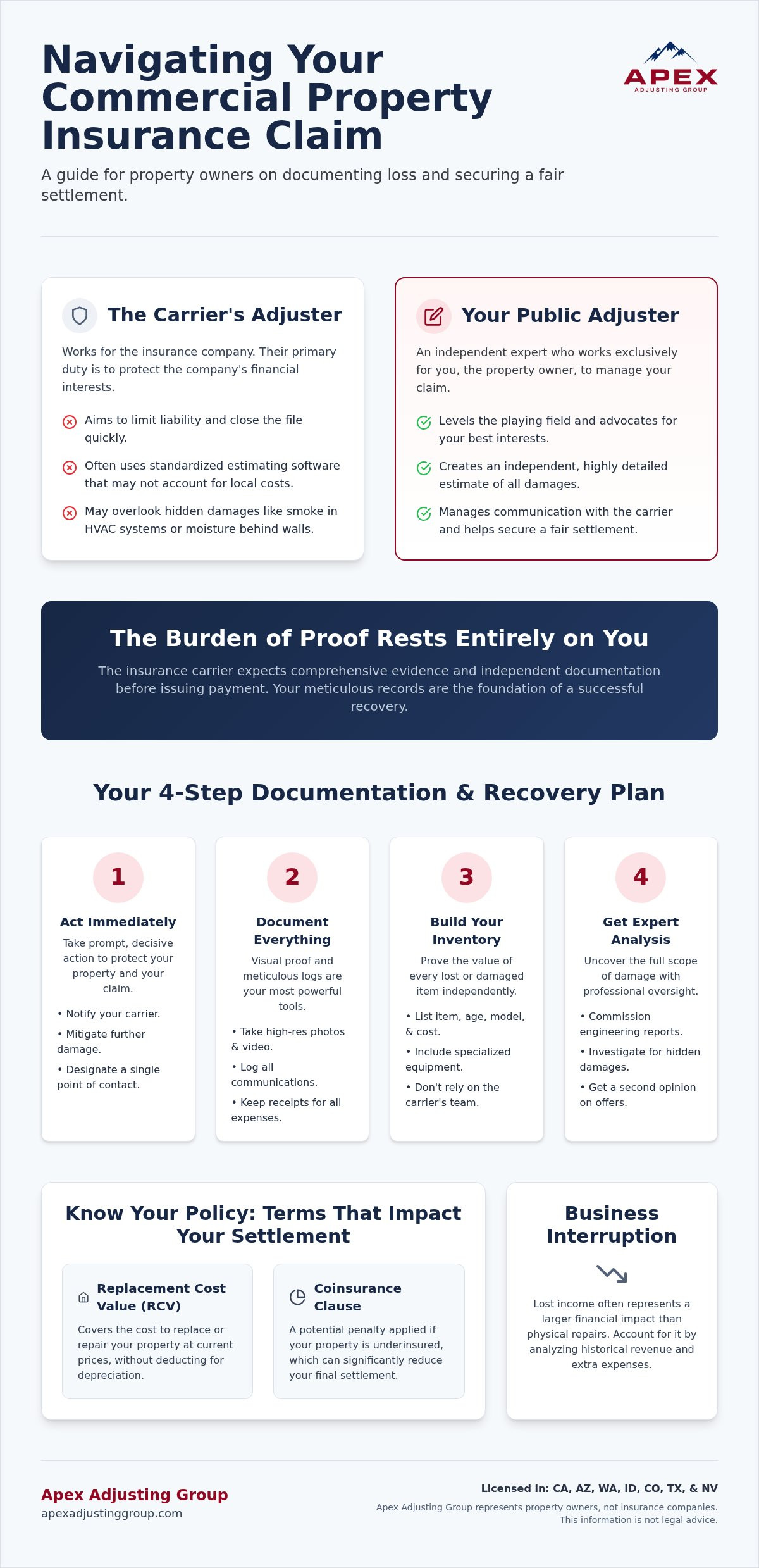
- Understand that the burden of proof for a loss rests entirely on the property owner. Carriers expect comprehensive evidence and independent documentation before issuing payment.
- Use high-resolution photos and detailed maintenance logs to justify restoration costs. Visual proof and meticulous records are the foundation of a successful recovery.
- Account for business interruption by analyzing historical revenue and seasonal trends. Lost income often represents a larger financial impact than the physical repairs themselves.
- Identify policy provisions like Replacement Cost Value and coinsurance clauses early. These specific terms dictate the final settlement amount and can penalize owners who are underinsured.
- Partner with an expert to manage your commercial property insurance claim and secure an independent estimate. Professional representation levels the playing field against carrier-assigned adjusters.
Navigating the Commercial Property Insurance Claim Process
The insurance company doesn't write the check just because you had a loss. In a commercial property insurance claim, the burden of proof falls entirely on the property owner. You must document every detail of the damage and provide a comprehensive valuation to justify a settlement. This process involves more than just listing broken windows or charred walls. It requires a deep understanding of property insurance policies and how they apply to specific business assets and operational requirements.
A commercial property insurance claim involves more than just physical assets; it impacts your operations and revenue. Early reporting mistakes often lead to partial denials or lengthy delays. Don't assume the carrier's adjuster will find every issue or advocate for your business's needs. They're looking for reasons to limit the company's liability and close the file quickly. If you fail to account for business interruption or specialized equipment repairs, you're leaving money on the table that belongs in your business.
Immediate Steps After Discovering Property Damage
Protect your business by acting fast. Policy requirements usually mandate that you mitigate further loss to remain eligible for coverage. This means taking reasonable steps like boarding up windows or stopping leaks to prevent secondary damage from weather or theft. Follow these steps immediately:
- Notify your agent or carrier right away to open the official claim file.
- Establish one person as the single point of contact for all claim communications to avoid conflicting statements.
- Keep a detailed log of every conversation, email, and site visit from the insurance company.
- Photograph all damage before any temporary repairs or cleanup begins.
Establishing a clear paper trail from day one prevents the carrier from claiming that damage was pre-existing or caused by neglect after the loss event. Documenting the timeline of events is just as vital as documenting the physical destruction.
The Role of the Carrier's Adjuster vs. Your Interests
Understand that the carrier's adjuster is not your advocate. Their primary duty is to the insurance company's financial interests. They often use standardized estimating software that may not account for local labor rates or specific code upgrades required for your building. Their scope of work frequently misses the "soft costs" or the long-term impact on your business's ability to function.
Hidden damages are a constant threat in commercial claims involving structural issues or water intrusion. A carrier's estimate might ignore smoke damage inside HVAC systems or moisture trapped behind industrial walls. You need an independent expert to review the scope and ensure nothing is missed. Don't settle for the first offer without a professional second opinion to verify that the carrier's estimate is comprehensive and fair.
Documenting Damage to Meet Your Burden of Proof
Detailed documentation is the only way to justify a higher settlement offer. Vague descriptions of damage lead to lowball estimates in a commercial property insurance claim. You must prove every dollar of your loss through an exhaustive evidence trail. Carriers typically assume the lowest possible repair cost unless presented with undeniable proof of a higher valuation.
Visual evidence must include high-resolution photos and video of all affected areas. Capture wide angles to establish context and close-ups to show specific damage to machinery or structural finishes. Inventory logs should include the age, model numbers, and replacement cost estimates for every item. Don't rely on the carrier's inventory team. They often overlook specialized components or essential accessories that are vital to your business's core function.
Structural damage often requires expert engineering reports to identify compromised integrity. Visible cracks or sagging are frequently symptoms of deeper foundation or frame issues. An independent engineer provides the technical data needed to support a claim for full structural restoration rather than a cosmetic patch. If you're unsure if your evidence is complete, a free claim review can identify missing documentation before it impacts your recovery.
Creating a Comprehensive Evidence Portfolio
Capture the 'before' and 'after' state of the property using existing records. Maintenance logs, recent appraisal photos, or even security footage can establish the pre-loss condition. For water damage claims, use thermal imaging or moisture meters to find hidden issues behind walls or under flooring. These tools reveal moisture that the naked eye cannot detect. Maintain a log of every conversation and email with the insurance company to track verbal promises and prevent the carrier from shifting their position.
Professional Appraisals for Specialized Equipment
Standard adjusters may not understand the value of industrial machinery or complex tech stacks. They often treat specialized assets like common office furniture. Hire independent experts to provide replacement cost valuations for these high-value items. Ensure that 'like kind and quality' requirements in the policy are strictly met. If your machinery required a specific manufacturer or custom configuration, the settlement must reflect that exact replacement. Expert appraisals provide the technical leverage needed to challenge an underpaid commercial property insurance claim.
Calculating Business Interruption and Extra Expense Losses
Physical damage is visible, but the invisible loss of revenue is what often sinks a business. A commercial property insurance claim frequently hinges more on accounting expertise than construction estimates. Business interruption claims often represent a larger financial impact than physical repairs. Insurers scrutinize these figures more heavily than physical property damage because they rely on projections and historical data rather than debris you can touch.
Calculations must account for historical revenue, seasonal trends, and projected growth. If your business was on an upward trajectory before the loss, the carrier might try to cap your recovery at last year's lower numbers. Don't let them ignore your momentum. Use your financial data as a weapon to demand a settlement that reflects your actual business trajectory. Every day your doors are closed is a day of lost opportunity that the carrier must address.
Expertise in commercial claims is vital when the carrier's adjuster tries to minimize your operational losses. They'll look for any reason to suggest your business would have slowed down anyway. You need a clear, data-driven narrative to counter these assumptions. If you're struggling to value your lost income, a free claim review can help identify the true scope of your financial interruption.
Proving Lost Revenue and Continuing Expenses
Gather profit and loss statements, tax returns, and sales records from previous years. These documents form the foundation of your proof of loss. You must identify "fixed costs" like rent, payroll, and taxes that continue even when the business is closed. Factor in the loss of key contracts or long-term customers who may migrate to competitors while you're offline. Proving this loss requires a methodical approach that leaves no room for carrier ambiguity or interpretation.
The Importance of Extra Expense Coverage
Extra expense coverage pays for the costs of staying operational during the restoration period. This includes expenses for temporary relocation, equipment rentals, or expedited shipping for critical components. It also covers the costs of notifying customers and marketing to maintain your market share during the downtime. Track these expenses separately from the physical repair budget. Mixing these costs can lead to administrative confusion and delayed payments in your commercial property insurance claim.
Policy Provisions That Can Impact Your Final Settlement
Your policy is a complex legal contract filled with specific provisions that can either maximize your recovery or leave you with a massive financial gap. In a commercial property insurance claim, the difference between Actual Cash Value (ACV) and Replacement Cost Value (RCV) determines the check amount. ACV factors in depreciation, meaning the carrier pays only what the item was worth right before the loss. RCV is more favorable because it covers the actual cost to buy new equipment or materials at current market prices.
Sub-limits for specific types of damage can also restrict funds unexpectedly. Your policy might have a high overall limit but a tiny sub-limit for mold remediation, electronic data recovery, or debris removal. If your business relies on specialized tech or operates in an environment prone to moisture, these caps can be devastating. Don't wait for the carrier to point out these limitations after the damage is done. Always identify these "hidden" limits before they derail your restoration budget.
Understanding Coinsurance and Valuation Penalties
Coinsurance clauses can penalize owners if the property was underinsured before the loss. The common "80% rule" requires you to carry insurance equal to at least 80% of the property's total value at the time of the loss. If you fall below this threshold, the carrier may apply a penalty that significantly reduces your payout, even for a partial loss. This means you might receive only a fraction of your actual repair costs. The impact of depreciation on ACV settlements for commercial assets is another hurdle, as industrial machinery often loses value quickly in the carrier's eyes. Replacement cost value is typically calculated and paid out only after the repairs are actually made and documented.
Code Upgrades and Ordinance or Law Coverage
Ordinance or Law coverage is critical for older buildings needing modern code upgrades. Standard policies generally pay to restore the property to its pre-loss condition, which may not meet current building codes. This coverage is essential for commercial fire damage claims where local authorities require new sprinkler systems or ADA-compliant features. Without this provision, you'll be forced to pay for mandated upgrades out of your own pocket. Identify which sections of your policy address local building department requirements to avoid being blindsided by unrecovered costs. Understanding these provisions is the only way to protect your recovery during a commercial property insurance claim.
How a Public Adjuster Protects Your Commercial Recovery
Large insurance carriers employ teams of adjusters, engineers, and accountants to limit their financial exposure. When you file a commercial property insurance claim, you're entering a high-stakes negotiation against a system designed to protect the company's bottom line. Public adjusters level the playing field by providing an independent expert estimate that reflects the true cost of restoration. This expertise is often the difference between a lowball offer and a settlement that covers your specialized equipment and lost income. You shouldn't have to fight a multi-billion dollar entity without a professional advocate in your corner.
Expert representation removes the massive administrative burden from the business owner. Managing a complex claim is a full-time job that pulls you away from running your company and managing your staff. A public adjuster handles the heavy lifting, from documenting every damaged asset to negotiating with the carrier's representatives. Because they work on a contingency fee basis, their goals align perfectly with your recovery. There's no fee unless a settlement is obtained, which ensures your advocate is motivated to maximize every available policy provision.
The Benefits of Independent Representation
Public adjusters manage all site inspections and meetings with the carrier to ensure nothing is overlooked during the scope of work. They interpret complex policy language to identify coverage that the carrier's adjuster might miss or ignore. Partnering with a specialist for commercial claims is the first step toward regaining control of your recovery process. They act as a steady hand in a crisis, combining technical precision with the grit of a dedicated negotiator to protect your interests. This proactive force takes the burden off your shoulders while you focus on business continuity.
Securing a Free Claim Evaluation
Evaluate whether your current offer truly reflects the scope of your loss before you sign a final release. A professional review of the carrier's estimate often finds missing line items, incorrect depreciation, or undervalued labor rates. This service is especially vital for owners who feel underpaid or are facing delays without clear explanations from their carrier. Request a free commercial claim review to verify that your business is receiving the full benefit of the policy you've paid for. Don't leave your financial future to the carrier's discretion when independent expertise is available to fight for your commercial property insurance claim recovery.
Take Control of Your Business Recovery
Recovering from a loss is about more than just structural repairs. It's about securing the financial future of your operation. A successful commercial property insurance claim requires meticulous documentation and a firm grasp of complex policy provisions like coinsurance and extra expense coverage. Don't leave these high-stakes calculations to the carrier's adjuster, who represents the insurance company's interests rather than yours.
Apex Adjusting Group acts as a fierce advocate for property owners and specializes in complex commercial losses. We are licensed in CA, AZ, WA, ID, CO, TX, and NV. We operate on a contingency basis, so there's no fee unless a settlement is obtained for you. Professional representation removes the administrative burden from your shoulders so you can focus on running your business.
You've worked hard to build your business. Let a seasoned expert protect your interests and help you secure the recovery you deserve.
Frequently Asked Questions
What is the first thing I should do after a commercial property loss?
Mitigate further damage immediately to comply with your policy requirements. Board up broken windows, stop active leaks, and secure the perimeter to prevent theft or secondary weather damage. Document the scene with high-resolution photos before moving any debris. Establish a single point of contact for all carrier communications to ensure your narrative remains consistent throughout the entire recovery process.
Can I reopen a commercial property insurance claim if I was already paid?
You can often reopen a claim if you discover hidden damage or realize the initial settlement doesn't cover the actual cost of repairs. Owners in states like Texas and California have specific windows to file supplemental claims for overlooked items. Don't sign a final release until an independent expert verifies that every line item in the scope of work is fully accounted for.
How long does the commercial property insurance claim process take?
Timelines for a commercial property insurance claim vary by complexity and state regulations. Small losses may settle in 30 to 90 days, while large-scale disasters often take six to eighteen months. Texas law requires insurers to acknowledge claims within 15 business days. California carriers generally have 40 days to accept or deny a claim once they receive your formal proof of loss documentation.
What happens if my commercial claim is denied by the insurance company?
Review the formal denial letter to identify the specific policy exclusion the carrier is citing. Denial is a common problem and doesn't have to be the final word on your recovery. You have the right to challenge the decision by providing new evidence or independent engineering reports. A professional evaluation can often identify if the carrier misinterpreted policy language or overlooked covered perils.
Does commercial property insurance cover lost profits during repairs?
Coverage for lost profits is available if your policy includes business interruption provisions. This coverage helps recover lost revenue and pays for continuing fixed costs like payroll and rent while your property is unusable. Proving these losses requires meticulous accounting and historical financial data. You must provide profit and loss statements and tax returns to demonstrate your business's projected growth and seasonal revenue trends.
What is a proof of loss and who is responsible for completing it?
A proof of loss is a formal sworn statement that documents the total financial extent of your claim. The property owner is responsible for completing and submitting this document within the strict deadlines set by the policy. It must include detailed repair estimates and comprehensive inventory logs. Filing an incomplete or inaccurate proof of loss can lead to significant delays or denials in your commercial property insurance claim.
How much does it cost to hire a public adjuster for a commercial claim?
Apex Adjusting Group operates on a contingency fee basis, which means there are no upfront costs for our services. We only receive payment if we successfully obtain a settlement from your insurance carrier. The fee is a percentage of the final recovery we negotiate for you. This structure aligns our goals with yours and ensures you have expert representation without any out-of-pocket financial risk.
Will my insurance premium go up if I file a commercial property claim?
Premiums may increase after a claim, but many factors like regional risk and loss history influence your future rates. In California, certain ZIP codes near wildfire emergencies have temporary protections against non-renewal. Focus on securing the funds needed for a full restoration rather than potential rate changes. An underpaid claim is a much larger threat to your business's long-term survival than a premium adjustment.
Need Help with Your Insurance Claim?
Our licensed public adjusters can help you get the maximum settlement you deserve. Contact us today for a free claim evaluation.
Related Articles


