An initial property settlement check rarely reflects what restoration actually costs. When you review a payment notice and realize it falls far short of an independent contractor's bid, receiving an insurance adjuster lowball offer can bring your recovery to an immediate halt. You paid your premiums reliably, yet the carrier's initial estimate often overlooks concealed damage, slashes labor pricing, and excludes necessary trade repairs. Pushing back can feel intimidating, especially when you worry that questioning the numbers might delay your repairs even further.
You don't have to accept an inadequate payout as the final word on your claim. You will discover why property settlement offers fall short, how automated estimating software artificially lowers repair valuations, and how thorough physical documentation protects your recovery. Below is a direct breakdown of five common adjuster traps property owners encounter, along with practical steps to challenge an incomplete scope of loss and secure the funds needed to rebuild properly.
Key Takeaways
- Understand why initial carrier scopes fall short due to automated estimating databases and off-site desk reviews.
- Identify the operational warning signs of an insurance adjuster lowball offer before signing release waivers or depositing checks.
- Avoid critical settlement traps, including relying on insurer-preferred vendors and overlooking concealed structural damage.
- Learn practical methods to challenge an inadequate scope of loss using line-item contractor bids and specific policy provisions.
- Discover how licensed public adjusters inspect hidden losses and prepare replacement cost estimates to secure complete property recovery.
What Is an Insurance Adjuster Lowball Offer on Property Claims?
An insurance adjuster lowball offer occurs when an insurer's initial claim estimate falls substantially below the actual cost of materials, specialized trade labor, and building code requirements needed to rebuild. Rather than an outright denial, this offer typically arrives as a partial scope of loss that deliberately narrows the boundaries of your property damage. It reflects what the carrier wants to pay at first glance, not what the local market requires to make you whole.
Company adjusters answer to the carrier, protecting corporate loss ratios and adhering to strict internal estimating guidelines. Receiving a low initial payment is simply a standard phase in the claim lifecycle rather than the final word on your loss. In standard claims handling, accepting an undisputed payment check does not waive your right to secure supplemental payments as repairs get underway.
Company Adjusters Versus Independent and Public Adjusters
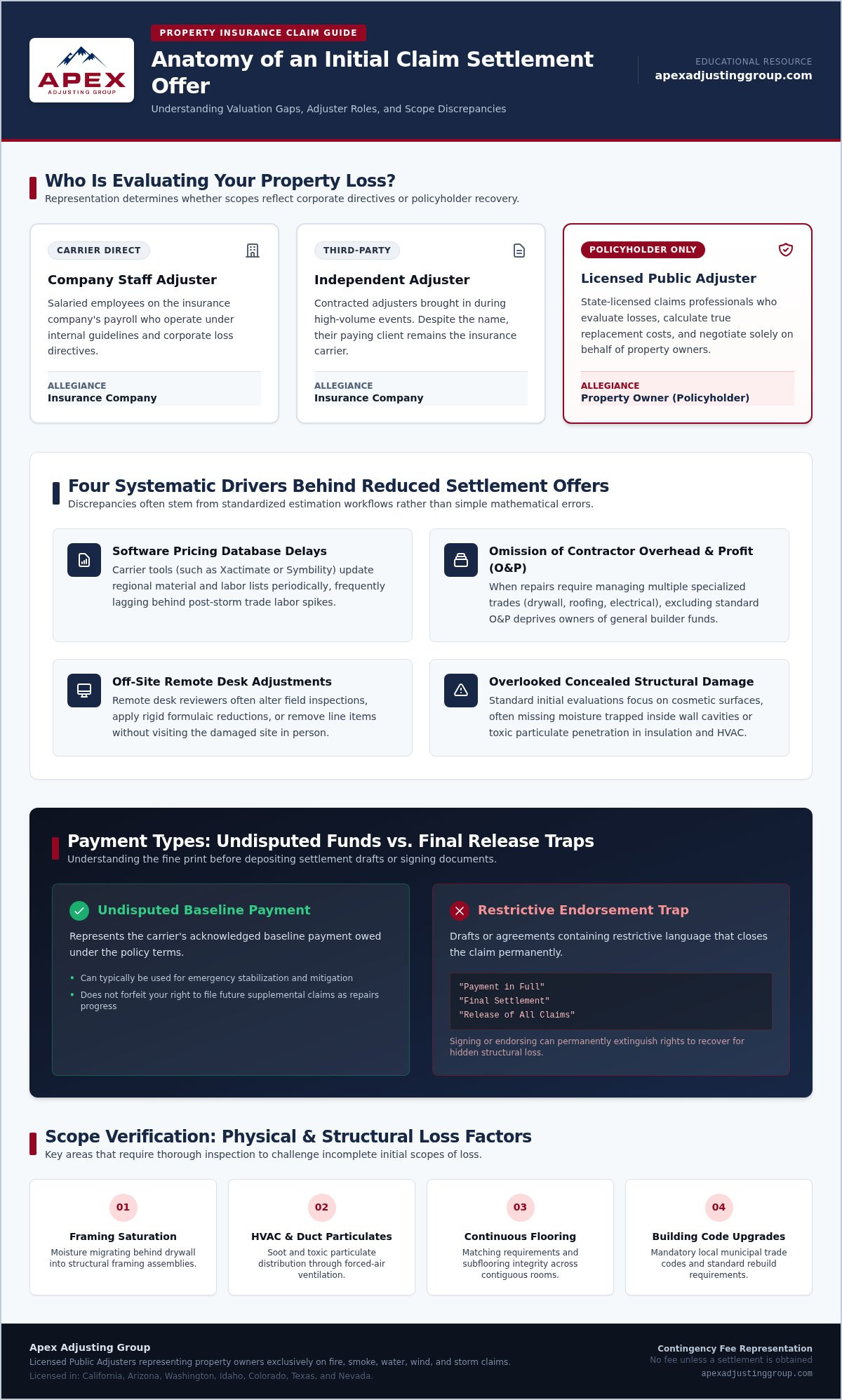
Understanding who is evaluating your property explains why initial valuations often fall short:
- Company staff adjusters: Salaried employees on the insurer's direct payroll who follow corporate payment guidelines and internal claim directives.
- Independent adjusters: Third-party contractors hired by the carrier during high-volume claim events. Despite their name, their client is the insurer, not you.
- Public adjusters: State-licensed claims professionals who work exclusively for policyholders to scope structural losses, calculate replacement costs, and negotiate directly with the carrier.
Undisputed Payments Versus Full and Final Release Traps
An undisputed check represents the carrier's admission of baseline funds owed under your policy. You can usually deposit these funds to stabilize your property or begin emergency mitigation without forfeiting future supplemental claims. The danger lies in the accompanying fine print.
Examine the front and back of every draft alongside any attached settlement agreements. Look out for restrictive endorsement language stating "payment in full," "final settlement," or "release of all claims." Signing a release or endorsing a restricted check can permanently extinguish your right to demand funds for hidden structural damage, continuous flooring replacement, or necessary contractor overhead.
Why Initial Property Damage Settlement Offers Fall Short
Property insurance payouts rarely fall short by accident. When you review an insurance adjuster lowball offer, the discrepancy usually stems from systematic estimating methods rather than simple mathematical errors. Insurers increasingly rely on remote desk adjusters who alter field estimates, apply standardized formulas, and delete line items without ever setting foot on your damaged property.
Understanding these institutional bottlenecks gives you the leverage to dispute an insufficient payout effectively.
Standardized Estimating Software Pricing Discrepancies
Insurance carriers and independent adjusters rely heavily on estimating platforms like Verisk Xactimate or CoreLogic Symbility. While these software databases update regional material, equipment, and labor price lists monthly across metropolitan areas, they frequently lag behind sudden surges in real-time contractor costs. Local post-storm labor shortages push prevailing trade wages far above published database averages.
Carrier estimates also routinely remove General Contractor Overhead and Profit (O&P). When a project requires coordinating multiple licensed trades, such as drywallers, roofers, and electricians, omitting this standard operational allowance deprives you of the funds needed to hire an experienced general builder.
Overlooked and Concealed Damage Behind Walls and Ceilings
Visual inspections often focus only on cosmetic surface layers. Water intruding into framing cavities or ceiling assemblies migrates downward, creating concealed saturation that standard adjusters fail to track with moisture meters or thermal imaging. Similarly, soot and toxic particulates from a fire penetrate insulation, subflooring, and HVAC systems.
Addressing persistent soot and odor requires certified fire damage remediation protocols. If these structural measures are missing from your initial paperwork, requesting a professional, no-pressure claim evaluation helps uncover the true extent of your hidden physical loss.
Excessive Depreciation and Actual Cash Value Deductions
To reduce initial outlays, carriers calculate an initial Actual Cash Value (ACV) payout by subtracting heavy depreciation from the estimated Replacement Cost Value (RCV). In an insurance adjuster lowball offer, adjusters frequently apply uniform, across-the-board depreciation rates to items that do not age, including:
- Demolition, debris removal, and haul-away labor costs
- Dimensional structural framing and subfloor assemblies
- Architectural roof trusses, structural posts, and concealed rough plumbing
Under a replacement cost policy, these withheld depreciation funds should be recoverable once repairs are completed. When an adjuster slashes the baseline ACV too low, you may lack the working capital to start reconstruction in the first place.
Five Common Traps When Facing an Inadequate Settlement Offer
Disputing an inadequate claim payment requires spotting the subtle administrative traps that limit recovery. Navigating an insurance adjuster lowball offer becomes dangerous when policyholders assume carrier estimates include every necessary phase of reconstruction. Missing line items and procedural hurdles routinely drain settlement funds before rebuilding even begins.
Watch for these five frequent pitfalls during early adjustment discussions:
- Assuming carrier estimates are final: An initial statement of loss is simply the carrier's opening calculation, not a binding legal ceiling.
- Relying on insurer-preferred vendors: Network contractors often agree to carrier-dictated pricing caps and narrow scopes to preserve high-volume referral streams.
- Prematurely signing liability releases: Agreeing to close a file before receiving competitive bids from independent builders extinguishes future supplement rights.
- Ignoring matching requirements: Settling for patched flooring or partial roof slopes leads to mismatched finishes and diminished property resale value.
- Missing statutory proof of loss deadlines: Failing to submit formal paperwork within state or policy deadlines can jeopardize an otherwise legitimate claim.
Trap 1: Accepting Surface Repair Rather Than Full Replacement
Carriers frequently scope spot repairs for continuous surfaces. If wind rips shingles off an aged slope or water ruins hardwood across a hallway, patching only the damaged area creates noticeable aesthetic inconsistencies. Many states require uniform appearance across adjoining rooms or roof planes. Demand that adjusters scope continuous material runs rather than localized patches.
Trap 2: Ignoring Ordinance or Law Building Code Upgrades
Reconstruction must satisfy modern municipal building standards. When major repairs take place, local inspectors often require upgraded electrical panels, modern insulation values, or specialized roofing fasteners. Base property policies often exclude these mandatory expenses, but policy endorsements for Ordinance or Law provide designated funds. Insurer estimates routinely omit these upgrades until the property owner formally documents and submits the local building department mandates.
Trap 3: Rushing File Closure Under Financial Stress
Prolonged displacement places heavy stress on families and commercial operations. Insurers understand this pressure and may offer fast disbursements to close files quickly. Rushing to accept an insurance adjuster lowball offer closes the door to uncovering structural framing rot, electrical damage, or hidden water pockets. Utilize Additional Living Expense (ALE) or Business Interruption benefits to relieve immediate financial pressure so you have time to document the full scope properly.
How to Dispute an Inadequate Property Insurance Settlement
Overcoming an insurance adjuster lowball offer requires clear physical evidence rather than emotional arguments. Carriers adjust claims based on itemized data, so you must counter an inadequate settlement with objective documentation. Start by hiring licensed, independent restoration contractors to prepare detailed scopes that reflect local material costs and labor rates.
Review your policy declarations page, endorsements, and exclusions. Pay close attention to your coverage limits, deductible structures, and ordinance or law provisions. Building a solid file forces the insurer to evaluate real repair conditions rather than automated desktop calculations.
Building an Objective Line-by-Line Evidence Package
Thorough documentation transforms an informal dispute into an indisputable claim file. Compare your independent contractor's estimate directly against the carrier's statement of loss to pinpoint discrepancies:
- Take clear, high-resolution photographs and videos of every damaged area, including framing cavities, underlayments, and attic spaces.
- Highlight omitted operational items such as dust barrier containment, air scrubbers, permit fees, and debris disposal.
- Match contractor unit pricing against company adjuster line items to demonstrate regional labor shortages and prevailing trade rates.
Submitting Supplemental Claims and Proof of Loss
Send a formal written supplement request to the assigned adjuster outlining the exact omissions. Cite specific policy provisions that grant your right to recover repair costs, and attach your contractor's line-item estimate alongside supporting photographs.
Track every carrier communication deadline established by your state insurance regulations. For example, insurers face strict acknowledgment and decision windows in states like California, Arizona, Washington, Nevada, and Idaho. Maintaining an organized, written timeline prevents the carrier from shelving your file while your property sits in disrepair.
Invoking the Policy Appraisal Clause for Valuation Deadlocks
When negotiations stall over the true cost of repairs, most standard property policies include an appraisal clause. Invoking appraisal provides a contractual dispute resolution mechanism without court action. Under this provision, each party selects an independent, competent appraiser, and the two appraisers agree on a neutral umpire to resolve pricing differences. Read our guide on the insurance appraisal process for complete procedural steps.
How Public Adjusters Help Secure a Fair Property Claim Payout
Leveling the playing field against an insurance adjuster lowball offer demands specialized technical expertise. Public adjusters represent property owners exclusively, never the insurance companies. While carrier adjusters focus on closing files within internal budget guidelines, licensed public adjusters build comprehensive replacement scopes designed to capture the total financial cost of repairs.
Operating on a contingency fee basis aligns your adjuster's goals directly with your own, because there is no fee unless a settlement is obtained. This structure allows property owners to secure veteran claims representation without upfront financial strain.
Forensic Property Inspections and Scope Reconstruction
A rigorous adjustment starts with physical forensic scoping. Licensed adjusters inspect roof trusses, subfloors, and internal insulation systems using specialized tools like moisture meters and thermal imaging. They uncover concealed water migration, soot pathways, and framing displacement that company adjusters routinely miss during quick visits.
For complex business locations, working alongside dedicated commercial property claims professionals ensures that delicate elements like machinery, inventory loss, and business income disruption receive proper valuation. Public adjusters translate this physical evidence into itemized scopes utilizing the exact estimating software platforms carriers use, challenging pricing gaps line by line.
Managing Carrier Communications and Negotiations
Handling a contested claim takes considerable time and energy. Public adjusters step in to manage all direct communication, administrative paperwork, and on-site reinspections with company representatives. They analyze policy declarations, endorsements, and strict timelines to ensure your filing satisfies every policyholder obligation.
Across Western jurisdictions, including California, Arizona, Washington, Idaho, Colorado, Texas, and Nevada, state insurance regulations dictate exact prompt payment and claim handling standards. Public adjusters enforce compliance with these standards, holding carriers accountable to required statutory response windows.
Requesting a Professional Claim Review
If you suspect an insurance adjuster lowball offer has stalled your property's recovery, obtaining an independent review of your estimate is a vital step. A detailed scope audit reveals where line items were cut, where depreciation was improperly applied, and where building code allowances were omitted.
You don't have to face an underpaid scope on your own. Request a free claim review today to have a licensed public adjuster evaluate your paperwork and outline the exact steps to restore your property.
Take Control of Your Property Claim Recovery
Receiving an insurance adjuster lowball offer can feel discouraging, but an initial scope is simply an opening calculation. Carrier figures often omit critical trade operations, apply excessive depreciation, and rely on software databases that lag behind true local repair pricing. Rebuilding your property demands an independent, itemized scope that captures every layer of physical loss.
Apex Adjusting Group represents property owners exclusively, never insurance carriers. Operating on a contingency fee basis where you pay nothing unless a settlement is obtained, our team brings deep expertise in Xactimate scoping and carrier estimating methods to protect your financial interests.
You don't have to navigate structural loss disputes alone. Take proactive steps today to secure the settlement funds required to restore your property completely.
Frequently Asked Questions
Can I negotiate an insurance adjuster lowball offer on my property?
Yes, an initial statement of loss is fully negotiable. You can challenge an insurance adjuster lowball offer by submitting a detailed supplemental claim backed by itemized contractor estimates and physical documentation. Insurance adjusters regularly adjust scopes when policyholders present line-item evidence demonstrating that regional labor rates and true material replacement costs exceed the carrier's initial software estimates. Property owners across California, Washington, and Colorado frequently use this process to align funds with actual repairs.
Will cashing the first insurance claim check prevent me from getting more money?
Cashing an undisputed claim check usually does not stop you from seeking supplemental funds, provided you don't sign a liability release. Check the front and back of the draft carefully for restrictive endorsements like "final settlement" or "payment in full." If the draft contains standard payment language, you can apply the undisputed funds toward immediate emergency mitigation while your adjuster prepares supplemental scopes for remaining damages.
Why is my contractor repair estimate higher than the adjuster payout?
Contractor estimates reflect actual local labor wages, specialized subcontractor trades, and current building material costs in real time. Company adjusters rely on pricing databases that often lag behind localized market spikes across Western metropolitan markets like Phoenix, Seattle, and Los Angeles. Additionally, carrier adjusters frequently exclude General Contractor Overhead and Profit, permit fees, and mandatory code upgrades that licensed contractors must include to complete compliant restoration work.
What should I do if the insurance adjuster missed hidden property damage?
Document the newly discovered damage immediately with clear photos, video walkthroughs, and moisture readings before disturbing the area. Notify your carrier in writing that latent damage was uncovered behind walls, framing cavities, or subflooring. Request an immediate supplemental inspection. Having an independent public adjuster conduct a forensic scope ensures all structural shifts, smoke penetration, or trapped water pockets are accurately measured and submitted as an official supplemental claim.
What is the difference between a company adjuster and a public adjuster?
Company adjusters work directly for the insurance carrier, while public adjusters represent policyholders exclusively. Staff and independent adjusters represent the financial interests of the insurance company. In contrast, licensed public adjusters work solely on your behalf across states like Nevada, Arizona, Colorado, and California. They operate on a contingency fee basis, inspecting losses forensically and negotiating fair settlements without upfront out-of-pocket costs to the property owner.
How does the policy appraisal process resolve low settlement disputes?
The appraisal clause provides a formal contractual mechanism to resolve repair cost disputes without entering a courtroom. When scope negotiations stall, either party can invoke the policy's appraisal clause. Each party selects an independent, competent appraiser, and both appraisers select a neutral umpire. An agreement between any two of these three individuals establishes a binding valuation of the loss, helping policyholders overcome low settlement figures efficiently.
Do I need to hire an attorney if my property claim is underpaid?
Most underpaid property claims stem from scope and valuation disputes that do not require legal counsel. Scope disagreements are standard insurance adjustment issues rather than legal conflicts. Licensed public adjusters specialize in structural inspections, building code compliance, and estimating software line items to resolve pricing shortfalls directly with carriers. While policyholders can consult legal counsel if desired, working with a public adjuster provides dedicated valuation expertise without formal litigation procedures.
Need Help with Your Insurance Claim?
Our licensed public adjusters can help you get the maximum settlement you deserve. Contact us today for a free claim evaluation.
Related Articles