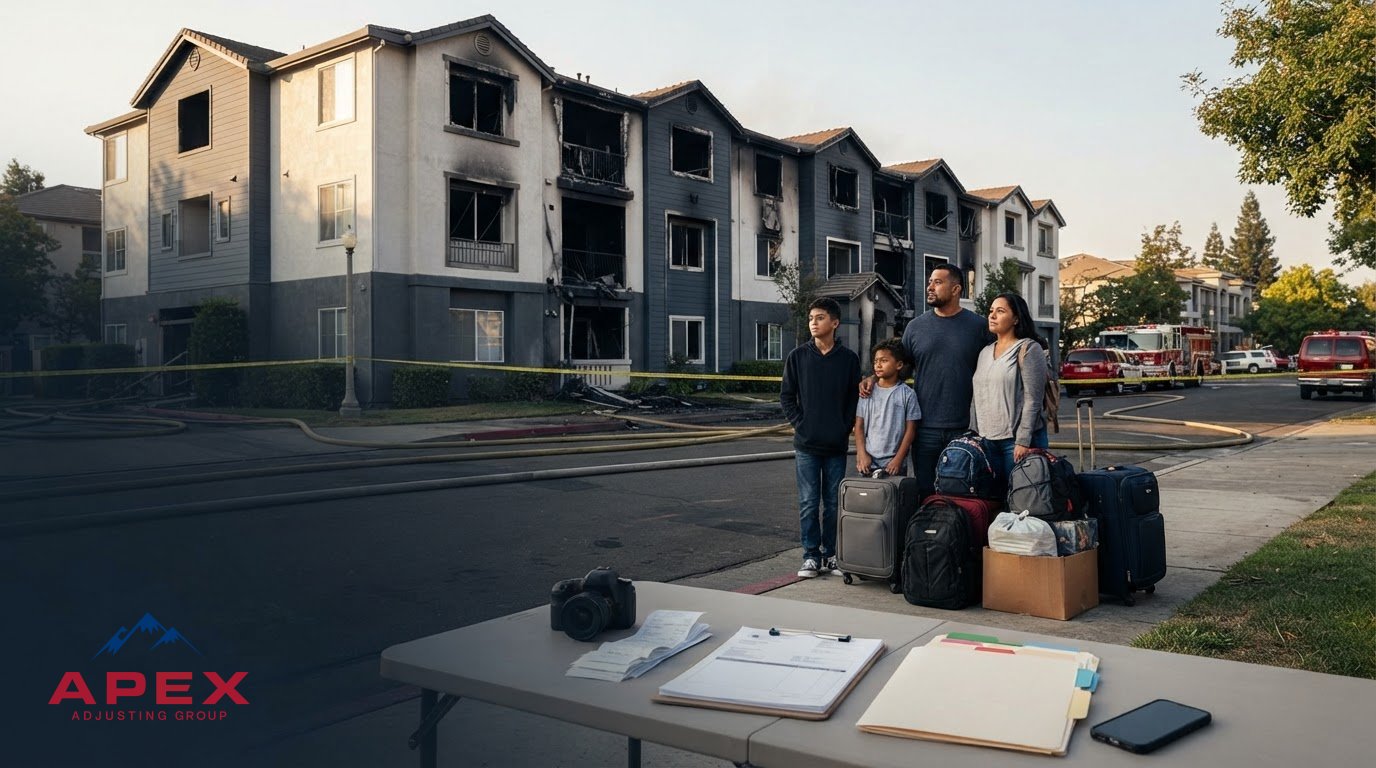
A fire can displace tenants before damaged units are safe to occupy. Additional Living Expenses, or ALE, may help eligible policyholders pay certain extra costs during temporary displacement. Effective Sacramento apartment complex fire claim help starts by separating the building claim from residents’ individual expenses. Structural fire repairs in Sacramento require a building permit, and repair documentation should identify the work, permits, and licensed contractor estimates. Residents can request an advance for covered ALE, keep receipts, and track expenses.
It’s reasonable to expect the repair plan and temporary housing costs to be handled clearly, but both can become harder to manage when claim records are incomplete or repair scopes don’t match the damage. A careful file connects the fire damage, proposed work, permit needs, and residents’ documented expenses. The Sacramento fire damage claim page also covers local claim support.
This article explains how permits and contractor estimates fit into a fire claim, what to gather to document damage and ALE costs, and how to request an advance. It also explains how a claim review can help property owners address a delayed, denied, or potentially underpaid fire claim.
Key Takeaways
- Separate building repair costs from tenants’ temporary living expenses so each part of the claim has clear documentation.
- Keep receipts and a dated record of added living costs when requesting an advance for covered Additional Living Expenses.
- Photograph damage and preserve fire-related records; a clear timeline can help support a property or injury claim.
- Permit requirements and contractor estimates can affect the repair scope, so include them in the claim file.
- Liability depends on evidence about how the fire started and who may be responsible; keep that question separate from your insurance claim deadlines.
Requesting an advance for Additional Living Expenses
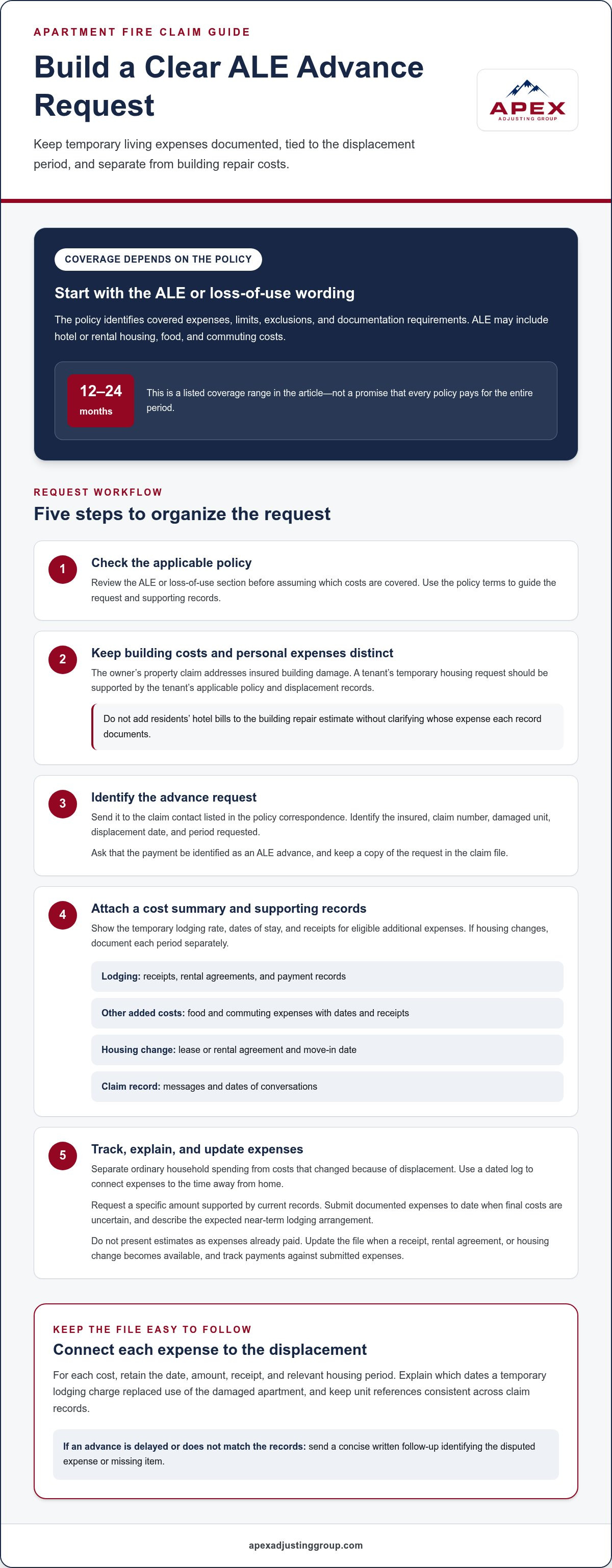
A fire can displace tenants before damaged units are safe to occupy. Additional Living Expenses, or ALE, may help eligible policyholders pay certain extra costs during temporary displacement. Start with the policy, rather than assumptions about what an apartment owner or tenant should cover.
Review the section describing ALE or loss-of-use coverage. The policy wording identifies covered expenses, limits, exclusions, and documentation requirements. Coverage may include hotel or rental housing, food, and commuting costs for 12 to 24 months. That period is a listed coverage range, not a promise that every policy pays for the entire period.
For an apartment complex, keep the building claim separate from each tenant’s personal expenses. The owner’s property claim addresses insured building damage. A tenant’s request for temporary housing expenses should be supported by the tenant’s applicable policy and displacement records. Don’t add residents’ hotel bills to the building repair estimate without clarifying whose expense each record documents.
Build a clear advance request
Send the request to the claim contact listed in the policy correspondence. Identify the insured, claim number, damaged unit, displacement date, and period for which an advance is requested. Ask that the payment be identified as an ALE advance, and keep a copy of the request in the claim file.
Attach a brief cost summary and supporting records. Include the temporary lodging rate, dates of stay, and receipts for eligible additional expenses. If a household moves from a hotel to a rental, document each period separately. Keep the lease or rental agreement, payment records, and move-in date together.
- Keep lodging receipts and rental agreements.
- Record added food and commuting expenses with dates and receipts.
- Save claim messages and note the date of each conversation.
- Track payments received against the expenses submitted.
Separate ordinary household spending from costs that changed because of displacement. For example, show the temporary lodging charge and explain which dates it replaced use of the damaged apartment. A dated log connects each expense to the period away from home.
Request an advance for a specific amount supported by current records. If final costs are uncertain, submit documented expenses to date and describe the expected near-term lodging arrangement. Don’t present estimates as expenses already paid. Update the file when a new rental agreement, receipt, or housing change becomes available.
That example shows why a documented request matters, but it doesn’t establish a standard payment or amount for another claim. The policy terms and submitted records remain central to each request.
In Sacramento, coordinate the building repair file with residents’ separate displacement records. Use consistent unit numbers across photographs, lodging receipts, and claim correspondence. For owners seeking Sacramento apartment complex fire claim help, this organization can make the difference between a clear advance request and a confusing file.
When expenses or claim handling become difficult to track, Sacramento apartment complex fire claim help can include organizing the property owner’s records and separating the building claim from residents’ individual ALE documentation. If an advance is delayed or the amount does not match the submitted records, send a concise written follow-up identifying the disputed expense or missing item.
Who is liable for an apartment complex fire in California, and when can tenants make a claim?
A fire’s location alone doesn’t establish who caused it or who may be responsible. In a California apartment complex, review the fire’s origin, the damage, and records showing what happened before the incident. A tenant can document losses and notify their insurer if fire damage affects belongings or makes the apartment unusable.
Keep the tenant’s insurance claim separate from a claim involving another party. A renter’s policy may cover the tenant’s belongings and temporary displacement, subject to its terms. A claim against another party raises a different question: whether available evidence connects that party’s actions or maintenance to the fire or resulting harm.
Relevant records depend on the fire’s location and circumstances. A kitchen fire, for example, calls for a different evidence review than a fire that begins in a shared electrical room. Records about appliances, electrical systems, smoke alarms, maintenance, and reported hazards can help establish a timeline.
Identify the facts that connect a party to the fire
Start with the incident location and known sequence of events. Note which unit or shared area was involved, when smoke or flames were first noticed, and who responded. Avoid guessing about the cause. Record what a witness saw, heard, or reported, and identify who provided each detail.
Depending on the evidence, responsibility may involve a property owner, property manager, contractor, equipment maker, or another person. A maintenance complaint about a recurring electrical problem, for example, differs from a fire with no prior warning or repair history. Records need to connect the specific condition to the incident.
- Save messages about reported hazards, inspections, or completed repairs.
- Write down names of witnesses and the details they personally observed.
- Keep photographs of damaged belongings and the affected unit, if safe to take.
- Record the incident date, unit location, and any claim reference numbers.
For a Sacramento Fire Department incident report, a Day 1 request takes 3 to 7 days. Keep the request details and report with other incident records. The report can document response information, but tenants should preserve their own photographs, messages, receipts, and witness notes as well.
Tenants can start a property claim with their own insurer if belongings are damaged. For an injury or a claim involving another party, preserve medical and incident records and document how the harm relates to the fire. Keep separate folders for personal property, injury-related records, and communications about the building.
Apartment owners should also keep building claim documents separate from tenants’ personal loss records. A damaged common area, a repair invoice, and a tenant’s belongings represent different items and claim interests. Consistent unit labels and dates help prevent one resident’s records from being confused with another’s.
When the building’s fire damage is underpaid, delayed, or disputed, a property owner can request a free review of the fire claim. Keep the insurer’s estimate, repair documents, and incident records together for that review.
Medical records and receipts can help keep injury and loss documentation together, but they do not by themselves establish who caused a fire. FEMA Individual Assistance grants of up to $42,500, with no repayment, may be available when assistance is available. The North Complex Fire reached mountain communities in Butte County, California, by September 8th, 2020; that history is separate from evidence about an apartment fire and does not determine liability.
The California Department of Insurance could assist Sacramento County apartment fire survivors with insurance claims, while the California Department of Motor Vehicles could help survivors replace lost or destroyed driver’s licenses. The Local Assistance Center for the Sacramento County apartment fire was at 6040 Watt Avenue, North Highlands, California 95660. Sacramento County may require current building code compliance when fire damage exceeds 50% of assessed value. These recovery details do not replace preserving records that may support a claim.
What evidence should tenants collect after an apartment fire to support an insurance or injury claim?
After a fire, smoke, water, and firefighting activity can damage different items in one apartment. Tenants should preserve evidence for each type of loss rather than rely on memory later. Start with photographs, a dated inventory, and records showing what happened to belongings or health.
Photograph each affected room from the doorway, then take close-ups of damaged items. Include soot on walls, water on flooring, broken windows, and contents exposed to smoke. Enter the area only when it is safe. Keep original files and record the date, unit, room, and photographer.
Create an inventory identifying each damaged or missing item. Note its description, brand, model, approximate age, condition before the fire, and observed damage. For example, list a smoke-damaged laptop separately from a water-damaged sofa. Supporting records may include purchase emails, account statements, warranties, and product photographs.
- Save photographs and videos of each affected room and item.
- Keep receipts, order confirmations, warranties, and repair records.
- Record damaged clothing, furniture, electronics, and personal documents separately.
- Save temporary lodging receipts and other displacement expense records.
- Keep copies of claim forms, emails, letters, and adjuster communications.
Keep the details of your Sacramento Fire Department incident report request, along with the report when it arrives. File it with your timeline, photographs, and witness information. The report may document response details, while your records can show specific belongings, conditions, and events inside your unit.
Build a timeline while details are clear. Write down when smoke or flames were noticed, when the apartment became inaccessible, and when you first saw damage. Identify who observed each event, such as a neighbor, building employee, or responding firefighter. Mark whether an observation is firsthand or was reported by someone else.
For an injury-related claim, keep medical visit summaries, treatment instructions, and expense records. Note when symptoms began and how they changed after the fire. Describe smoke exposure or an injury only as personally experienced; leave diagnosis and treatment decisions to medical professionals. Keep records of missed work if an injury affected scheduled shifts.
Messages about conditions before the fire can matter. Save maintenance requests, emails, text messages, photographs of reported hazards, and responses from building management. If a tenant reported a burning odor, for example, preserve the original message and any reply. These records show what was communicated and when, but don’t prove a cause by themselves.
Separate evidence by claim type. Put personal belongings in one folder, injury records in another, and building communications in a third. Use consistent dates and unit details across the files. If several residents share photographs, note who took each image and which apartment or common area it shows.
Back up digital records to a secure account or drive, and keep paper copies of essential documents. Don’t discard damaged property before photographing it and documenting its condition. If removal is necessary for safety or cleanup, photograph the item first and keep related receipts or disposal records.
Tenants who previously reported any hazard before the fire should keep the original message, any reply, and related photographs together with the rest of the claim file. After getting out of a fire, people should immediately call 9-1-1. Once immediate safety needs are addressed, keep notes of any assistance sought and retain records connected to the fire and its effects. Local Assistance Centers are activated after disasters to support survivors and businesses with disaster-related losses or damage, so tenants may look to them for support related to losses or damage.
For after-fire contact information, the Sacramento Fire Department lists (916) 368-3131 and (916) 448-0890 as after-fire contact phone numbers. SMUD's after-fire contact phone number is 1-888-742-7683. Keep a record of any calls or follow-up communications, including the date, person or office contacted, and information provided. Fire-related injuries are also a significant concern: fires injure an additional 25,000 Americans each year. Tenants should preserve available medical and expense records, note symptoms as personally experienced, and keep those materials organized with other evidence supporting an injury claim. A complete, orderly file can help keep property, displacement, and injury documentation distinct, especially when seeking professional guidance from experts like Apex Adjusting Group.
What are the deadlines for filing a California fire injury or property damage claim?
A Sacramento apartment fire can create separate timelines for an insurance claim and a claim involving injury or another responsible party. Deadlines depend on the claim pathway, policy language, and relevant event dates. Keep these tracks separate from the start.
For a property insurance claim, review the policy’s notice, documentation, and proof-of-loss provisions. They explain what the policyholder must submit and when. Record each stated deadline in a calendar, then connect it to the insurer’s written instructions and the fire date.
Don’t treat the initial notice as the entire claim process. A policy may require additional records after notice, such as an inventory, receipts, or a signed proof of loss. Track each request separately. For example, record when the insurer requested a room-by-room contents list and when you submitted it.
Track each claim timeline separately
A tenant’s personal property claim differs from an apartment owner’s building claim. An injury claim involving another party follows a separate path from either insurance file. Label records by claimant, unit, and claim type so a building repair document isn’t mistaken for a tenant’s personal property submission.
For an injury or claim involving another party, the applicable deadline depends on the legal basis and the facts. Relevant dates may include the fire, discovery of an injury, and communications about responsibility. Keep a dated timeline and have a California attorney assess legal filing deadlines. An insurance adjuster can assess property damage documentation, not provide legal advice.
Use a deadline log with these fields:
- The claim type, policyholder, and apartment unit.
- The date of the fire and the date notice was sent.
- Each insurer request, its stated due date, and the response date.
- Any proof-of-loss or other submission requirement in the policy.
- Written acknowledgments, claim references, and follow-up dates.
Save proof that each document reached its destination. Keep sent emails, upload confirmations, delivery records, and copies of attachments. If a request gives a deadline, note its exact wording and date. If the insurer changes a requested submission date, retain the revised instruction with the original.
For example, a tenant may report smoke-damaged belongings while the owner documents repairs to a shared hallway. These files involve different policyholders and evidence. A calendar entry labeled only “fire claim” can obscure who must respond and which records remain outstanding.
Act promptly after the incident. Send notice using the method identified in the policy or claim correspondence, and keep a dated copy. If damage is still being assessed, report known facts accurately and identify records to follow. Don’t delay notice while waiting for a complete inventory or final repair scope.
When a property claim is delayed or disputed, organize the policy, correspondence, estimates, and submission dates for review. A review can help identify documentation gaps and clarify the building claim’s status. Legal filing deadlines for injury or liability claims require a separate assessment.
Apex Adjusting Group: Fire Damage Claims
Apex Adjusting Group represents property owners when an apartment fire claim is delayed, disputed, or appears underpaid. Its licensed public adjusters review building damage, repair scopes, estimates, policy correspondence, and supporting records. For a complex property, this can help organize fire, smoke, and related water damage within the owner’s first-party claim.
Owners can consider a claim review when the insurer’s estimate omits documented damage or the claim file has stalled. The review focuses on the property loss and supporting records, including estimates and repair documentation.
Owners seeking help with a Sacramento fire claim can request a free claim review from Apex Adjusting Group, without pressure to proceed.
Move the Claim Forward With a Clear File
The next step is to bring scattered records together in one organized property claim file. Keep the building owner’s documents separate from tenants’ personal belongings and injury records, then identify unanswered questions in the estimate or claim correspondence. This gives the review a clear starting point.
For owners seeking Sacramento apartment complex fire claim help, Apex Adjusting Group handles Fire Damage Claims, Water Damage Claims, and Commercial Claims. Its licensed public adjusters represent property owners in first-party property damage claims and can review documented damage, repair scope, and claim records. Their support focuses on the property claim, not tenant injury deadlines or legal representation.
A free claim review can help an owner understand the file’s current status and what documentation may need attention. There’s no pressure to take a further step.
With an organized file and a practical next step, property owners can move forward with greater confidence.
Need Help with Your Insurance Claim?
Our licensed public adjusters can help you get the maximum settlement you deserve. Contact us today for a free claim evaluation.
Related Articles