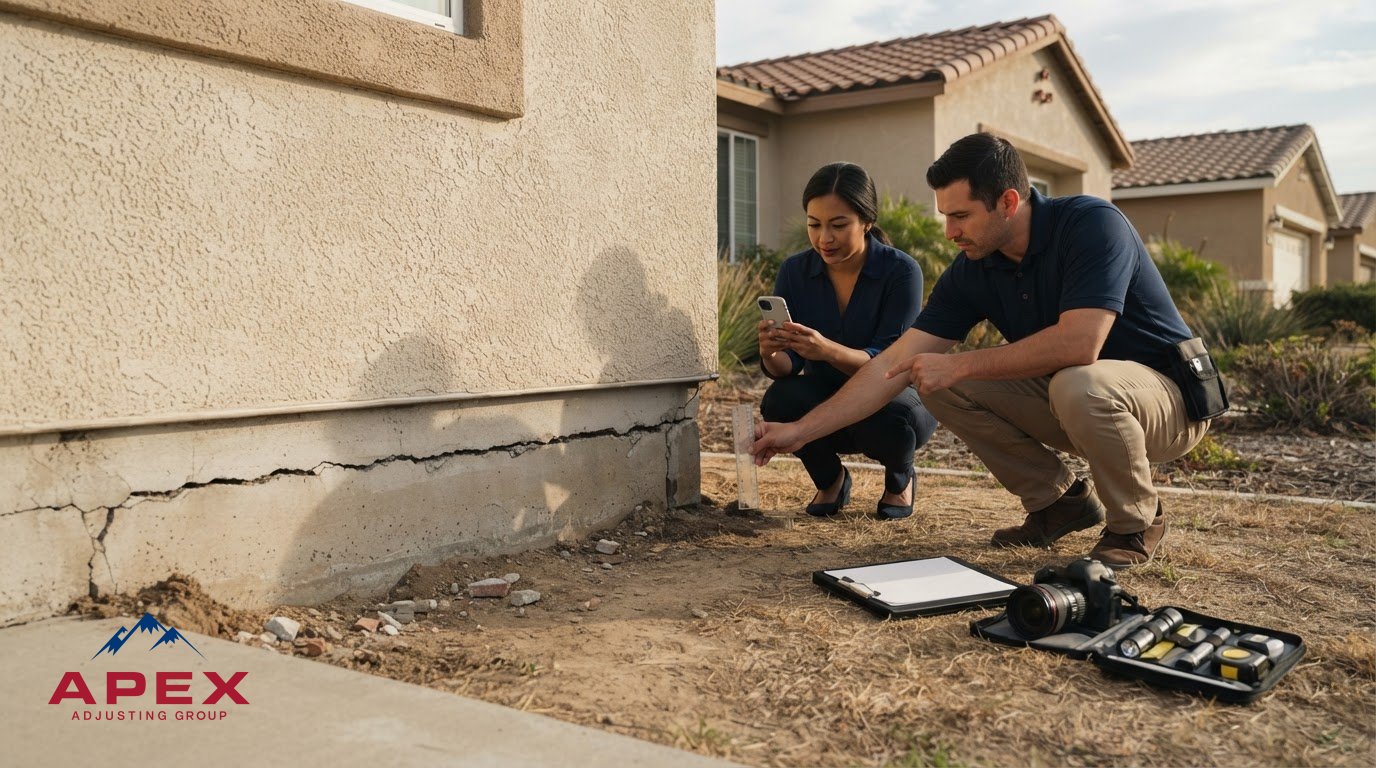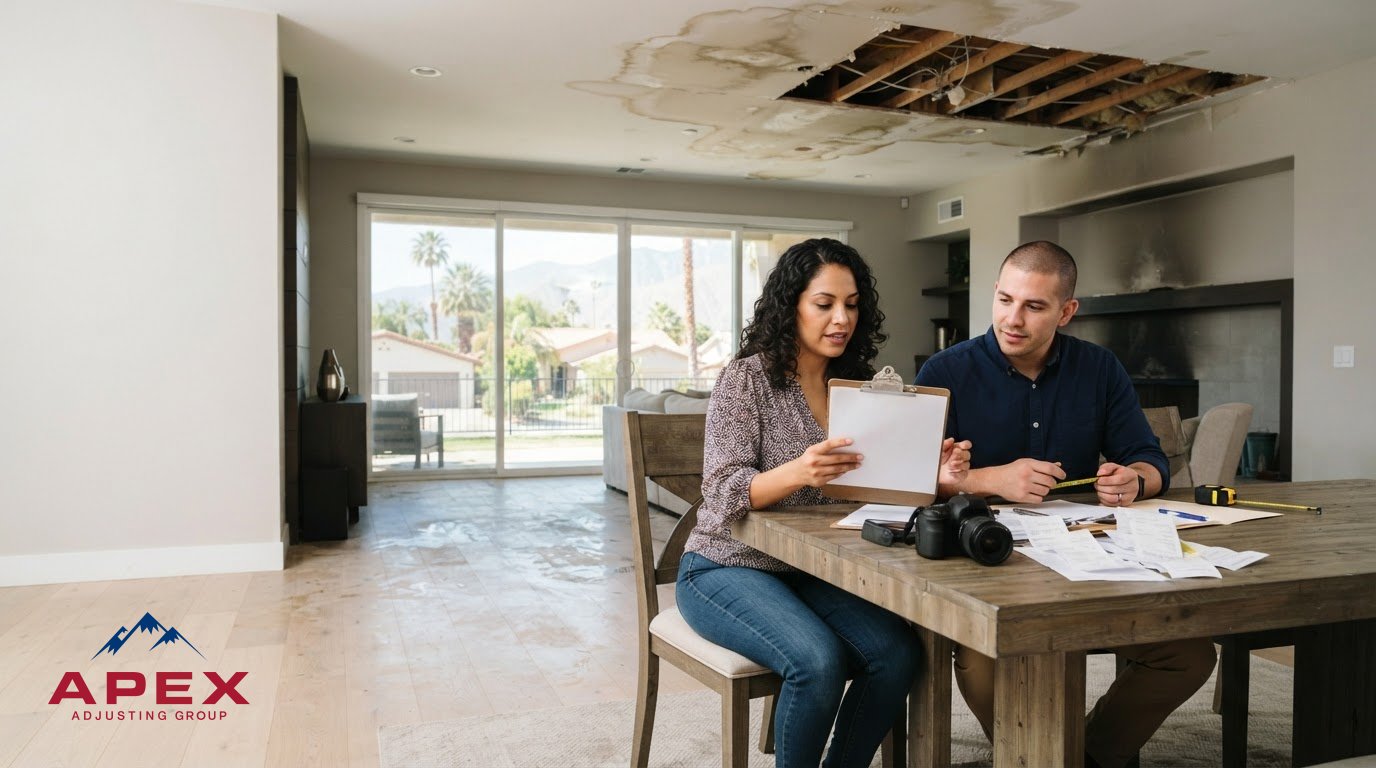
An insurance estimate is only as useful as the damage it accounts for. After a fire, water loss, or storm, a residential property damage claim can leave a homeowner sorting through policy language, photos, repair records, and an estimate that may not capture the full scope. Damage that is not clearly documented can be harder to evaluate.
A stronger claim starts with a clear record and a close review of the policy. Coverage depends on the policy’s terms, including its limits, exclusions, and deductible, so assumptions can lead to gaps. Careful documentation connects the observed damage to the repairs and expenses being considered.
This guide explains which policy provisions and damage categories to review, what to photograph, and how to organize repair estimates, receipts, and claim communications. It also covers what to do when an estimate appears to leave out damaged areas or related work. For an active or recent claim, Apex Adjusting Group represents property owners in first-party property damage claims and reviews the loss scope and supporting documentation.
Key Takeaways
- Review the full policy, not just the declarations page, to understand how limits, deductibles, exclusions, and conditions apply.
- Compare each damaged area with the estimate line by line. Separate observed damage from the repair scope and questions that need more support.
- Build a clear record for a residential property damage claim with dated photos, saved documents, and a log of claim communications.
- Track the claim from initial notice through inspection, estimate review, and follow-up so gaps are easier to identify and address.
- An independent public adjuster represents the property owner and can assess claim scope and documentation, but cannot guarantee an outcome.
Residential Property Damage Claims: Start With the Loss, Not the Paperwork
Damage to a home can disrupt daily life before the claim process is clear. A room may be unusable, belongings may be affected, and the homeowner may still be waiting to understand what the estimate includes. Start by recording what happened and what is visibly affected. A residential property claim is evaluated based on the policy, the cause of loss, and the documented damage, not simply on the fact that damage occurred.
A first-party property claim is made under the homeowner’s own policy for damage to the insured property. A liability dispute concerns responsibility for damage allegedly caused by another person. This guide focuses on documenting a homeowner’s own property loss. For general context on the term, see Understanding Property Damage.
Before cleanup or repairs, take these initial steps when it’s safe:
- Photograph the overall conditions and each affected room.
- Record damaged building materials and personal belongings separately.
- Save receipts and notes related to emergency work and other loss-related expenses.
What Belongs in a Residential Property Damage Claim?
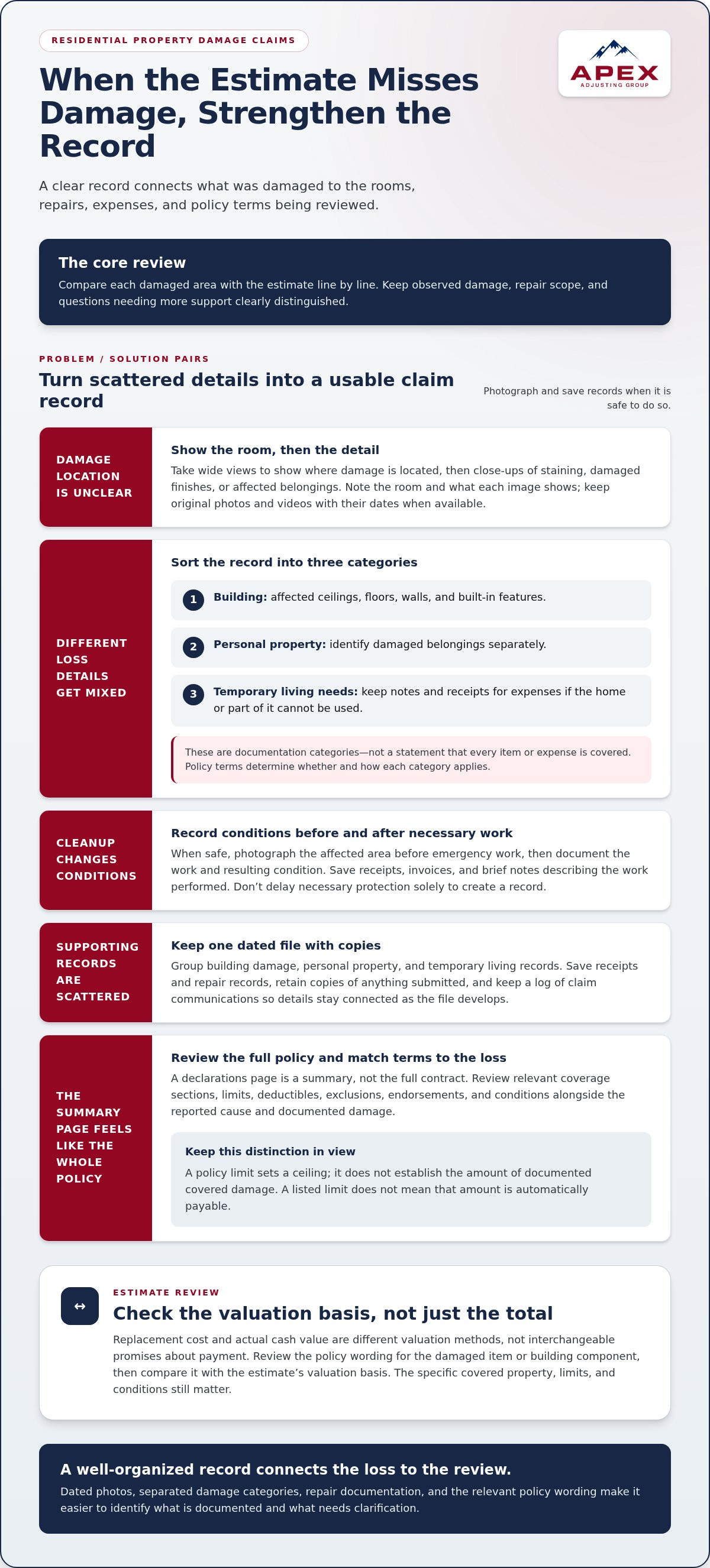
Organize the loss into three documentation categories: the building, personal property, and temporary living needs. Building records may include affected ceilings, floors, walls, and built-in features. Personal property records identify damaged belongings. Notes and receipts for temporary living needs document expenses if the home or part of it cannot be used.
For example, after a kitchen leak, a homeowner might document damage to cabinets and flooring, affected small appliances, and temporary lodging expenses. This is a way to organize the file, not a statement that every item or expense is covered. Policy terms determine whether and how each category applies.
What to Record Before Cleanup or Repairs
Make the evidence easy to connect to specific rooms and items. Take wide views to show where damage is located, then close-ups to capture details such as staining, damaged finishes, or affected belongings. Note the room and what each image shows. Keep original photos and videos with their dates when available. For examples of systematic documentation and thorough defect inspection techniques, resources like primedefectors.com illustrate how property specialists methodically catalog residential issues room by room.
Document conditions before and after necessary steps to protect the property. If emergency work is needed, record the affected area first when it’s safe, then photograph the work and resulting condition. Save receipts, invoices, and brief notes describing the work performed. Don’t delay necessary protection solely to create a record.
Keep these materials together in a dated file. Separate building damage, personal property, and temporary living records, and retain copies of anything submitted. This gives the claim a clearer starting point and helps distinguish observed damage from related expenses as the file develops.
How Policy Terms Shape a Residential Property Damage Claim
A declarations page can look like a complete answer because it lists important policy details in one place. It is a summary, not the full contract. To understand how a residential property damage claim may be evaluated, homeowners need to connect the reported cause and documented damage to the coverage language, including limits, deductibles, exclusions, endorsements, and conditions.
A policy limit sets a ceiling; it does not establish the amount of documented covered damage. The amount considered under a claim depends on the policy terms and the supported scope of loss. A listed limit does not mean that amount is automatically payable.
Which Policy Sections Should Homeowners Review?
Gather the declarations page and full policy, including endorsements that modify its terms. Review the coverage sections, exclusions, and conditions alongside the language that applies to the reported cause of loss. A residential property claim may involve different coverage sections, so match each damaged area or expense to the relevant wording rather than relying on a single summary line.
Coverage labels commonly identify categories such as:
- Dwelling: The home’s structure and covered building components, subject to the policy wording.
- Personal property: Belongings, with coverage and valuation governed by the applicable terms.
- Additional living expenses: Certain extra costs related to living elsewhere when covered damage affects use of the home, as defined by the policy.
Check the stated limit, deductible, and any conditions for each relevant category. An exclusion may remove or restrict coverage for certain damage, while an endorsement may change how a particular term applies. The meaning and applicability of each provision depend on the complete policy and the facts of the loss.
What Do Replacement Cost and Actual Cash Value Mean?
Replacement cost and actual cash value are different valuation methods, not interchangeable promises about payment. Replacement cost generally refers to valuing repair or replacement under the method and requirements stated in the policy. The specific covered property, limits, and conditions still matter.
Actual cash value is a separate valuation method. Its calculation depends on the policy’s definition and terms, so homeowners should not assume a single formula applies to every policy or type of property. Review the wording that applies to the damaged item or building component, then compare it with the estimate’s valuation basis.
For a practical review, note the coverage section, relevant limit, deductible, any endorsement, and the valuation term cited for each part of the estimate. If the policy language or estimate leaves a scope question unresolved, an independent review can help clarify what the documents support. Homeowners with an active or recent claim can request a free claim review.
How to Check Whether the Claim Estimate Reflects the Damage
An estimate can list several repair items and still leave questions about what each line covers. Review it alongside the damage record, area by area. Separate three things: what is visibly affected, what work the estimate describes, and what needs more documentation before the difference can be assessed.
Look for Missed Areas, Materials, and Related Damage
Start with the estimate’s room names and repair descriptions. Match each entry to photos and notes, checking whether the affected area, material, and item are described. Keep building materials separate from personal belongings so a missing entry for a wall finish does not get mixed up with a question about damaged furniture.
Record what can be observed, not a diagnosis of damage that isn’t visible. A photo of a ceiling stain shows the visible condition, but it doesn’t establish what may be behind the surface. Note the location and appearance, then flag whether additional assessment or documentation may be needed.
Check related spaces as well as the room where damage first appeared. If an estimate describes work in one room, compare it with records of adjacent areas that were also documented. Don’t assume a nearby area is affected or covered; treat it as a separate observation to review.
Keep Estimate Questions Specific and Documented
Turn each concern into a focused note. Identify the room, estimate entry, item, or repair description, then state what appears absent or unclear and which record supports the question. Dated images, contractor documentation, or relevant receipts may help explain the concern when available.
A difference between estimates does not by itself establish whether a disputed item is covered. Keep the estimate question distinct from the coverage question, which depends on the policy terms and facts of the loss. If the total seems low, identify the particular scope or documentation issue behind that concern.
Use a comparison table to make the review easier to follow:
| Damaged area | Estimate entry | Supporting evidence | Unresolved question |
|---|---|---|---|
| Hallway ceiling | Paint listed; ceiling material not described | Dated wide view and close-up of visible staining | Does the repair description address the affected material? |
| Bedroom contents | No itemized contents entry | Photos and available purchase or repair records | Which items need additional documentation? |
| Window area | Repair description is unclear | Room photos and contractor notes, if available | What work does the estimate describe? |
Adapt the rows to the actual estimate and property. Treat each entry as a question to investigate, not proof that coverage applies. For a residential property damage claim with unresolved scope questions, Apex Adjusting Group can review the estimate and supporting records on the property owner’s behalf.
What Homeowners Can Do at Each Stage of a Damage Claim
A claim can involve several moving parts at once: protecting the home, reporting the loss, arranging an inspection, and reviewing the estimate. A simple sequence helps keep urgent decisions separate from later scope questions. Each step should leave a dated record that makes the file easier to follow.
- Document the loss. Record visible conditions and affected areas before cleanup when it’s safe. Keep photos and notes organized by room or property area.
- Give notice. Follow the policy’s reporting instructions and keep a copy of the notice and any confirmation. Note what information was provided and when.
- Protect the property. Take reasonable temporary steps to prevent further damage, such as temporarily covering or securing an affected area when needed. Keep receipts and records of the work. Separate these measures from permanent repairs, which address the longer-term repair scope.
- Prepare for inspection. Make affected areas accessible when safe, and keep a list of documented locations and items. Have relevant photos, notes, and records available.
- Review and follow up. Compare the written estimate with the damage record, then send focused questions with supporting documents. Track any request for additional information and the response provided.
Consistent, dated claim records help clarify what happened, what was reported, and when each step took place.
Build a Claim File That Is Easy to Follow
Organize photos, policy documents, estimates, receipts, and correspondence by date and property area. A short log can capture the contact date, topic, information requested, and next action. Keep copies of submitted materials, and note when additional information is requested so it can be matched to the right part of the file.
Use a consistent naming method for digital files, such as the date, room, and item shown. Keep original records together, even if copies are sent separately. This reduces confusion when the same room appears in photos, an estimate, and later correspondence.
Prepare for Inspection and Follow-Up
Before an inspection, review the room-by-room record and identify documented damage locations. Don’t move or conceal an affected item solely to make the area look orderly; instead, make the space accessible when safe. Keep questions specific to inspection findings, estimate scope, or records supporting a repair item.
Homeowners who need help organizing and assessing an active or recent residential property damage claim can work with Apex Adjusting Group. Its public adjusters represent property owners and review the loss documentation, estimate, and claim records.
When an Independent Public Adjuster May Help With a Residential Claim
A claim may need another review when the estimate appears to omit documented damage, the scope is difficult to assess, or the file contains unanswered questions. A public adjuster represents the property owner in a first-party property damage claim and reviews the loss records from the homeowner’s perspective.
A public adjuster is not an attorney and does not provide legal representation. If a contested claim escalates into formal legal proceedings or contract litigation, parties often seek counsel from dispute resolution practices such as Fervent Chambers LLC. An adjuster cannot guarantee a particular claim outcome, but can help clarify which questions relate to the documented damage, the estimate, or the supporting file.
What a Public Adjuster Can Contribute to a Claim Review
A review can compare the documented loss, relevant policy information, estimate, and claim records. Photographs may show an affected area that is not clearly addressed in the estimate, or correspondence may identify documentation still needed. A public adjuster can help organize these questions and assess what the available records support.
For a residential property claim, this can give the homeowner a clearer view of unresolved scope or documentation issues. The policy wording and facts of the loss remain central, and a review does not determine coverage or promise that a disputed item will be accepted.
How Apex’s Claim Review Fits the Next Step
Apex Adjusting Group represents property owners, not insurance companies, and offers a free claim evaluation. The firm works on a contingency basis and charges a fee only when it obtains a recovery. A review can help homeowners understand the claim file and identify questions for follow-up without guaranteeing a specific result.
Apex is licensed in California, Arizona, Washington, Idaho, Colorado, Texas, and Nevada. Its local service footprint includes Southern California, Arizona, Spokane, San Jose, Phoenix, San Francisco, Las Vegas, Oakland, Tucson, Seattle, Orange County, Idaho, Sacramento, Los Angeles, and Reno. Homeowners with an active or recent claim in its licensed states can request an independent review of loss documentation, policy information, estimates, and claim records.
Move Forward With a Clear Next Step
An open question in a residential property damage claim doesn’t have to define the whole process. Identify what remains unclear, gather the records that relate to it, and decide whether an independent review would help. A specific question is easier to assess than a general concern that the claim feels incomplete.
Homeowners can use that approach even when the claim has been active for some time. Keep the file accessible, note what still needs clarification, and choose a next step that fits the situation. A clearer view of the issue helps homeowners make an informed decision about what to do next.
Homeowners with an active or recent claim can request a free review from Apex Adjusting Group to discuss the claim file and possible next steps.
Frequently Asked Questions
What does a residential property damage claim cover?
A residential property damage claim may include damage to a home’s structure, personal belongings, or other categories addressed by the policy. The cause of loss and policy wording shape what applies. For example, a storm-related roof issue and damage to a personal item inside the home may involve different coverage provisions and documentation. Review each category separately, and don’t treat a policy summary or list of damaged items as confirmation of coverage.
How do I document home damage for an insurance claim?
Capture enough detail to identify the condition, location, and affected property. Along with room photos, record identifying details for damaged belongings, such as the item type, brand, or model when available. Note whether an item was already damaged before the event, if known, so the record distinguishes prior condition from new observations. Keep estimates and receipts connected to the relevant item or area rather than in an unlabeled stack.
Can I start repairs before the insurance inspection?
Necessary steps to prevent further damage may be appropriate before an inspection, but permanent work can change what is visible. Prioritize safety and address urgent conditions. Before work begins, record the affected area when it’s safe; afterward, keep invoices and a description of what was removed, treated, or replaced. Review the policy and claim instructions for the situation, and preserve available records of the original condition.
What is the difference between replacement cost and actual cash value?
Replacement cost and actual cash value are distinct ways a policy may value damaged property. The policy defines which method applies and how it is calculated, so the terms shouldn’t be treated as interchangeable. Check the estimate for the valuation basis assigned to each item or repair line. If the estimate uses an unclear term, compare it with the relevant policy provision before drawing conclusions about the amount shown.
What should I do if my property damage claim estimate seems incomplete?
Identify the specific room, item, or repair description that appears incomplete, then compare it with the records for that location. Write down what is unclear and which document supports the concern. For example, a repair line may name a surface without describing the related work shown in the file. Keep the question and any response together. An estimate discrepancy alone doesn’t determine coverage, which depends on the policy and loss facts.
Can a public adjuster help with a residential property damage claim?
A homeowner can seek independent claim support when the file contains unresolved questions about documented damage, estimate scope, or the records needed to explain a loss. Organize the current estimate, relevant policy provisions, and correspondence, then note the specific issues that remain unclear. Apex Adjusting Group offers free claim evaluations and represents property owners in first-party property damage claims. A review can focus on the file and the homeowner’s questions without promising a particular outcome.
Need Help with Your Insurance Claim?
Our licensed public adjusters can help you get the maximum settlement you deserve. Contact us today for a free claim evaluation.
Related Articles