
A denial is a documented decision to examine, not a reason to respond blindly. When an insurance claim is denied, what to do next starts with the reason in the letter and the policy language behind it. A difficult-to-read explanation can leave property owners unsure which facts matter, but a denial alone doesn’t resolve whether the damage and coverage were fully considered.
Start by matching the stated reason to the relevant policy provision. Then gather the records that speak directly to it: damage photos, repair estimates, inspection notes, invoices, and communications about the loss. Check the letter and policy for response deadlines or other conditions, and keep copies of anything sent or received. The right next step depends on what the file shows, so avoid assuming either that the denial is final or that additional evidence will change the decision.
Apex Adjusting Group represents property owners, not insurance companies, in first-party property damage claims. As a licensed public adjusting firm, Apex can review claim documentation and damage scope from the owner’s perspective. This article explains how to read the denial, organize relevant evidence, and consider a practical response while keeping the claim record clear.
Key Takeaways
- After a denial, preserve the notice and claim correspondence, then note any response dates or policy conditions that may affect your options.
- Read the letter for the specific decision, policy wording, damage areas, and evidence the insurer considered.
- For insurance claim denied what to do, compare the stated reason with relevant photos, repair records, estimates, and other claim documentation.
- Organize unresolved questions and request a factual explanation of how the cited policy language applies to the documented damage.
- A public adjuster can review the property damage scope and claim file from the owner’s perspective without assuming what the insurer will decide.
Insurance Claim Denied? Take These First Steps
A denial can land like a verdict, especially after a fire, leak, or storm has already disrupted a home or business. But the written notice gives the property owner a place to start: it identifies the decision and may point to the policy language or claim evidence the insurer relied on. For anyone asking insurance claim denied what to do, the first move is to preserve the record, not to assume the explanation is complete or rush into a response.
A methodical first response helps keep the file clear. Policy terms, response requirements, and available procedures vary, so there is no single deadline or remedy that applies to every claim. The property owner can review the denial notice and policy for dates and stated requirements, then request clarification in writing if an instruction is unclear.
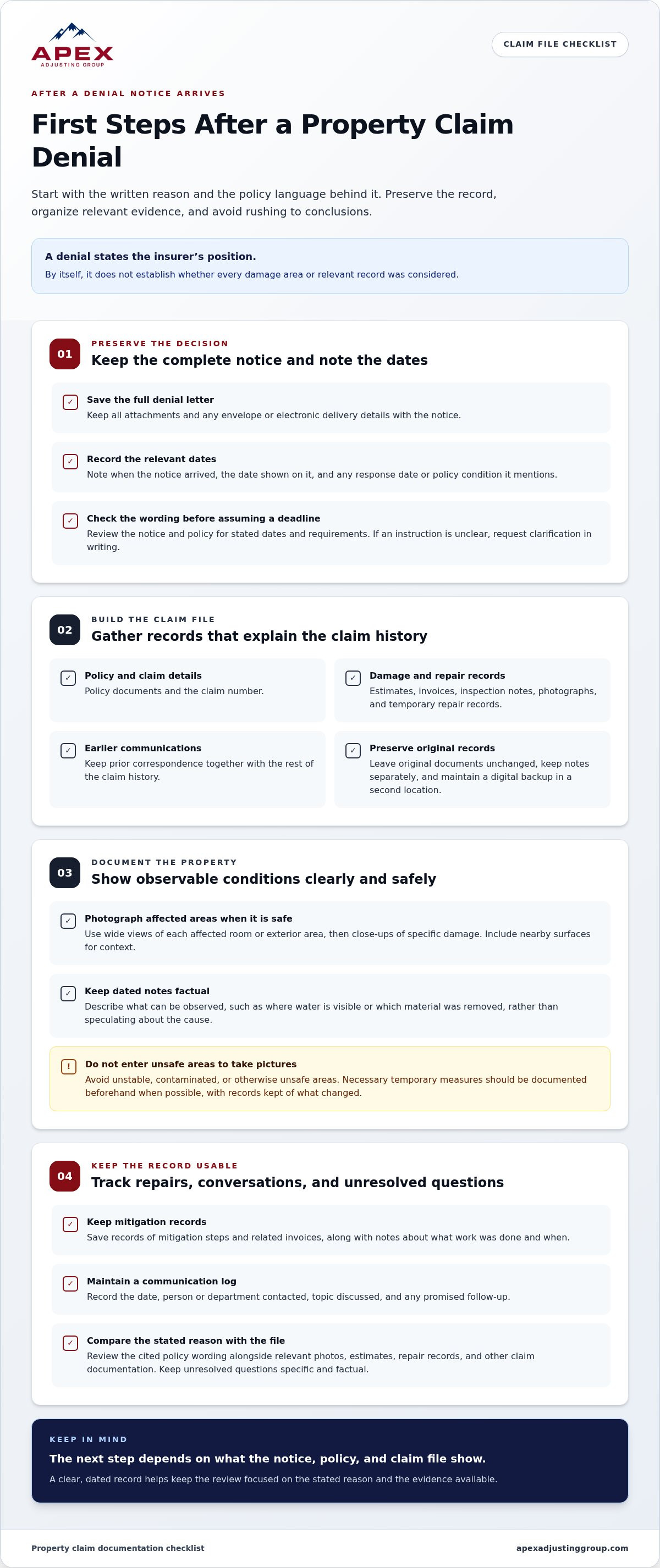
- Preserved notice: The complete denial letter, including attachments and any envelope or electronic delivery details, belongs in the claim file.
- Recorded dates: The file should note when the notice arrived, the date shown on it, and any response date or policy condition it mentions. A deadline shouldn’t be assumed without checking the relevant wording.
- Gathered claim records: Policy documents, the claim number, prior correspondence, estimates, invoices, inspection notes, photographs, and temporary repair records help establish the claim history.
- No rushed conclusions: A denial states the insurer’s position. By itself, it doesn’t establish whether every damage area or relevant record was considered.
What to Save When a Denial Arrives
A single folder, organized by date or claim activity, can keep the file usable. It should include the full denial letter, policy, claim number, estimates, invoices, inspection notes, and photos. Receipts and notes about temporary repairs can record what work was done and when.
A communication log can capture the date, the person or department contacted, the topic discussed, and any promised follow-up. Original documents should remain unchanged, with notes kept separately. Digital backups in a second location can protect the claim history if a device or paper file is misplaced or damaged.
How to Protect the Property and the Claim Record
Visible conditions can be documented before repairs alter them, but only when it’s safe. Photos can show each affected room or exterior area from a wide angle, followed by close-ups of specific damage, such as water staining, damaged finishes, or broken materials. Nearby surfaces can provide context. No one should enter unstable, contaminated, or otherwise unsafe areas to take pictures.
Dated notes and photographs can record changing conditions or continuing damage. They should describe observable facts, such as where water is visible or which material was removed, rather than speculate about cause. Mitigation steps and related invoices also belong in the file. The term Insurance bad faith describes a separate legal concept; a denial alone doesn’t establish it, so this first step is to document facts without reaching legal conclusions.
Where practical, the scene can be preserved without leaving an immediate hazard unaddressed. Necessary temporary measures should be documented beforehand when possible, with records kept of what changed. A clear, dated file helps the next review focus on the stated reason and the evidence available.
How to Read the Insurance Claim Denial Letter
A denial letter is the insurer’s written explanation of its decision on the submitted claim. It may reject the entire claim, deny specific items, limit the damage scope, or leave some submitted issues unresolved. The letter should be read as a decision about the claim file, not as a complete inventory of every damaged area or document the owner provided.
The owner can mark the decision, each damage area discussed, the policy language cited, and the evidence the letter says it considered. Those details can then be compared with the applicable policy and the records submitted for the claim. For anyone determining insurance claim denied what to do, that comparison is more useful than treating one sentence as the whole explanation.
The cited reason and policy wording should be reviewed together; neither should be interpreted in isolation.
Find the Stated Reason and Policy Provision
Terms such as exclusion, limitation, condition, or insufficient documentation can point to the basis for the decision. An exclusion identifies a type or cause of loss the policy says it doesn’t cover; a limitation restricts coverage in a specified way; and a condition describes a policy requirement. These labels indicate wording to examine, but a single phrase doesn’t settle how it applies to the full claim.
The relevant policy version is the one that applied to the loss. The complete provision, nearby definitions, and related sections provide more context than a short quotation in the letter. If the decision says evidence was missing, the owner can identify which record the insurer says it needed and whether that item appears in the claim file. Going forward, policyholders who want to avoid unexpected gaps can also consult an independent team like The Lewis Agency to review their commercial or personal coverage.
Separate Denied Damage From Accepted or Unresolved Damage
The decision can be organized by room, building component, or damaged item. Different parts of a claim can have different outcomes. Payment or acceptance of one portion doesn’t mean every submitted item was accepted or addressed.
- Denied: The letter clearly states that a particular item or area isn’t covered or included.
- Accepted: The letter identifies damage included in the insurer’s estimate or decision.
- Unresolved: The letter doesn’t clearly address an item, or requests information before deciding on it.
- Not addressed: The owner submitted documentation, but the letter doesn’t explain whether or how it was considered.
This list can be compared with the submitted estimate, photographs, inspection notes, and invoices. For example, a letter may discuss roof damage but say nothing about interior staining documented after a leak. That omission doesn’t establish coverage or an error; it identifies a specific question that may need clarification.
Any outside reference should be kept in its proper context. HealthCare.gov’s appeal process explains appeals for health insurance decisions, not property-damage claims, so its procedures shouldn’t be assumed to apply here. Property claim requirements depend on the relevant policy and circumstances.
Once the decision is mapped against the policy wording and each damage item, the remaining questions can be stated more precisely. Owners seeking a review of property damage scope and claim documentation can request a free property claim review.
Match the Denial Reason to Damage Evidence
A denial becomes easier to assess when each stated reason is matched with records that speak to it. The goal isn’t to prove a conclusion by collecting paperwork indiscriminately. It’s to identify what the file shows, what remains uncertain, and what information may help clarify the difference between the insurer’s position and the documented damage. For owners considering insurance claim denied what to do, this comparison gives the next review a clear focus.
A two-column working list can keep the comparison organized. One side records the insurer’s wording; the other lists records that may add context. Evidence can help explain scope, timing, or observed conditions, but it doesn’t establish coverage by itself.
Document the Property Damage Clearly
A useful visual record shows both location and detail. Photographs can cover each affected room, building component, or damaged item from a wider view, followed by close-ups of the specific condition. Context, such as the relationship between a ceiling stain and nearby walls, can help locate the damage. Unsafe areas shouldn’t be entered for documentation.
Repair estimates, invoices, receipts, and records of temporary protective work can be organized by affected area and date. For fire, water, wind, or storm damage, those records help connect the documentation to the reported loss without guessing at causation. A note that a contractor removed damaged material is more useful than an unsupported conclusion about what caused the damage.
Create a Clear Record of What Remains Disputed
A comparison of the insurer’s inspection notes or estimate with observed damage and submitted materials can reveal items that are missing, described differently, or unresolved. A simple record can identify each item, the supporting photograph or document, and the question that remains. This keeps follow-up specific and grounded in the file.
A public adjuster evaluates property damage scope and claim documentation from the owner’s perspective, not legal questions. Owners with fire-related damage can find relevant information in Apex’s fire damage claim guidance.
Choose a Practical Response to a Denied Claim
A response is strongest when it addresses the specific gap in the claim file. Before sending anything, match the denial reason to the damage item involved, identify what remains unanswered, and decide what record or explanation could clarify it. A measured approach keeps the communication focused on the property, the documentation, and the policy wording rather than assumptions about why the decision was made.
There isn’t one appeal process or deadline that applies to every property claim. Policy terms and applicable state requirements can affect response procedures, so review the policy and denial notice carefully and verify any stated deadline against current, authoritative information. Don’t assume that asking a question pauses or extends a deadline.
Prepare a Focused Written Follow-Up
Keep the message factual and specific. Identify the claim number, denial date, stated reason, and the particular damage area or item that needs clarification. Refer to the relevant policy wording and ask how it applies to the documented conditions, without asserting that the item must be covered.
Attach only records that relate to the question. Label each photo, estimate, invoice, inspection note, or repair record so the reviewer can find it quickly. Keep a copy of the message and every attachment, note how and when they were sent, and record any response or requested follow-up.
Use clear questions, such as whether a specific submitted estimate was considered or which additional record is needed to evaluate an unresolved damage area. If the denial refers to an exclusion or condition, ask which part of the provision the decision relies on and how it connects to the facts described in the claim file. Neutral wording keeps the exchange centered on information that can be checked.
Know When Professional Claim Review May Help
A claim-focused review may be useful when the documented damage scope doesn’t align with the estimate, key records appear unaddressed, or the policy language is difficult to connect to the property conditions. A public adjuster evaluates property damage and claim documentation from the owner’s perspective. That work is distinct from legal advice or legal representation.
A public adjuster can help organize the damage scope and claim records, but cannot determine legal questions or promise that a decision will change. If a disagreement involves policy interpretation, procedures, or rights beyond adjusting the property claim, those questions may require guidance from a qualified legal professional, such as Cowper Law. Keep the roles clear as the response takes shape.
Before sending a follow-up, check that each disputed item has a clear reference, relevant supporting records, and a specific question. That gives the insurer a focused point to address and gives the owner a cleaner record of what was submitted and what remains unresolved. For an owner who wants a property claim file reviewed, a free claim review is an option.
How a Public Adjuster Can Review a Denied Property Claim
A denial can leave an owner facing two separate problems: damage that still needs attention and a claim file that’s difficult to assess. Apex Adjusting Group is a licensed public adjusting firm that represents property owners, never insurance companies, in first-party property damage claims. Its review focuses on the documented damage, the claim scope, and the records behind the insurer’s decision. It doesn’t guarantee that a denial will change.
For owners determining insurance claim denied what to do next, an independent review can help clarify what the file shows and which questions remain open. The review is about property damage and claim documentation, not legal advice or legal representation.
What Apex Reviews in a Denied Claim
A claim review brings the reported damage and the file’s supporting records together. Apex can compare the areas identified in estimates or inspection notes with the owner’s photographs, repair records, invoices, and other claim communications. For example, if an estimate addresses damage in one area but the file documents additional affected rooms, the review can identify that difference for consideration without assuming what the policy covers.
For residential properties, the review can focus on the home’s documented damage scope and related claim records. Commercial property files may involve damage across different building areas or components; Apex also provides commercial property claim support. The appropriate records depend on the loss and the property, whether the reported damage involves fire, smoke, water, wind, hail, or a storm.
Apex can also organize the issues that need clarification, such as a damage item that appears in the owner’s records but not in the estimate, or a document whose relevance to the stated denial reason isn’t clear. This helps create a more complete picture of the file. It doesn’t determine legal rights or assure a particular claim outcome.
Apex is licensed in California, Arizona, Washington, Idaho, Colorado, Texas, and Nevada. Claim review and adjusting support are available for eligible property damage claims in those states.
Take the Next Step With a Free Claim Review
Apex offers free claim evaluations. Its fee is contingent on achieving a recovery: the firm receives a percentage of amounts recovered, and there’s no fee unless a recovery is achieved. A review is a way to have the property damage scope and claim records examined from the owner’s perspective, without assuming what the insurer’s next decision may be.
Move Forward With a Clear Claim Record
After a denial, the next step doesn’t have to settle every question at once. Focus on making the unresolved issue precise: which damage or document remains in dispute, what the insurer’s explanation says, and what response or information is still needed. That clarity can help the property owner decide what deserves attention next without assuming how the claim should end.
If you’re weighing insurance claim denied what to do, use the file as your guide. Keep the communication factual, preserve each response, and review any stated policy requirements before taking further action. A careful next step is more useful than a rushed one.
A claim review can offer another perspective on the property damage scope and supporting records. Choose it if a second set of eyes would help clarify the file.
With a clear record and a focused question, the path forward can feel more manageable.
Frequently Asked Questions
Can I challenge a denied insurance claim?
A property owner can ask the insurer to review or clarify a denial, but the available process depends on the policy and applicable requirements. A focused request can identify a specific damage item, explain what record may have been overlooked, or provide relevant new documentation. Keep the request factual and retain a copy. A challenge or request for review doesn’t guarantee the insurer will change its decision.
What should I do first after my insurance claim is denied?
For owners asking insurance claim denied what to do, start by preserving the decision and checking its details. Save the complete notice, policy, claim correspondence, estimates, photographs, and repair records. Note when the decision arrived and identify the reason given. Then compare that reason with the damage and documents submitted. Check the policy for response requirements, since procedures can vary and a stated deadline may affect available options.
Does a denied insurance claim mean the insurer will not reconsider it?
No. A denial doesn’t necessarily prevent further review, particularly if the owner can point to a specific unresolved issue or provide relevant information that wasn’t considered. For example, a later inspection record may clarify the condition of an affected area. Whether the insurer reexamines the file depends on the claim, policy, and applicable process. A request should address the stated reason directly, without assuming reconsideration or a different decision.
How do I respond to an insurance claim denial letter?
Send a concise written response that identifies the claim and the issue needing clarification. Rather than restating the entire loss, refer to a particular room, building component, or estimate line and ask a direct question about the decision. If attaching records, use clear labels and explain what each one relates to. Keep a copy of the complete submission and note how it was sent, so the claim record shows what information was provided.
Can a public adjuster help with a denied property insurance claim?
A public adjuster can review property damage scope and claim documentation from the policyholder’s perspective. That review may help identify differences between the reported damage, the available records, and the insurer’s estimate or explanation. A public adjuster does not provide legal advice or legal representation. The review can clarify claim-related questions, but it cannot determine legal rights or establish in advance how the insurer will respond.
Will hiring a public adjuster guarantee my denied claim is paid?
No. Hiring a public adjuster doesn’t guarantee payment, a changed decision, or a particular settlement. The review focuses on the damage and claim file, and any outcome depends on the facts, policy terms, and insurer’s assessment. Property owners should be wary of anyone promising a specific result. A careful review can help explain the documented scope and identify questions that may need a response, without predicting the final decision.
Do insurance claim denial deadlines vary by state and policy?
Yes. Response procedures and deadlines may depend on the policy, the type of claim, and applicable state requirements. Don’t assume a deadline from another policyholder’s experience applies to this claim. Check the denial notice and relevant policy provisions, then verify any unclear requirement using current information from an authoritative state source. If a date is approaching, consider getting qualified guidance promptly rather than waiting for informal discussions to resolve the issue.
Need Help with Your Insurance Claim?
Our licensed public adjusters can help you get the maximum settlement you deserve. Contact us today for a free claim evaluation.
Related Articles