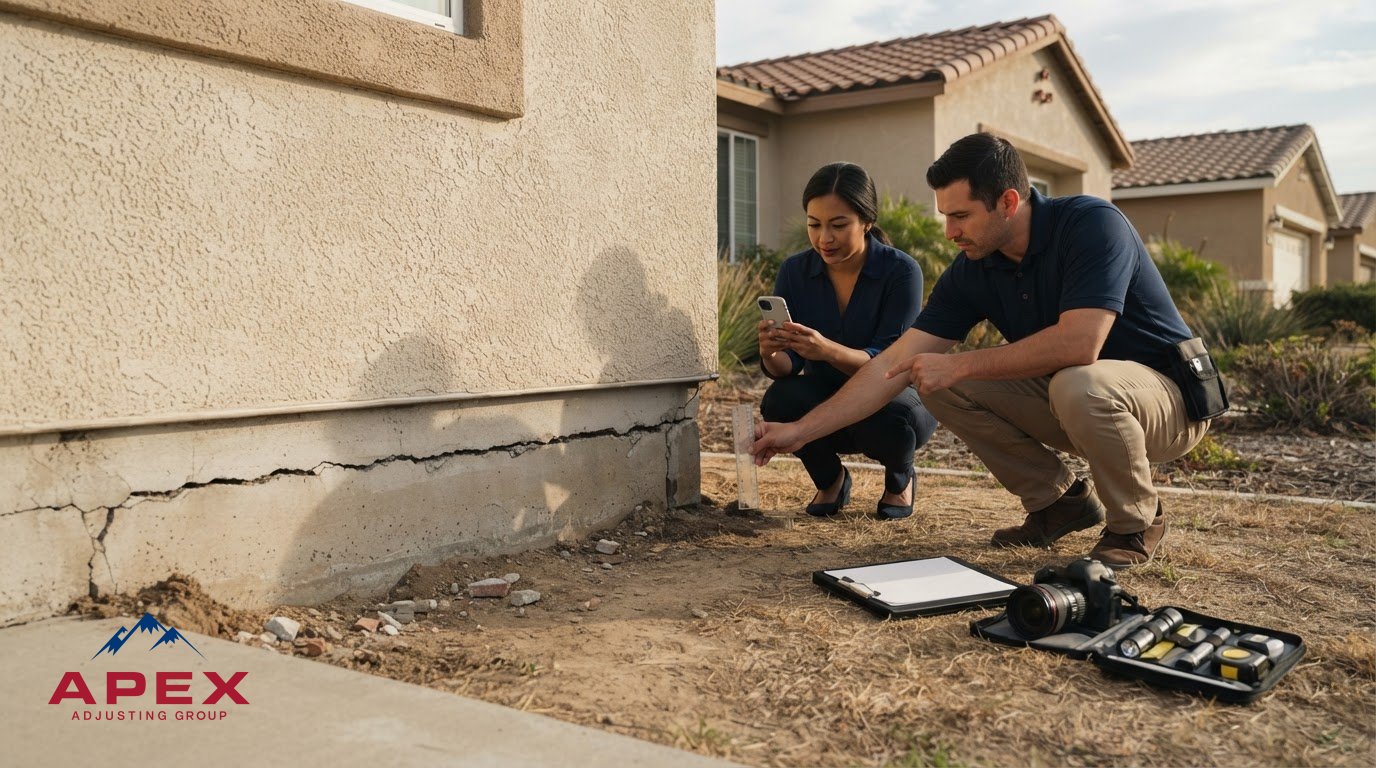
A foundation crack that appears after an earthquake does not automatically prove the quake caused it or that the damage is covered. An earthquake foundation crack insurance claim may depend on how the policy defines coverage, whether earthquake protection was purchased separately or added by endorsement, and what the damage record shows.
It is understandable to worry that an insurer may attribute cracks to settling or prior damage. The cause should be assessed against the available evidence, not assumed from the crack’s appearance alone.
This guide explains which policy provisions may affect coverage, including exclusions and percentage-based deductibles. It also covers how to preserve useful evidence: photograph cracks and nearby damage, record when changes appear, and keep inspection notes and repair documents together.
Clear documentation can show the damage’s location, extent, and possible relationship to the earthquake. The guide also explains how to respond when a claim review raises questions about cause or repair scope, and how a public adjuster can review the policy, damage documentation, and claim estimate on the property owner’s behalf.
Key Takeaways
- Visible foundation cracks alone do not establish when they formed or what caused them. Compare pre-earthquake records with dated post-event evidence.
- For an earthquake foundation crack insurance claim, review the policy’s earthquake coverage, exclusions, and deductible provisions before assessing the claim scope.
- Photograph cracks from a safe distance and up close, noting their location and date. Record changes and keep inspection and repair documents together.
- Follow the policy’s reporting instructions, keep copies of submitted materials, and maintain written records through inspection and claim review.
- A public adjuster represents the property owner and can help organize damage evidence, review claim scope, and communicate about a first-party claim.
Earthquake Foundation Cracks: What Coverage Depends On
Foundation cracks noticed after an earthquake can raise an immediate coverage concern, but their appearance alone does not establish when they formed, what caused them, or whether the policy covers the resulting damage. A crack may be visible after shaking without evidence showing the earthquake created it. The claim file needs to connect the reported damage to the applicable policy language and documented cause.
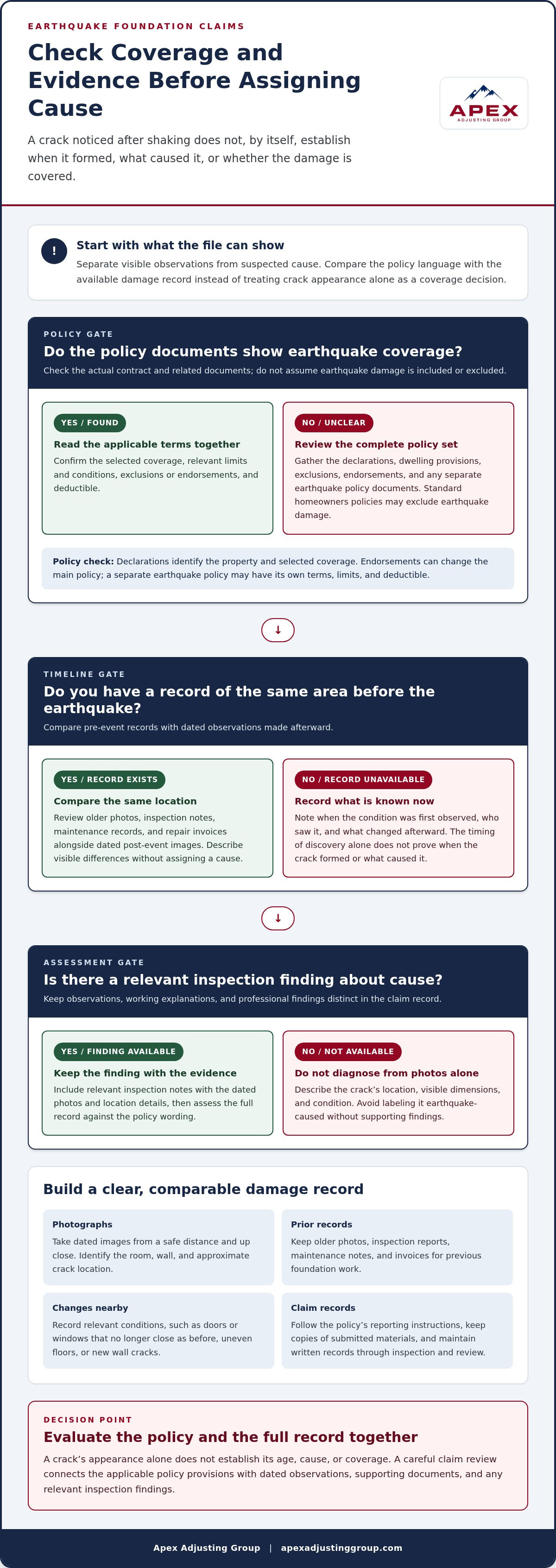
Coverage depends on the policy and documented cause, not crack appearance alone. For an earthquake foundation crack insurance claim, determine whether earthquake coverage applies, what exclusions or conditions affect it, and how the observed damage fits the policy’s terms. Standard homeowners policies may exclude earthquake damage, so review the actual contract rather than assume earthquake losses are included or excluded in every case.
Which policy documents matter for earthquake foundation damage?
Gather the declarations page, dwelling coverage details, policy exclusions, endorsements, and any separate earthquake policy documents. The declarations identify the insured property and selected coverage. Exclusions and endorsements can change how the main policy applies, while a separate earthquake policy may set its own terms, limits, and deductible. For general context, the Earthquake Insurance Overview describes common features of this coverage.
Read the documents together. An endorsement may add or modify coverage, while a separate policy may address earthquake damage under different provisions. A general description of homeowners coverage is not a substitute for the wording in the policy issued for the property. Similarly, for property owners managing multi-unit buildings or flats, consulting specialists like WS Insurance Brokers can help clarify how block policies and endorsements cover structural risks.
- Declarations: Confirm the property and selected coverage.
- Dwelling provisions: Identify the terms relevant to the structure.
- Exclusions and endorsements: Look for language that limits, removes, or changes coverage.
- Earthquake documents: Check the applicable limits, deductible, and conditions.
Foundation damage can also be associated with causes other than earthquake shaking. Coverage for those causes depends on the relevant policy provisions, so do not assume they fall under earthquake coverage. Apex Adjusting Group reviews policy provisions and damage documentation on the property owner’s behalf as part of its earthquake damage claim support.
Why crack appearance alone does not determine coverage
Similar-looking cracks can have different origins, and a photograph by itself may not establish when or why a crack formed. Keep observations separate from conclusions: record the crack’s location, visible dimensions, and condition, but do not label it earthquake-caused without supporting findings. A careful review compares the policy language with the evidence rather than treating appearance as a coverage decision.
Preserve pre-event photos, inspection notes, and repair records alongside dated images taken after the shaking. Changes over time may provide useful context, but they do not independently prove cause. Avoid diagnosing structural movement from photographs alone. The claim assessment should account for the full record and, where available, relevant inspection findings.
How to Distinguish Earthquake Damage From Older Foundation Cracks
A crack found after an earthquake may be new, older, or an existing crack that changed. The claim record should show what was observed and when, without treating timing alone as proof of cause. Compare the property’s condition before the event, its first documented condition afterward, and any later changes.
Observed damage describes what is visible; suspected cause is a working explanation; a professional cause assessment is a separate finding. Keep those distinctions clear in notes and claim communications. An earthquake foundation crack insurance claim is easier to evaluate when the evidence supports each statement without overstating what it proves.
Evidence that can establish when the cracks appeared
Build a timeline from records created before and after the shaking. Prior photos, inspection reports, maintenance notes, and repair invoices may show whether a crack was previously documented, repaired, or monitored. Record when someone first noticed the current condition and describe any change in plain terms, such as “newly visible” or “appears wider than in the dated photo,” rather than assigning a cause.
- Collect dated interior and exterior photographs, including older images that show the same area.
- Save inspection reports, maintenance records, and invoices describing prior foundation work.
- Note when the damage was first observed, who saw it, and what changed afterward.
- Document nearby conditions, such as doors or windows that no longer close as before, uneven floors, or new wall cracks.
Tie each observation to a location. Identify the room, wall, and approximate position of a crack so later photographs and inspection notes can be compared. A nearby door sticking after the event is useful to record, but it does not by itself establish that the foundation moved or identify the cause.
What professional observations can add
A structural inspection may provide a more systematic description than homeowner photographs alone. The professional can document where cracks occur, their pattern and visible severity, and related conditions observed during the inspection. Ask that the written findings distinguish direct observations from opinions about timing or cause, and preserve the complete report for the claim file.
These observations can help define the reported damage and repair scope, but they do not interpret the insurance contract or decide coverage. Those are separate parts of the claim review. Ready.gov’s Earthquake Preparedness and Recovery guidance can help property owners consider safety and recovery after shaking. Document damage only when it is safe to do so.
For property owners in earthquake-prone areas such as Southern California, Los Angeles, Orange County, San Jose, San Francisco, Oakland, and Sacramento, the same comparison of dated records can help clarify a crack’s history. Apex Adjusting Group also serves property owners with claims in Phoenix and Tucson, Las Vegas and Reno, Seattle and Spokane, and Idaho. Its earthquake damage claim support can include organizing damage documentation and reviewing claim scope on the property owner’s behalf. For an active or recent claim, a free claim review can help clarify how the records and reported damage fit together.
What to Document Before Filing an Earthquake Foundation Claim
Start with safety, not the camera. If the building appears unstable or an area feels unsafe, stay out and follow appropriate safety guidance. Do not enter a damaged space, move debris, or perform tests just to improve the claim record. Urgent protective steps take priority over photographs. Document what was done when it is safe.
Once you can safely record the damage, build a clear file in sequence: photograph what you can access, note what you observe and when, collect the relevant policy and property records, then report the loss according to the policy’s instructions. An organized earthquake foundation crack insurance claim file helps reviewers understand the reported damage and the information available to evaluate it.
Photographs and records that make the damage clear
Photograph each crack in context and in detail. Take a wide view showing the room or exterior area, then closer views that show the crack itself. Where safe, include a ruler or another familiar object for scale. Keep the original files with their dates, and note the property location and the specific wall, room, or foundation area in a separate log.
- Capture several angles of each crack, including surrounding walls, floors, and nearby openings.
- Record visible changes over time, such as a new crack or a change in its appearance.
- Save pre-earthquake photographs, inspection reports, maintenance records, and repair invoices.
- Keep policy documents, claim communications, inspection notes, and repair estimates together.
- Note temporary protective steps taken, when they occurred, and any related receipts or records.
A simple log can connect images to the property. Write the date, location, what is visible, and who observed it. If the condition changes, add a new entry rather than replacing the earlier description. Preserve records showing the foundation’s prior condition, even if they document earlier concerns or repairs.
How to describe damage without overstating its cause
Use observable details: “diagonal crack on the interior wall beside the window” is more precise than “earthquake damage” when the cause has not been established. Describe the location, visible length or width if safely measurable, and any changes you personally observed. Do not diagnose structural movement or assign a cause based on appearance alone.
Keep firsthand observations distinct from professional opinions. Label inspection findings as such, preserve the report, and avoid rewriting a professional’s conclusion in stronger terms than the report supports. Clear descriptions help maintain a reliable record without prejudging cause or coverage.
For a homeowner, the documented scope should connect foundation damage with related affected areas and supporting records. Apex Adjusting Group’s residential property claim support can include reviewing that scope and its documentation. If a claim is active or recent, a free claim review can help clarify the records and claim materials.
Filing and Responding to Earthquake Foundation Crack Claims
A clear claim file starts with the policy’s reporting instructions and stays organized through inspection and review. Keep a copy of the policy, the notice you submit, and any confirmation that it was received. An earthquake foundation crack insurance claim can raise questions about timing, cause, or repair scope, so preserve a written record rather than relying on memory or phone conversations alone.
Before reporting, assemble a concise timeline, damage inventory, photographs, and records showing the foundation’s prior condition. Follow the policy’s stated process and report the loss promptly, even if the full repair scope is not yet known. If the policy directs an earlier report, do not wait for every document before giving notice.
From first notice to inspection
Use the reporting method and contact information stated in the policy. Describe what was observed and when, without presenting an unconfirmed cause as established. Retain the notice, confirmation, and any claim reference information for your records.
- Review the policy’s reporting instructions and applicable earthquake documents.
- Submit notice using the stated process and keep a copy of what was provided.
- Organize dated photographs, a damage inventory, the timeline, and prior-condition records.
- Record inspection dates, attendees, observations, and requests for additional documents.
At an inspection, note which areas were viewed and which were inaccessible or not examined. If additional materials are requested, record what was requested and when it was submitted. Keep estimates, inspection reports, and follow-up communications in the same claim file so the history is easy to track.
How to respond when cause or repair scope is disputed
Compare the written assessment with the reported damage, photographs, professional inspection findings, and repair estimate. Check that the locations and components described in each document match. If a crack or related area is missing from the assessment, identify it specifically and provide the supporting record rather than making a broad objection.
- List each disputed item and the document or photograph that supports the reported condition.
- Ask for a written explanation of how the cause or scope was evaluated.
- Keep responses factual, dated, and grouped with the materials they address.
Read an initial assessment alongside the policy terms and complete claim record. Do not assume it resolves every coverage question. If the policy contains an appraisal provision, review its wording and how it applies to the disagreement before deciding whether it is relevant. Appraisal addresses the process stated in the policy and should not be treated as a substitute for reviewing coverage provisions.
A public adjuster can review damage documentation, claim scope, and policy provisions on the property owner’s behalf when questions remain about an active or recent claim.
When Public Adjusting Support Can Help With a Foundation Claim
A foundation claim can be harder to assess when inspection findings, reported damage, and repair scope do not align. A public adjuster represents the property owner, not the insurance company, and reviews the claim from the owner’s perspective. That support may help when questions remain about what the file documents or which damage items were included.
For an earthquake foundation crack insurance claim, a claim-file review can bring policy provisions, damage records, and the estimate together for closer examination. It can identify documentation gaps or items that may need clarification, but it does not guarantee coverage or a particular result.
What a public adjuster can contribute to a foundation claim
A review may compare photographs and inspection records with the estimate, identify damage that appears unaddressed, and help organize communications about the first-party claim. The focus is on the property owner’s documentation, claim scope, and policy provisions. Public adjusters are not attorneys and do not provide legal representation.
Apex Adjusting Group is a licensed public adjusting firm serving California, Arizona, Washington, Idaho, and Nevada. It offers free claim evaluations and works on a contingency basis, with no fee unless a recovery is achieved.
A practical next step for an active or recent claim
Gather the records that show the damage and the claim’s progress. A focused review can begin with the documents already available, even if some information is still outstanding.
- Policy declarations and applicable earthquake coverage documents
- Claim correspondence and written inspection findings
- Dated photographs and prior inspection or repair records
- Repair estimates and documents describing the reported scope
A free evaluation can assess the available claim information and surface questions about documentation, scope, or policy provisions. It cannot promise a coverage decision or recovery, but it may help clarify what deserves attention in the claim file.
Put the Claim Record to Work
Turn the records into a clear account of what was observed, what remains uncertain, and which policy questions still need attention. For an earthquake foundation crack insurance claim, this distinction keeps documented facts separate from assumptions as the claim moves forward.
Before the next claim discussion, organize the strongest supporting records and note any gaps that may need clarification. A focused review can help identify where the damage scope, inspection findings, and policy language need closer attention. The goal is a more complete, better-supported claim record, not a promise of a particular decision.
A free claim review offers a straightforward way to discuss an active or recent claim.
Careful documentation gives the claim a stronger foundation for the next step. Keep the record factual and organized, then request a free claim review from Apex Adjusting Group for an active or recent claim.
Frequently Asked Questions
Does homeowners insurance cover earthquake foundation cracks?
Coverage depends on the policy, the cause of damage, and whether earthquake coverage applies. Standard homeowners policies may exclude earthquake damage. A separate earthquake policy or an endorsement may provide coverage under its own terms, limits, and deductible. Check the declarations and relevant policy wording for the insured structure and selected coverage. A crack’s shape or size cannot establish its cause or settle whether coverage applies.
Can I file an earthquake claim for foundation cracks that appeared after shaking?
Yes. A property owner can report newly noticed damage through the policy’s stated claim process. Discovery after shaking is useful timeline information, but it does not prove the earthquake caused the cracks. For an earthquake foundation crack insurance claim, preserve records that help compare the property’s condition before and after the event, such as earlier inspection notes and dated images. Report observations accurately, even if the cause has not yet been established.
How can I prove an earthquake caused foundation cracks?
No single photograph can establish cause on its own. Build a timeline that pairs pre-event records with dated post-event images, notes about when changes were noticed, and documentation of related damage. A structural professional may describe the crack pattern and observed conditions, and may offer an assessment of cause. Keep that professional opinion distinct from your own observations, and do not state certainty beyond what the available findings support.
What should I photograph for an earthquake foundation crack claim?
Take wide photographs that show where the damage is, then close-ups that make each crack visible. Include identifying context, such as the room, wall, or exterior side, and a scale reference where it is safe to do so. Photograph related changes, such as a door that no longer aligns or a new floor gap. Keep original image files and note when and where each was taken. Never enter an unsafe area to get a picture.
What if the insurer says my foundation cracks were preexisting?
Ask for the basis of that assessment in writing, then compare it with records showing the property’s earlier condition. For example, an older inspection may document one crack while a later photograph shows a different location or visible change. Organize the relevant documents and identify the specific discrepancy in a factual response. The evidence may clarify the history, but it does not guarantee a different coverage decision.
Does earthquake insurance cover foundation repair?
It may, depending on the earthquake policy’s language, exclusions, limits, deductible, and the documented cause and scope of damage. Check whether the policy addresses the dwelling’s foundation and what conditions apply to repairs. A deductible or limit can affect how coverage applies, even when the reported cause falls within the policy’s scope. Do not assume every foundation repair qualifies or that a homeowners policy includes earthquake protection.
Can a public adjuster help with an earthquake foundation crack claim?
Yes. A public adjuster can help the property owner organize claim records, compare reported damage with the claim scope, and communicate about a first-party property claim. For example, a review may identify an affected area shown in photos but not addressed in the estimate. Public adjusters are not attorneys and do not provide legal representation. They also cannot guarantee coverage or a specific recovery.
Need Help with Your Insurance Claim?
Our licensed public adjusters can help you get the maximum settlement you deserve. Contact us today for a free claim evaluation.
Related Articles