A commercial property policy is more than its declarations page. For an owner trying to understand how to read your commercial property insurance policy, the challenge is connecting limits and covered locations to the forms, exclusions, and endorsements that shape a claim.
Dense wording can make key terms hard to find. Coverage may differ for the building, business personal property, and lost income, and policy details may not match current property records. Those gaps deserve a closer look, especially after damage or when a claim is disputed.
This guide explains where to find the declarations page, coverage form, causes-of-loss form, and endorsements, and how to read them together. It also covers building and contents coverage, business income, valuation terms such as replacement cost and actual cash value, and exclusions that may affect a loss. Then it shows how to compare policy language with property schedules, maintenance records, photos, and claim documents so an owner can flag discrepancies and identify questions for follow-up. Apex Adjusting Group represents property owners in commercial property claims across its licensed states. That includes owners in Southern California, Orange County, Los Angeles, Sacramento, San Jose, Oakland, San Francisco, Phoenix, Tucson, Las Vegas, Reno, Seattle, Spokane, and Idaho.
Key Takeaways
- Gather the declarations, policy form, endorsements, property schedules, and renewal documents so you can review coverage terms together.
- Compare the policy’s building and business personal property descriptions with current deeds, leases, inventories, and site details.
- Learn how to read your commercial property insurance policy by separating covered causes, exclusions, limits, sublimits, deductibles, and valuation terms.
- For a loss review, match each affected item to the relevant policy wording, photograph the damage and affected areas, and note unresolved discrepancies.
- When claim scope or documentation is disputed, a public adjuster can review the policy and claim records while representing the property owner.
Start With the Policy Packet: Find the Documents That Control Your Review
A commercial property owner may have a declarations page, a detailed policy form, separate endorsements, property schedules, and renewal paperwork spread across emails and files. The declarations page is a useful starting point, but it doesn’t explain every condition, exclusion, or change that may affect a loss. To understand how to read your commercial property insurance policy, first assemble the documents that apply to the policy period in question.
A policy packet is a connected set of documents whose terms must be read together to understand how coverage may apply to a property or loss. A limit shown on one page, for example, may be subject to terms in a coverage form or modified by an attached endorsement. Don’t treat a summary or certificate as a substitute for the policy wording.
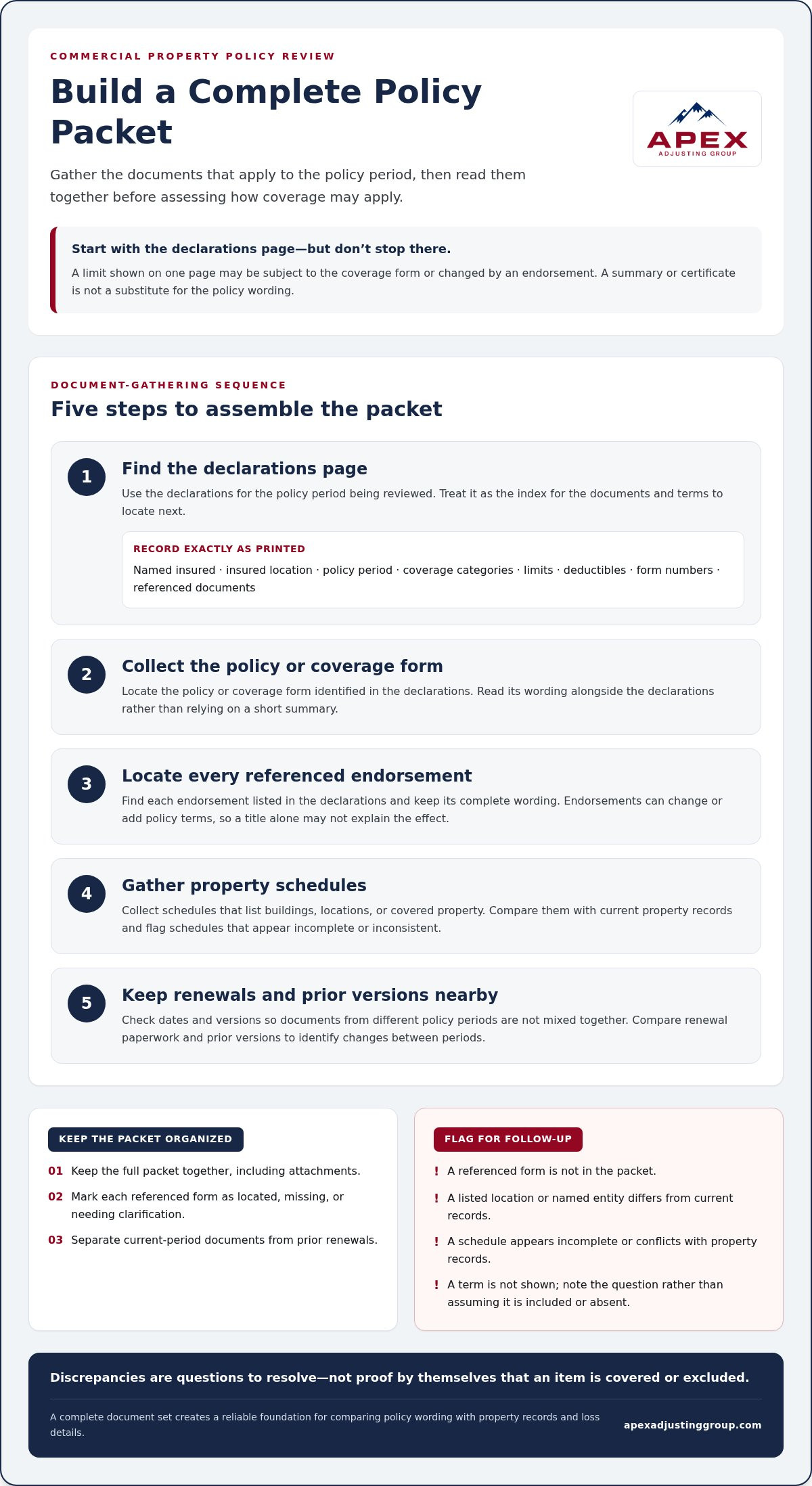
Gather the documents in a practical sequence:
- Find the declarations page for the policy period being reviewed.
- Collect the policy or coverage form identified in the declarations.
- Locate every referenced endorsement and its complete wording.
- Gather property schedules listing buildings, locations, or covered property.
- Keep renewal documents and prior versions nearby to identify changes between policy periods.
Use the declarations page as your index
Start with the named insured, insured location, policy period, and listed coverage categories. Record each limit, deductible, form number, and referenced document exactly as printed. If a term isn’t shown, mark it for follow-up rather than assuming it is included or absent.
Then compare the listed locations and named entities with current records. A building may have changed ownership, a business name may have changed, or a location may have been added or removed. Flag differences for review; don’t assume that a similar address or entity name means the records match.
Match each form, endorsement, and schedule
Use the form numbers and titles in the declarations to organize the packet. Endorsements can change or add policy terms, so read the attached wording itself rather than relying on a short title or summary. A broad introduction to property insurance concepts is available in Understanding Property Insurance Basics, but the issued policy wording controls the review of a specific claim.
Check that the documents correspond to the policy period under review. Compare dates and versions, and note any form listed in the declarations that isn’t in the packet. Also flag schedules that appear incomplete or conflict with current property records. These are questions to resolve, not proof by themselves that a particular item is covered or excluded.
- Keep a copy of the full packet together, including attachments.
- Mark each referenced form as located, missing, or needing clarification.
- Separate current-period documents from prior renewals to avoid mixing terms.
This document-by-document check creates a reliable foundation for the next step: matching policy descriptions to the buildings, contents, and operations affected by a loss.
Read Commercial Property Coverage by Building, Contents, and Use
A policy may list a location or a broad property category without identifying every building, asset, or business activity at that site. To see how those descriptions line up with the property, compare the policy wording with deeds, leases, inventories, and current site details. The policy language, endorsements, and facts of the loss all matter when assessing how coverage may apply.
A listed property category does not, by itself, settle whether a specific loss is covered. A building may be described, for example, while a disputed equipment item raises a separate question about ownership, location, or applicable terms. The Guide to Commercial Property Insurance Coverage offers broader context, but the issued policy and loss facts guide a specific review.
Check building and business personal property descriptions
Find the sections and schedules that describe buildings and business personal property, often abbreviated as BPP. Look for wording that addresses the structure, fixtures, equipment, inventory, furniture, or other business property. Then compare those descriptions with current records, not just an older asset list.
Separate owned property from leased property. A tenant’s equipment, a landlord-owned fixture, and a leased machine may be treated differently under the policy or related agreements. Don’t assume that a general contents label answers who owns an item or how its loss is addressed.
Flag property that appears omitted, outdated, or described differently. For example, note when an inventory shows equipment at one location but a schedule identifies another, or when a lease assigns responsibility for a fixture differently from the property records. These discrepancies call for review, not an automatic conclusion about coverage.
Connect property use to the policy wording
Check how the policy identifies each location and any described operations. Compare that language with current site conditions: a warehouse may now include a production area, or a previously vacant portion may be occupied. Renovations, changes in occupancy, and newly acquired property can raise questions about whether the policy’s descriptions and terms fit the facts.
Build a simple comparison record for each affected location:
- Policy location description and listed property categories
- Current use, occupancy, and relevant site changes
- Deed or lease details and who owns or maintains affected items
- Inventory or asset records showing where property is located
Keep the source documents alongside the comparison, and mark any conflict without trying to resolve it by assumption. For broader claim context, the commercial property claim service addresses property damage claims involving business locations and property. Owners with an active or recent claim can also use Apex Adjusting Group’s free claim review.
Separate Covered Causes, Exclusions, Limits, and Valuation Terms
A cause of loss can’t be assessed from a single phrase pulled out of the policy. The coverage grant, causes-of-loss form, exclusions, exceptions, endorsements, limits, and valuation wording may all affect how a specific damaged item is handled. Read those provisions together, then compare them with the event and property involved.
Use this comparison to keep distinct policy terms from getting blurred:
Covered-cause wording: Identifies the causes of loss addressed by the applicable form. Check whether the policy uses named-cause wording or broader wording, then read its conditions and exclusions.
Exclusions: Identify causes, property, or circumstances the policy says it does not cover. Read any exceptions or endorsements that may affect the exclusion.
Limit: Sets a maximum amount for a covered category or location, subject to the policy’s terms and claim facts.
Sublimit: Applies a more specific limit to a particular property type, event, or expense when stated in the policy.
Deductible: Describes an amount or method that may apply to a covered loss before payment is calculated. Check the wording for the applicable cause or category.
Valuation: States how covered property may be valued for a loss, subject to conditions and other policy provisions.
Trace a cause of loss through the policy
Locate the coverage grant and the causes-of-loss form referenced for the affected location. Follow the wording through related exclusions, exceptions, and endorsements. A sentence that appears to exclude a cause may have an exception nearby, while an endorsement may revise only specified terms.
Record the event and damaged property next to each provision that may apply. For example, distinguish damage to a roof from damage to inventory inside the building; the relevant wording or limits may differ. Mark unclear wording and the exact item or event it concerns. Don’t declare a cause covered or excluded without reviewing the complete policy and loss facts.
Compare limits, deductibles, and valuation language
Keep the overall limit separate from any category-specific sublimit. A listed building limit, for instance, doesn’t by itself answer whether a separate sublimit applies to a particular type of property or expense. Note the deductible stated for the relevant coverage and cause, and flag wording that appears to set different terms.
Check whether the applicable valuation provision refers to replacement cost or actual cash value (ACV). Replacement-cost wording generally concerns repair or replacement without a depreciation deduction, while ACV wording may account for depreciation. The exact definitions, conditions, and payment provisions in the policy control, so don’t assume either label alone determines the calculation.
Also flag coinsurance or similar conditions for careful review. Their effect depends on the specific wording and facts, including the property values and coverage shown in the policy. This is a practical part of how to read your commercial property insurance policy: identify the provision, connect it to the affected property, and preserve questions that need a closer claim review.
Turn Policy Language Into a Focused Property and Loss Review
A policy review is more useful when each provision is tied to a specific damaged area, building component, or business item. Owners learning how to read a commercial property insurance policy can follow a consistent sequence: identify the affected property, locate the potentially relevant provision, gather supporting records, and write down what remains unclear. Keep observations separate from conclusions about cause or coverage.
Work through the loss in an orderly way:
- Identify the affected building, area, equipment, inventory, or other property.
- Find the policy wording that may relate to that property and the reported event.
- Gather photographs and records that show condition, location, ownership, or repair activity.
- List unresolved questions, linking each one to a specific item and policy provision.
Documentation can support a careful review, but it doesn’t determine coverage on its own. The complete policy wording and facts of the loss still matter.
Build a property-specific evidence file
Keep evidence organized by building, affected area, and issue. Take wide photographs to show where damage is located, then close views to capture visible details. Include relevant building features, affected equipment, and inventory. Preserve original photo files where practical, and note the date, location, and item shown without guessing at the cause or repair scope.
Group supporting records with the property or issue they concern. Useful materials may include:
- Inventories, asset records, and ownership details
- Repair estimates, invoices, and other claim documents
- Maintenance and inspection records
- Leases, location records, and relevant correspondence
For example, file photographs of damaged equipment with the related inventory record and any estimate addressing that equipment. This makes it easier to see which facts are documented and which still need clarification. Similarly, routine inspection documentation—such as reports from UK Fire Risk Assessments for UK business properties—helps verify that physical safety standards and risk inspections were systematically maintained prior to any incident.
Create a question list from policy discrepancies
Compare observed conditions and claim documents with the relevant policy descriptions. Note differences between locations, property schedules, records, and the actual site. Write down the provision that raises a question and the specific item or damage it may affect. This keeps follow-up focused instead of leaving a general concern with no clear reference point.
Questions might identify an item shown in an inventory but absent from a property schedule, or ask which wording applies to a damaged building component. Keep the question neutral. A mismatch calls for review; it doesn’t establish whether the loss is covered or excluded.
For claim-specific review of policy issues and supporting documentation, owners can learn about commercial property claims. An organized file connects each question to the relevant property, evidence, and policy language.
Know When a Commercial Policy Review Could Help Your Claim
A closer review may help when the damage scope is unclear, a specific item is disputed, or the claim documents don’t match property records. These are reasons to organize the file and compare the reported loss with the policy wording, not proof that a particular item is covered or excluded.
A policy question concerns what a term says or how property is described. A claim disagreement concerns how reported damage has been evaluated. The issues can overlap, so both call for attention to the policy, supporting records, and facts about the loss. A careful review can identify the specific point that needs follow-up without predicting a coverage or settlement outcome.
Distinguish a policy question from a claim disagreement
An owner may be unsure whether a scheduled location matches the damaged site. That’s a policy and record question. If the location is clear but a damaged item is disputed or omitted from the claim evaluation, that’s a claim-scope disagreement. Keep each concern tied to the affected property and relevant documents.
A public adjuster represents the property owner in a first-party property damage claim. Apex Adjusting Group reviews commercial property claims on the owner’s behalf and charges a contingency fee, a percentage of the recovery, only when a recovery is obtained.
Request a review with organized documents
Gather the materials that connect the policy to the reported damage. An organized file helps clarify what’s documented, what’s disputed, and which questions remain open.
- The policy packet, including declarations, forms, endorsements, and schedules
- Claim correspondence and documents describing the damage evaluation
- Photographs of affected areas, building details, equipment, or inventory
- Relevant property records, such as leases, inventories, and maintenance documents
A claim review can assess how the policy language, property records, and claim documents relate to the specific loss. It doesn’t guarantee a particular coverage decision or result. Apex Adjusting Group offers free claim evaluations for owners with active or recent commercial property claims.
Make Your Policy Review a Useful Claim Record
Keep a working record as the claim develops. Add new correspondence, estimates, and inspection findings to the same file, and update the question list when a response clarifies or raises an issue. This creates a clear trail from each concern to the affected property and supporting document.
Use how to read your commercial property insurance policy as a practical process, not a one-time search for a single answer. If an unclear provision, disputed damage item, or mismatch remains, preserve the exact wording and records connected to it. A focused file can help a claim reviewer assess what has been documented and what still needs closer attention.
An unresolved question doesn’t mean the owner has to sort through every policy term alone. A review can bring the policy language, property details, and claim record into focus without assuming what the final coverage decision should be.
With the right questions clearly documented, the next step can feel more manageable.
Frequently Asked Questions
What is the declarations page in a commercial property insurance policy?
The declarations page is the policy’s quick-reference summary, not a complete account of every coverage term. It usually identifies the named insured, policy period, locations, coverage categories, limits, deductibles, and referenced forms. For example, a listed building limit can help identify the relevant coverage section, but it doesn’t explain every condition that may affect a loss. Use it as an index, then check the forms it references.
Does a commercial property policy cover a tenant's improvements?
It may, depending on the policy wording, who owns the improvements, the lease, and the loss facts. A tenant-installed partition, built-in counter, or upgraded electrical system may be treated differently from the landlord’s original building components. Compare the lease’s ownership and maintenance terms with the policy’s property definitions and schedules. For a claim, keep invoices, lease provisions, and photos showing the improvements together for a focused review.
What does a coinsurance clause mean in a commercial property policy?
A coinsurance clause generally links the amount of insurance carried to a stated proportion of the property’s value, and falling short may affect payment for a partial loss. The calculation and any consequences depend on the clause’s exact wording, the values used, and the claim facts. Don’t assume the building limit alone answers whether the requirement is met. Flag the clause and the valuation records for careful review.
Can an endorsement change the terms shown in the main policy form?
Yes. An endorsement can add, remove, or revise terms in a policy form, but its effect depends on its wording and scope. For example, it may modify a provision for a specified location or property category without changing every other policy restriction. Check the endorsement’s form number, effective period, and complete text, then read it alongside the provision it references. A title alone doesn’t establish what changed.
How can a business tell whether its policy lists every insured location?
Compare the locations named in the policy and its schedules with the business’s current property records, leases, and operating site list. Check for recently acquired sites, storage areas, or locations under a related business entity, and note any address or entity-name mismatch. A certificate or summary may not show all policy details. The issued policy documents are the place to verify listed locations.
Should a business owner review the policy again after a property change?
Yes. A new location, renovation, change in occupancy, or major equipment purchase can make existing property descriptions or schedules worth revisiting. Keep records of what changed and when, such as a lease amendment, updated inventory, or renovation documents, then compare them with the policy packet. This helps surface questions early. For businesses with locations in California, Arizona, Washington, Idaho, or Nevada, review each relevant policy and location schedule with Apex Adjusting Group.
Need Help with Your Insurance Claim?
Our licensed public adjusters can help you get the maximum settlement you deserve. Contact us today for a free claim evaluation.
Related Articles