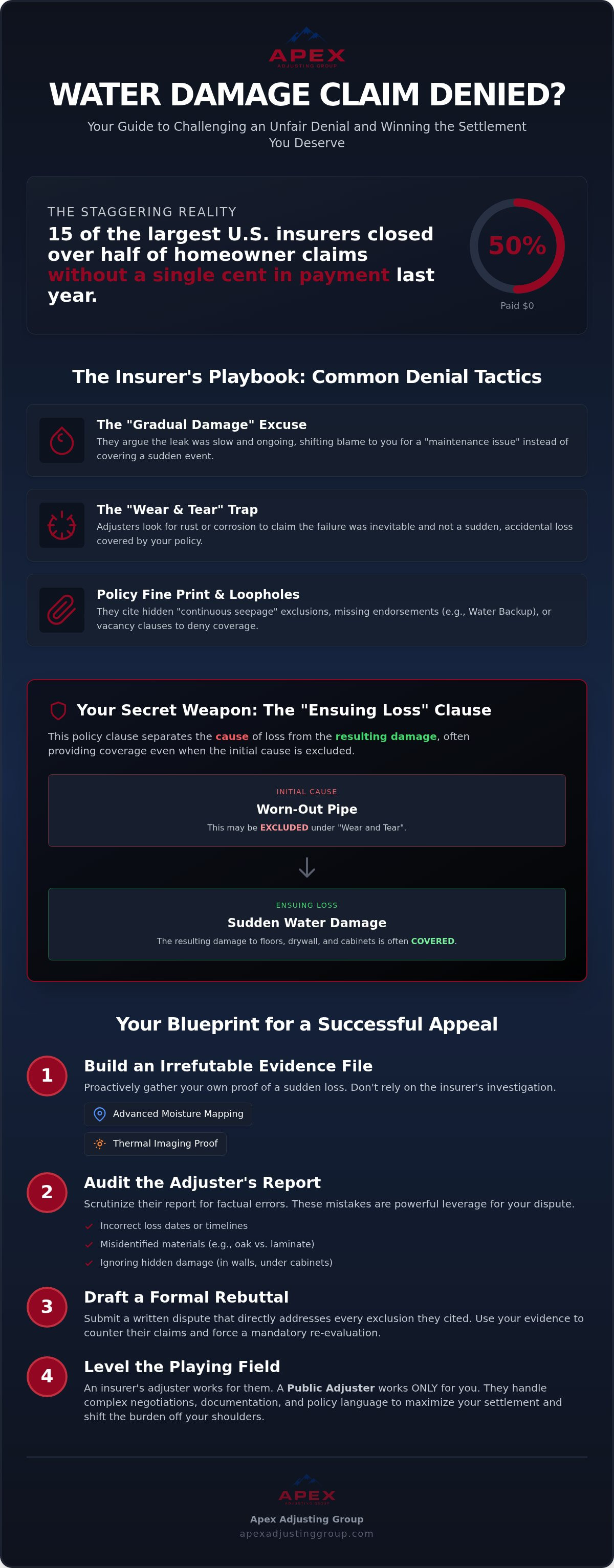
Did you know that fifteen of the largest U.S. insurers closed at least 50% of homeowner claims without a single cent in payment last year? It's a staggering reality for property owners in 2026. If you've just found your water damage claim denied, you're likely feeling the crushing weight of repair costs and the frustration of being ignored by a massive corporation. You paid your premiums; they're playing games. It's a high-stakes environment where your own policy is being used as a weapon against your recovery.
We agree that feeling lowballed and buried under complex jargon is unacceptable. You deserve a champion to shoulder this burden and restore your peace of mind. This article promises to show you exactly how to challenge an unfair denial using professional adjustment strategies and specific policy leverage. We'll break down the exact steps to force a re-evaluation, expose the flaws in "gradual damage" excuses, and explain how expert advocacy turns a flat rejection into the settlement you're legally owed. Stop being a victim of the system and start fighting for your property.
Key Takeaways
- Identify the "wear and tear" trap by distinguishing between gradual seepage and sudden leaks to challenge the insurer's default position.
- Search your policy for "Ensuing Loss" clauses that provide a critical backdoor to coverage even when a primary exclusion is cited.
- Use advanced moisture mapping and thermal imaging to prove the sudden nature of the loss and build an irrefutable evidence file.
- Draft a formal rebuttal letter addressing every cited exclusion directly to force a mandatory re-evaluation of your water damage claim denied.
- Partner with a licensed public adjuster to level the playing field and shift the burden of negotiation off your shoulders.
Common Reasons for Water Damage Claim Denials
Receiving a letter stating your water damage claim denied feels like a direct betrayal of the contract you've paid for. Insurers aren't your friends; they're businesses focused on minimizing their own financial loss. They often default to "gradual seepage" because it's the easiest way to shut down a file. This tactic shifts the blame from a failing system to your alleged negligence as a homeowner. Gradual damage is a maintenance exclusion used to shift liability. If they can prove the water was dripping for weeks, they don't have to pay a dime.
The "Wear and Tear" trap is equally dangerous. Adjusters look for rust on pipes or corrosion on water heaters to argue that the damage was inevitable. They want to see a lack of maintenance rather than a sudden, accidental burst. Understanding the Insurance Claims Process is vital here because the burden of proof often falls on you to show the damage was an isolated event. Don't let them bully you into accepting their timeline. If you wait too long to report the loss or fail to dry out the area immediately, they'll use "failure to mitigate" to kill your claim entirely.
The "Gradual Damage" vs. "Sudden Leak" Debate
Standard ISO policies define "sudden and accidental" as an event that happens quickly and without warning. It's the difference between a pipe exploding and a pinhole leak behind a wall. Adjusters use moisture patterns and mold growth to claim the damage is long-term. They'll use thermal imaging or simple visual cues like rotted wood to deny coverage. You need a professional water damage expert to counter these findings with hard data. We fight these assumptions by proving the timeline of the event was instantaneous.
Maintenance Exclusions and Policy Endorsements
Burying exclusions in the fine print is a standard industry practice. For example, many standard policies exclude "Water Backup" unless you specifically purchased an endorsement. If a sump pump fails or a sewer line backs up, you're out of luck without that rider. Vacancy clauses also create massive gaps; if your property is empty for 30 or 60 days, most water damage coverage vanishes. Check your policy for hidden language regarding "continuous or repeated seepage." These phrases are landmines designed to protect the insurer's bottom line while leaving your property in ruins.
Decoding Your Denial Letter: Identifying Insurance Overreach
Your denial letter isn't a final legal verdict. It's a strategic document designed to protect the insurer's financial reserves. When you see your water damage claim denied, the first step is stripping away the intimidation. Review the specific sections of your policy they've highlighted. Often, adjusters cherry-pick exclusions while ignoring the "Exceptions to Exclusions" that actually apply to your loss. If they are misrepresenting facts or failing to acknowledge your evidence, you might be looking at bad faith. It happens when insurers fail to conduct a thorough investigation or ignore clear evidence of a covered peril. Demand transparency and don't let complex jargon stop your recovery.
The Power of the Ensuing Loss Clause
This clause is the most overlooked weapon in your policy. It acts as a critical safety net when an excluded event causes a separate, covered loss. For example, if your policy excludes damage from "wear and tear" on an old pipe, the insurer will likely deny the cost of the pipe itself. However, the water that escapes that pipe is a separate peril. The pipe is the cause, the water is the peril. Under an ensuing loss provision, the damage to your hardwood floors, drywall, and cabinetry remains covered even if the pipe repair is not. Demand that your adjuster explain why they're ignoring this distinction. It often forces them to reverse a blanket denial on the spot.
Spotting Factual Errors in the Adjuster’s Report
Insurance adjusters are often overworked and incentivized to move quickly. This leads to sloppy reporting. Examine their findings for incorrect loss dates or misidentified materials. If they labeled your high-end oak flooring as cheap laminate, the settlement value drops instantly. They also tend to ignore what they can't see. Look for these common factual failures:
- Failure to use moisture meters or thermal imaging in adjacent rooms.
- Ignoring "hidden" damage behind baseboards, under kitchen islands, or inside wall cavities.
- Incorrectly applying depreciation to items that should be replaced at full value.
These omissions are grounds for a formal dispute. Accurate documentation of Water Damage Claims is the only way to stop this overreach. If you find your report is riddled with inaccuracies after having your water damage claim denied, you need a professional claim review to correct the record before the window for appeal closes.
Strategic Documentation: Building an Irrefutable Evidence File
When you find your water damage claim denied, basic cell phone photos of a wet carpet won't cut it. You're up against an multi-billion dollar industry that relies on technicalities to avoid payouts. You must fight back with professional-grade documentation. Move beyond static images. Capture high-definition video walkthroughs and 3D scans of the affected areas before any demolition begins. These digital records provide a comprehensive view of the loss that an adjuster can't easily dismiss or "forget" during their review. Every missed detail is money left on the table. Build a file that makes it impossible for them to look away.
Scientific Evidence vs. Visual Inspection
Visual inspections are subjective and often biased in favor of the insurer. You need hard data. Thermal imaging cameras are the "smoking gun" for hidden water intrusion. They reveal temperature anomalies behind drywall and under cabinetry that the naked eye misses. Use moisture meters to track the exact path of a leak from the source through the subfloor. Professional moisture mapping provides a timestamp of the damage. This scientific approach proves the "suddenness" of the event, directly countering the common "gradual seepage" excuse used to keep your water damage claim denied. It turns your argument from an opinion into a documented fact.
The Problem with Insurer Estimating Software
Insurers almost exclusively use software like Xactimate or Symbility to calculate repair costs. While these tools are industry standard, they are frequently manipulated. Adjusters may use "builder's grade" pricing for custom materials or omit necessary line items like debris removal and specialized drying equipment. This creates a massive gap between the carrier's estimate and real-world contractor pricing. You must obtain an independent, line-itemized estimate from a professional who understands the true cost of restoration. For more on this, review our guide on the Burst Pipe Insurance Claim Process to see how real-world data beats lowball software outputs.
Finally, maintain a rigorous communication log. Record the date, time, and name of every person you speak with at the insurance company. Summarize every phone call in a follow-up email. This paper trail is vital if the dispute escalates. It prevents the insurer from "losing" your evidence or claiming they never received your rebuttals. Force them into a position where they must address your evidence or admit to a flawed investigation. This level of organization shifts the power balance back into your hands.
Step-by-Step: How to Dispute a Denied Water Damage Claim
A denial letter is a negotiation tactic, not a final judgment. When you find your water damage claim denied, the first move is to demand a formal, written explanation. Don't accept a vague "not covered" over the phone. You need the specific policy language and the factual basis for their decision in writing. This forces the carrier to commit to a position they must then defend with evidence. If they can't justify their stance with hard data, they've already lost the upper hand. Hold them to the contract you've paid to maintain.
Drafting the Rebuttal Letter
Your rebuttal letter is your counter-attack. Address every cited exclusion directly using the professional evidence you've gathered from thermal imaging and moisture mapping. Use their own policy language to prove coverage, specifically pointing out any "ensuing loss" provisions they conveniently ignored. Attach your independent repair estimates to highlight the gap in their valuation. Set a firm 14-day deadline for a written response. This creates a paper trail that proves you're proactive and prepared to escalate if they continue to stonewall your recovery.
Invoking the Appraisal Process
When a deadlock occurs over the "amount of loss," look for the Appraisal Clause in your policy. This is a formal dispute resolution process designed to settle valuation disagreements without the need for court. You hire an appraiser, the insurer hires one, and together they select a neutral umpire to make a final, binding decision. It's a powerful tool to bypass a stubborn adjuster and secure a fair market value for your repairs. For a deeper look at why initial offers fall short, read our guide on Water Damage Claim Settlement strategies.
Don't settle for the first rejection. Request a re-inspection with a senior adjuster or a field supervisor. Entry-level adjusters often lack the technical expertise to identify complex structural damage or understand the "suddenness" of a pipe failure. Bringing in a supervisor often forces a more thorough, professional review of the file. It sends a clear signal that you won't be intimidated by high-pressure tactics or confusing jargon.
Fighting an insurance giant alone is an uphill battle. They count on you giving up when the process gets difficult. Don't let them win by default. If you're struggling to make progress after having your water damage claim denied, you need an ally who knows their playbook. Contact us today for a free claim evaluation and let a licensed professional take the burden off your shoulders.
Level the Playing Field: Why You Need a Public Adjuster
The insurance company has a team of experts working to minimize your payout. You are likely standing alone with a water damage claim denied letter and a massive repair bill. It's a rigged game. A company adjuster works for the insurance carrier; their loyalty is to their employer's profit margin. A public adjuster works exclusively for you. We are licensed professionals who step into the ring to defend your interests. We don't just ask for more money. We prove why you're legally owed it. This is about shifting the power dynamic back in your favor.
Apex Adjusting Group: Your Champion in the Fight
We take the entire burden off your shoulders. From the moment we take your case, we handle all communication, documentation, and high-stakes negotiation with the insurer. Whether you're managing a complex commercial property loss in Seattle or a residential disaster in Los Angeles, our expertise in Water Damage Insurance Claim Help ensures no technicality is left unchallenged. We specialize in re-opening and reversing denied claims by identifying the errors and overreach discussed in previous sections. You focus on your life; we focus on your recovery.
The ROI of Professional Representation
Represented claims average significantly higher settlements because we know the true cost of restoration and the exact language to defeat lowball offers. We operate on a "No Recovery, No Fee" model. This contingency structure means there is zero out-of-pocket risk for you. We only get paid if we secure a settlement. This levels the playing field, giving you access to expert witness services and professional appraisal without upfront financial strain. We act as a proactive force, combining technical precision with the grit of a dedicated negotiator.
The emotional toll of a property loss is draining. Don't let the insurance company's bureaucracy break your spirit. We serve clients throughout the Western US, including Southern California, Arizona, and the Pacific Northwest. If you've had your water damage claim denied, it's time to stop being polite and start being professional. Take the first step toward a fair settlement right now. Get a Free Claim Evaluation from Apex Adjusting Group and put an authoritative expert in your corner.
Reclaim Your Recovery and Force a Fair Settlement
A water damage claim denied letter is a tactical hurdle, not a final dead end. You now have the knowledge to challenge insurer overreach by identifying factual errors and leveraging "Ensuing Loss" clauses. Scientific documentation like thermal imaging and moisture mapping provides the irrefutable evidence needed to break a valuation deadlock. Don't let complex policy language or lowball software estimates dictate your financial future. It's time to shift the burden off your shoulders and onto ours.
You deserve a dedicated ally who understands the insurer's playbook and isn't afraid to challenge it. Apex Adjusting Group provides the steady hand you need in a crisis. Our licensed public adjusters serve clients across CA, AZ, WA, TX, and NV with a relentless commitment to maximizing payouts. We operate on a No Recovery, No Fee guarantee, ensuring you have professional advocacy without any financial risk. Your recovery depends on decisive action and expert negotiation.
Don’t take "No" for an answer. Get a FREE claim evaluation from Apex Adjusting Group today.
Take back control of your property restoration. We are ready to fight for the settlement you were promised and ensure your home or business is fully restored.
Frequently Asked Questions
Can I reopen a water damage claim that was already denied?
Yes, you can absolutely reopen a claim if you discover new evidence or if the initial investigation was flawed. Many property owners in the Western US, including cities like Los Angeles and Seattle, successfully reverse denials by providing professional moisture mapping or independent repair estimates. We act as a proactive force to challenge the insurer's initial rejection and force a formal re-evaluation of your file based on the true scope of damage.
What is the most common reason water damage claims are denied?
The most frequent excuse insurers use is "gradual seepage" or "wear and tear." Carriers default to this maintenance exclusion to shift liability onto the property owner and protect their financial reserves. They often use visual cues like rust or mold to argue the damage happened over weeks rather than being a sudden event. Proving the "suddenness" of the loss is the primary battlefield when you find your water damage claim denied.
How long do I have to appeal a denied insurance claim?
Appeal timeframes are dictated by state law and your specific policy language. In states like California and Washington, the window to appeal or file suit is often governed by specific policy provisions that can shorten the standard state statute of limitations. While the general limit for property damage in many Western states is three years, your policy's "Suit Against Us" clause might limit you to just one or two years from the date of loss. Act with urgency to preserve your rights.
Does homeowners insurance cover water damage from a leaking roof?
Standard policies generally cover the resulting interior damage if a covered peril, like wind or hail, created the opening in the roof. However, insurers rarely pay for the roof repair itself if the leak resulted from age or lack of maintenance. In regions with extreme weather like Arizona or the Pacific Northwest, adjusters scrutinize whether the breach was sudden or a result of long-term neglect. You must document the specific cause of the breach to secure a payout.
Is mold covered if my water damage claim was denied?
Mold is typically treated as a secondary peril. Most policies only cover mold remediation if it stems directly from a covered water loss. If the insurer successfully denies the underlying water claim, they will automatically reject the mold portion as well. You must reverse the primary water denial first. We use thermal imaging to prove the mold resulted from a sudden event, forcing the insurer to acknowledge the full scope of the disaster.
What is an "Ensuing Loss" clause and how does it help me?
An "Ensuing Loss" clause is a critical safety net that provides coverage for a separate peril following an excluded event. If an old pipe fails due to wear and tear, the pipe repair itself is excluded, but the resulting water damage to your floors and walls remains covered. It prevents a single exclusion from swallowing the entire claim. Use this clause to fight back when an adjuster tries to issue a blanket denial on your property.
Should I hire a lawyer or a public adjuster for a denied claim?
Public adjusters focus on the technical valuation and direct negotiation of the claim. We handle the documentation and moisture mapping that lawyers typically don't touch. While we don't provide legal representation, we level the playing field by acting as your expert advocate. Our contingency model means you pay nothing unless we secure a recovery. This approach often resolves disputes much faster and more efficiently than entering a years-long court battle in major cities.
Will my insurance rates go up if I dispute a denial?
Disputing a denial is your contractual right and generally does not trigger an individual rate hike. Insurance premiums are typically adjusted based on regional risk factors and total claim frequency across a broad pool of policyholders. Fear of rate increases is a common reason people accept a water damage claim denied without a fight. Don't let intimidation tactics prevent you from securing the settlement you have already paid for through years of premiums.
Need Help with Your Insurance Claim?
Our licensed public adjusters can help you get the maximum settlement you deserve. Contact us today for a free claim evaluation.
Related Articles