That hairline crack in the drywall isn't just a cosmetic nuisance. It's often the first warning sign of a compromised foundation or shifted framing. After the ground stops shaking, property owners face a second disaster in the form of a complex earthquake damage insurance claim process. High deductibles and dense policy language regarding earth movement make recovery feel like an impossible climb.
It's common to feel overwhelmed when serious damage is dismissed as simple settling. This guide provides the expert clarity needed to navigate recovery, from initial documentation to final negotiation. It details how to identify hidden signs of damage that adjusters often overlook and how to interpret specific policy provisions that impact the payout. This article also explains how contingency-based representation allows owners to access professional expertise with no out-of-pocket payment. Expert guidance takes the burden off the owner's shoulders and helps ensure the property is restored to its actual pre-loss condition.
Key Takeaways
- Learn how to manage the earthquake damage insurance claim process by identifying specific policy deadlines and mandatory response timelines.
- Discover how to distinguish between superficial cosmetic issues and the hidden structural damage that compromises long-term property value.
- Understand how independent appraisals provide the technical evidence needed to challenge underpaid or denied claims.
- Evaluate the benefits of contingency-based representation that allows owners to access expert adjusters with no out-of-pocket payment.
- Identify the essential documentation required for a free claim review to ensure all seismic damage is properly accounted for.
Navigating the Earthquake Damage Claim Timeline
The clock starts the moment the shaking stops. Property owners must act with precision to preserve their right to a full recovery. Managing the earthquake damage insurance claim process requires more than just calling an agent. It involves strict adherence to technical requirements and deadlines that standard property claims don't share. Most policies include a 72-hour aftershock clause. This provision treats all seismic activity within a three-day window as a single occurrence with one deductible. Don't rush into permanent repairs before this window closes.
Initial Damage Documentation and Reporting
Document every inch of the property before moving debris or starting clean-up. Take high-resolution photos of foundation cracks, separated siding, and interior wall shifts. Use a high-powered flashlight to check crawlspaces and attics for splintered framing or displaced piers. Standard homeowner policies typically exclude earth movement. You must verify if your coverage is through a separate policy or a specific Earthquake insurance endorsement.
Secure the property to prevent secondary losses like water intrusion from broken pipes or rain. Keep every receipt for emergency mitigation efforts. You generally have 12 months to file a claim, but this extends to 24 months for residential claims during a declared state of emergency. Missing these windows can result in a total loss of benefits. Prompt reporting is your best defense against claims of "pre-existing damage."
Managing the Carrier Adjuster Visit
Carrier adjusters represent the insurance company's interests. They frequently view structural shifts as pre-existing settlement or cosmetic wear. Be prepared to point out fresh cracks and structural anomalies during the inspection. Demand a copy of the adjuster's field notes and their initial estimate before they leave. California law requires insurers to acknowledge your claim within 15 days and decide on the claim within 40 days of receiving proof of loss.
Undisputed amounts should be paid within 30 days of acceptance. If the carrier's assessment seems inadequate, you may need a supplemental assessment. This is where professional earthquake damage claims expertise becomes vital. Experts can identify sub-surface structural issues that a cursory carrier inspection will miss. Don't accept a settlement until a technical expert provides a free claim review to verify the scope of work. Expertise is the primary weapon in ensuring your property is restored to its actual pre-loss condition.
Identifying Structural vs Cosmetic Earthquake Damage
Insurers often dismiss structural shifts as superficial plaster cracks to minimize their financial exposure. This mischaracterization is a primary hurdle in the earthquake damage insurance claim process. A hairline crack in a wall might look cosmetic, but it often signals that the building's skeleton has moved. Structural masonry failure occurs when the bond between bricks or blocks breaks. This compromises the entire wall's load-bearing capacity. Owners must look beyond the paint to find evidence of shifted framing in the attic or displaced piers in the crawlspace.
Navigating the earthquake damage insurance claim process requires documenting these hidden failures before the carrier closes the file. Carrier adjusters often lack the time or incentive to crawl into tight spaces. They may overlook the subtle signs of a compromised building envelope. You must be the advocate for your property's integrity.
Foundation and Slab Damage Indicators
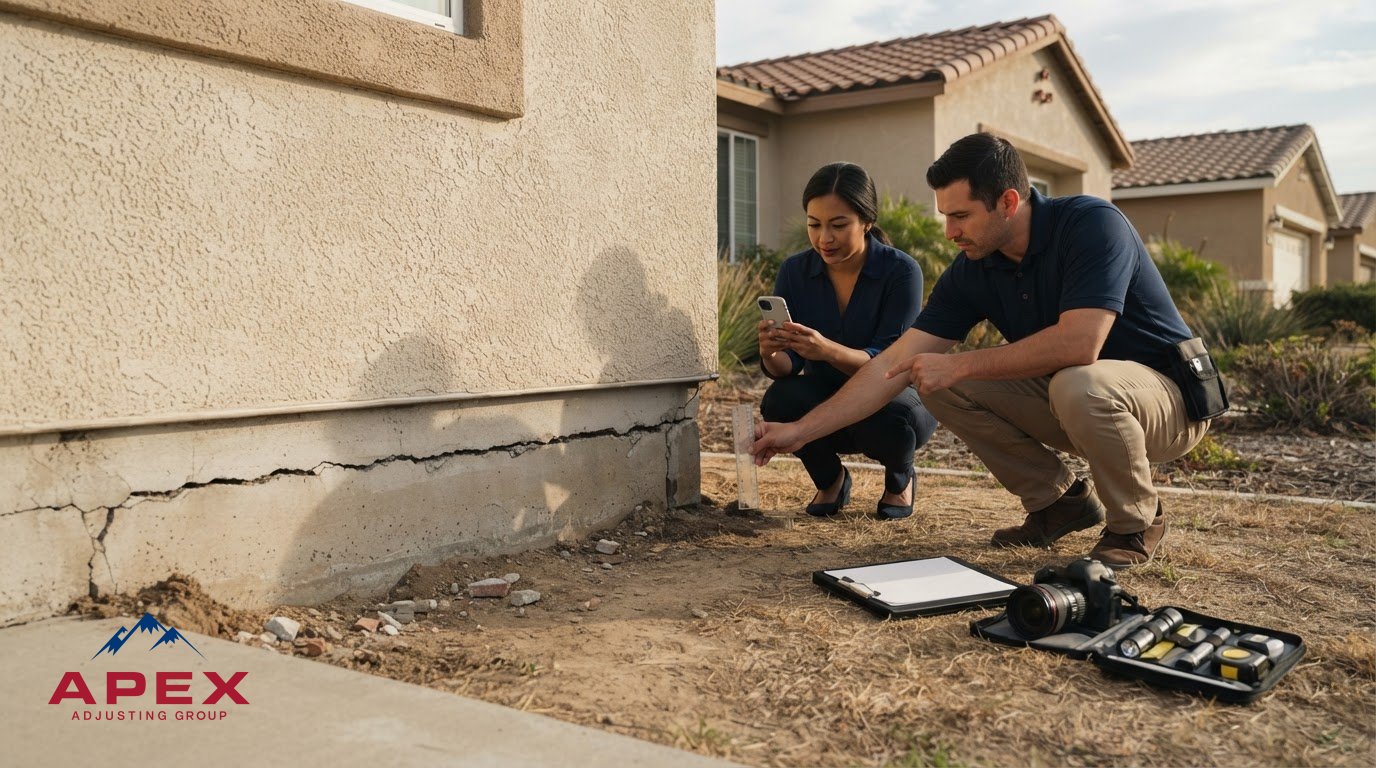
Inspecting the concrete slab is non-negotiable for any property owner in seismic zones. Look for hairline fractures that cross the entire floor or gaps where the wall meets the floor. These aren't just "settling" issues. Use a level to check for building tilts that indicate the foundation has dipped or shifted. Chimney separation is another major red flag. If there is even a sliver of daylight between the chimney and the siding, the structure has moved. Following the steps to take after an earthquake involves detailed inspections of these critical transition points.
Hidden System Failures Post-Earthquake
Damage isn't always visible on the surface. Seismic waves can shear underground waste lines or pull supply pipes just enough to cause slow, destructive leaks. Gas line connections and safety valves are high-risk points that require immediate professional inspection to prevent fires. Older masonry buildings face unique structural collapse risks where the mortar has turned to dust. Insurers frequently attempt to categorize these failures as pre-existing wear and tear.
Technical evidence is the only way to combat these denials. Professional adjusters look for "fresh" breaks in the dust and debris to prove the timing of the loss. Identifying these issues requires an eye for detail and specialized knowledge of building codes in states like California and Nevada. If you're unsure if a crack is structural, a professional claim evaluation can provide the technical clarity needed to move forward. Don't let a carrier adjuster convince you that a compromised foundation is just a cosmetic flaw.
The Role of a Public Adjuster in Earthquake Recovery
Insurance companies employ teams of engineers and adjusters trained to protect the bottom line. Property owners need an equal force on their side to avoid being steamrolled by complex bureaucracy. A public adjuster acts as a fierce advocate, taking control of the communication and technical documentation required for a successful recovery. They manage every interaction with the insurer to prevent the administrative delays that often plague the earthquake damage insurance claim process. By handling the heavy lifting, these experts allow the owner to focus on immediate recovery while the technical case for a full settlement is built.
Independent Damage Assessment and Estimating
Detection of structural misalignments requires more than a visual scan. Experts use specialized equipment like laser levels and digital manometers to prove the building is out of plumb. This technical data forms the basis of a comprehensive line-item estimate. Unlike carrier estimates that often use generic national averages, these estimates reflect current local construction costs in high-demand seismic zones. For owners dealing with San Jose earthquake damage claims, this localized accuracy is the difference between a partial fix and a full restoration. Every cracked stud and shifted pier is accounted for in the final scope of work.
Negotiating Policy Provisions and Endorsements
Understanding the fine print is a primary weapon in any claim. Public adjusters interpret 'Replacement Cost Value' provisions to ensure the settlement reflects today's prices, not depreciated values. They also identify 'Ordinance or Law' coverage. This is critical because post-earthquake repairs often trigger mandatory seismic code upgrades that standard policies may not initially cover. If the carrier refuses to acknowledge the full scope of damage, a public adjuster can initiate the insurance appraisal process. This formal mechanism challenges underpaid assessments by using independent experts to resolve disputes without the need for litigation. Representation levels the playing field and forces the carrier to address the actual cost of structural repairs.

No Recovery No Fee: Managing Claim Costs and Risks
Earthquake insurance is unique because of its high entry cost for the policyholder. Deductibles in states like California often range from 10% to 25% of the total dwelling coverage. This creates a massive financial barrier for property owners already dealing with the stress of a seismic event. Navigating the earthquake damage insurance claim process requires technical experts, but paying for engineers and appraisers out of pocket is impossible for many.
A contingency fee model solves this problem by removing all upfront costs for professional representation. It allows the policyholder to fight for a fair settlement without risking their remaining savings. It's a results-driven system that prioritizes the client's financial recovery over billable hours. This alignment of interests ensures that your adjuster is as committed to a full recovery as you are.
Understanding Contingency-Based Representation
Fees in this model are calculated as a percentage of the final settlement obtained from the insurance carrier. If the adjuster doesn't secure a settlement, the property owner owes nothing. This structure ensures the adjuster's interests are perfectly aligned with the owner's goal of maximizing the claim. It eliminates the risk of paying for an expert who doesn't deliver results.
Owners can find more details on when to hire a public adjuster through our resource center. This approach allows owners to focus on the immediate needs of their families or businesses while the technical work proceeds. It removes the stress of managing complex carrier correspondence during an already high-stakes recovery period.
The Value of Expert Advocacy Without Out-of-Pocket Expense
A major benefit of this model is the access it provides to a network of structural engineers and seismic specialists. These experts are necessary to prove the scope of damage, yet their fees can be substantial if hired independently. Under a contingency agreement, the adjusting firm handles the coordination and costs of these specialists. This professional advocacy is essential for residential claims where the carrier has initially underpaid or denied coverage.
Managing the earthquake damage insurance claim process correctly involves proving that structural shifts are directly related to the seismic event. Using a no recovery no fee public adjuster ensures that every structural crack is documented without draining the owner's bank account. It levels the playing field against the insurance company's nearly limitless resources. You get the benefit of a seasoned negotiator and a technical team at zero initial risk.
Starting Your Earthquake Damage Claim Evaluation
The final phase of the earthquake damage insurance claim process is the most critical. It's the point where technical evidence meets negotiation. Many property owners realize their initial settlement offer was based on a surface-level inspection that missed significant structural shifts. Reopening a claim or disputing an underpayment requires a methodical approach to documentation. It's not enough to claim the offer is too low. You have to prove the deficiency with line-item detail and engineering data.
Experts provide the technical precision needed to challenge a carrier's findings. This evaluation determines if your policy's replacement cost provisions are being honored. It also identifies if the carrier overlooked mandatory code upgrades required for seismic repairs. Taking this step ensures you aren't left paying out of pocket for damage the insurance company should cover.
Preparing for Your Free Claim Review
Organization is your primary weapon during a claim dispute. Before meeting with a public adjuster, gather every piece of paper the insurance carrier has sent you. This includes the full policy, the specific earthquake endorsement, and all digital correspondence. Having these documents ready allows for a faster assessment of your recovery options. You should organize the following items for the review:
- All carrier estimates and adjuster field notes.
- Formal denial letters or underpayment notices.
- Your own timestamped photos and videos of the damage.
- Preliminary bids from licensed contractors for structural repairs.
Accessing a Free Claim Review allows an expert to compare your current policy language against the carrier's actual offer. This step identifies gaps in the scope of work that often lead to significant unpaid repairs. It's a no-risk way to determine if your claim has been properly adjusted.
Taking Control of Your Property Recovery
Shift from a state of distress to an empowered position by leveling the playing field. The insurance company has experts on their side. You deserve the same level of advocacy. Professional representation ensures that every structural detail, from foundation hairline cracks to roof-to-wall connections, is accounted for in the settlement. This is especially vital for complex urban properties where seismic forces are amplified by building density.
If you're managing a San Francisco Earthquake Claim or a loss in other Western U.S. locations, local building codes are a major factor. An expert consultation provides a clear roadmap for your recovery. It clarifies the specific policy provisions that apply to your unique loss. Don't accept a settlement that fails to cover the actual cost of structural repairs. Start the evaluation process today to ensure your property's long-term integrity is protected.
Secure Your Structural Recovery
Recovering from a seismic event requires more than just filing paperwork. It demands a technical understanding of how buildings shift and fail under pressure. This guide has detailed how to identify hidden signs of structural compromise and why the earthquake damage insurance claim process often stalls without professional intervention. By utilizing technical appraisals and specialized equipment, property owners can challenge underpaid assessments and ensure that every structural detail is accounted for in the final settlement.
Apex Adjusting Group serves as a fierce advocate for policyholders throughout the Western U.S. As licensed public adjusters in states like California, Washington, Arizona, and more, we specialize in maximizing recovery for earthquake and structural collapse losses. Our contingency fee model means you access expert engineers and negotiators with no out-of-pocket expense. You don't have to face the insurance company's experts alone.
Take the burden off your shoulders and put your recovery in the hands of seasoned professionals. Your property's integrity is too important to leave to chance. We are ready to fight for the settlement you deserve.
Frequently Asked Questions
What is the typical deadline to file an earthquake damage claim?
Property owners generally have 12 months from the date of loss to report damage. However, for residential property claims in a declared state of emergency, the deadline to file a lawsuit is extended to 24 months. California law requires insurers to acknowledge your claim within 15 days and decide on the claim within 40 days of receiving proof of loss. Reporting damage promptly is essential to prevent carriers from arguing that the shifts are pre-existing settlement.
Can I reopen an earthquake claim if I found more damage later?
Yes, you can often reopen or supplement a claim if new damage is discovered after the initial filing. This is a standard part of the earthquake damage insurance claim process because structural shifts may not manifest clearly for several months. You must provide technical evidence that the newly discovered damage was caused by the original seismic event. A professional appraisal helps document these connections and justifies a supplemental payment for the actual repair costs.
How does a high earthquake deductible affect my insurance payout?
Earthquake deductibles are calculated as a percentage of the total dwelling coverage, typically ranging from 10% to 25%. This differs from standard flat-rate deductibles. For example, if your property is insured for $500,000 with a 15% deductible, you are responsible for the first $75,000 in repairs. Accurate damage valuation is critical to ensuring you exceed this threshold. Expert documentation helps prove that the structural damage is extensive enough to trigger a recovery from the insurer.
Do I need to hire an engineer before contacting a public adjuster?
No, you don't need to hire an engineer independently. Licensed public adjusters have an established network of structural engineers and seismic specialists they coordinate with during the investigation. Hiring an engineer on your own can be an expensive out-of-pocket cost. When you work with a firm on a contingency basis, they manage the coordination of these experts to prove the technical scope of your loss, removing the financial burden from the property owner.
What happens if the insurance company says the cracks are just 'settlement'?
This is a common tactic used to deny coverage for structural repairs. You must counter this claim with technical evidence that distinguishes between old settlement and fresh seismic shifts. Experts look for clean breaks in dust, recent separation of building materials, and specific fracture patterns. If the carrier refuses to acknowledge the earthquake's impact, you can trigger the appraisal process. This allows independent experts to determine the actual cause and scope of the damage.
Is there a fee if the public adjuster cannot increase my settlement?
No, there is no fee under a contingency model if a recovery is not obtained. This ensures the public adjuster's interests are aligned with yours. They only receive payment as a percentage of the final settlement successfully negotiated for the client. This "no recovery, no fee" approach allows property owners to access professional expertise without the risk of losing more money. It provides a steady hand during the earthquake damage insurance claim process at zero initial risk.
Does homeowners insurance automatically include earthquake coverage?
Standard homeowners and commercial property policies do not include earthquake coverage. Most policies specifically exclude damage from "earth movement." You must purchase a separate policy or a specific endorsement to be covered for seismic events. In California, insurers are required to offer this coverage every two years. If you don't have this specific endorsement active at the time of the loss, your carrier will likely deny any claim related to seismic activity.
What is the difference between a public adjuster and a lawyer in a claim?
Public adjusters are licensed professionals specializing in the technical valuation and negotiation of property damage claims. They focus on building codes, repair estimates, and policy provisions to settle claims directly with carriers. They don't provide legal representation or file lawsuits. Lawyers focus on litigation and legal strategy. A public adjuster's goal is to resolve the dispute through technical evidence and the appraisal process. This provides a faster, more direct path to recovery without the need for litigation.
Need Help with Your Insurance Claim?
Our licensed public adjusters can help you get the maximum settlement you deserve. Contact us today for a free claim evaluation.
Related Articles