
A business interruption insurance claim can be difficult to support when the business is closed but the financial impact is unclear. A shutdown alone doesn’t establish how much income was lost, which expenses continued, or whether the policy covers the cause. Many policies tie coverage to direct physical loss or damage, but the wording and endorsements matter. The file needs to connect the damage, the operational disruption, and the claimed financial loss.
Financial records show different parts of that story, and an insurer’s calculation may not reflect every documented impact. A clear timeline, relevant policy language, and consistent financial evidence help explain what changed and why.
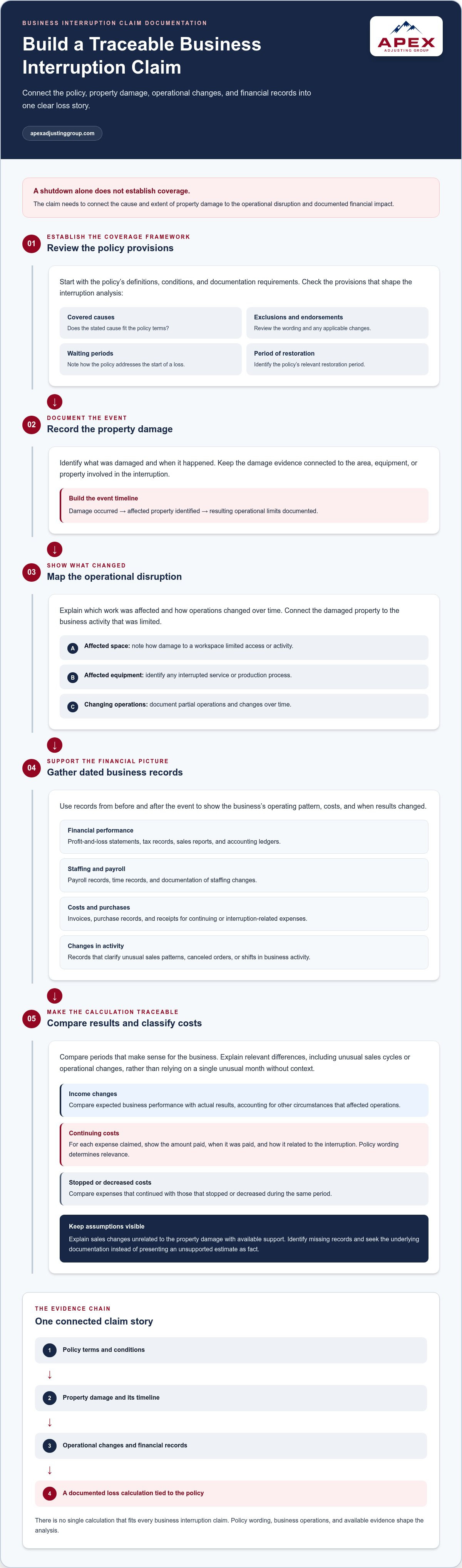
This guide covers policy provisions to review, including covered causes, exclusions, waiting periods, and the period of restoration. It also explains how profit and loss statements, tax returns, payroll records, sales reports, and expense invoices can support the calculation. The aim is to make the claimed loss traceable to both the business records and the property damage.
Key Takeaways
- A business interruption insurance claim needs evidence connecting the disruption, covered property damage, and claimed financial loss.
- Compare pre-loss and post-loss financial records to distinguish interruption-related losses from ordinary business fluctuations.
- Review the policy’s coverage terms, exclusions, and restoration period; a shutdown alone doesn’t establish coverage.
- Organize a loss timeline, damage documentation, insurer communications, and records supporting the calculation.
- A public adjuster can review the property damage scope, claim documents, and insurer’s loss calculation on the property owner’s behalf.
Business interruption insurance claims: identify the loss behind the shutdown
After property damage, rent, payroll, loan payments, and other obligations may continue even when operations stop. The claim needs to show which financial effects resulted from the interruption and how the policy addresses them. A business interruption insurance claim isn’t established by showing only that the business closed. The policy language, the cause and extent of the damage, and the documented operational impact all matter.
Business interruption coverage may apply to qualifying income loss following covered damage, subject to the policy’s terms. Many policies tie coverage to direct physical loss or damage to insured property, but terms, exclusions, endorsements, and conditions vary. A revenue decline during a shutdown doesn’t by itself show that the policy covers the loss. For a general overview of common concepts, see Business interruption insurance.
What a business interruption claim may address
Lost business income is evaluated under the policy’s definitions and conditions. The analysis may compare expected business performance with actual results during the interruption, while accounting for other circumstances that affected operations. Use records that show the business’s usual pattern and identify what changed after the damage.
Continuing operating expenses may also be relevant when the policy wording supports their inclusion. Payroll, extra expense, and other costs aren’t treated the same way under every policy. For each expense claimed, keep records showing the amount paid, when it was paid, and how it related to the interruption. Compare those costs with expenses that stopped or decreased during the same period.
Why property damage and operations belong in one claim story
Connect the physical damage to the operational change, then connect that change to the financial impact. For example, damage to a workspace may limit access to that area, while damage to equipment may interrupt a particular service or production process. Identify what was damaged, which work was affected, and how operations changed over time.
Business interruption coverage may address income loss and related costs when the policy wording and documented facts support coverage for an interruption caused by covered property damage.
Set out the events in order: the damage, its effect on the premises or equipment, the resulting operational limits, and the financial impact. This keeps the property damage and income loss connected without treating them as the same part of the claim.
How to document business interruption losses with financial records
A supportable loss calculation needs more than a revenue total. Connect the interruption period to the property damage, operational changes, and dated financial records. Organize records from before and after the event so the comparison shows what changed, when it changed, and how the disruption affected the business.
Start with the policy’s definitions, conditions, and documentation requirements. The California Department of Insurance’s FAQ on Business Interruption Insurance emphasizes reviewing the policy to understand the coverage. There isn’t one calculation that fits every business interruption insurance claim. Policy wording, business operations, and available evidence shape the analysis.
Which business records can help support the claim
Gather records that show financial performance and costs incurred during the interruption. Depending on the policy and circumstances, useful documents may include:
- Profit-and-loss statements, tax records, sales reports, and accounting ledgers.
- Payroll records, time records, and documentation of staffing changes.
- Invoices, purchase records, and receipts for continuing or interruption-related expenses.
- Records that clarify unusual sales patterns, such as canceled orders or shifts in business activity.
Dated documents help establish operating patterns and pinpoint when results changed. Compare periods that make sense for the business, and explain relevant differences, such as a recent operational change or an unusual sales cycle. Avoid relying on a single unusual month as the baseline without explaining why it is representative.
How to connect records to the interruption
Build a timeline linking the property damage to business activity and financial results. Record when the damage occurred, which areas or equipment were affected, what operations changed, and how those changes appear in sales, payroll, and expense records. Note partial operations and changes over time rather than treating the interruption as one unchanged period.
Separate the analysis into income changes, continuing costs, and expenses the business avoided. A cost that continued may be relevant under the policy, while a cost that stopped or decreased can affect the calculation. Tie each item to supporting records and applicable policy terms instead of assuming every expense or revenue decline qualifies.
Make assumptions visible. If sales varied for reasons beyond the property damage, explain those circumstances and include available support. If a ledger, invoice, or other record is missing, identify the gap and seek the underlying documentation rather than presenting an unsupported estimate as fact.
Does a business shutdown automatically qualify for coverage?
No. A business closing its doors does not, by itself, establish that a policy covers the resulting income loss. As commercial risk specialists at Paterson Insurance Brokers note, the review must consider the cause of the interruption, any related property damage, the policy’s coverage terms and exclusions, and the facts documented in the claim file.
Start with the actual policy and the insurer’s written position, not a general assumption about what business interruption insurance covers. The basics of a business interruption claim can help frame the issues, but policy language and circumstances control each file. A provision that applies in one situation may not apply in another.
What to review in the policy and claim file
Locate the business income and extra expense provisions, along with relevant exclusions, conditions, and endorsements. Check whether the policy defines a period of restoration or another time-based limit, and note how that language relates to the documented interruption. Civil authority or dependent-property provisions may also warrant review when the facts and policy wording make them relevant.
Organize what is established, what remains unclear, and which policy language may address each point:
| Confirmed facts | Unresolved questions | Policy provisions to review |
|---|---|---|
| Damage documented at the insured property | Which operations were affected, and when? | Business income coverage and covered cause |
| Sales or operating activity changed | What other factors contributed to the change? | Exclusions, conditions, and definitions |
| Some expenses continued or changed | Which costs are supported and relevant? | Extra expense and expense treatment |
| Access or a related property was affected | Does the policy address these circumstances? | Civil authority or dependent-property terms |
How to distinguish a coverage issue from a calculation dispute
A coverage dispute asks whether the policy may apply to the documented cause and circumstances. A calculation dispute concerns the amount, time period, income assumptions, or expense treatment. Keep those issues separate: a disagreement about the loss calculation does not, on its own, resolve whether coverage applies.
Compare the insurer’s stated position with the specific policy wording and records supporting the claim. Identify the provision cited, the facts relied on, and any documents that clarify the disputed point. Don’t treat a clause as a universal rule across policies or states. A public adjuster can review the damage scope, documentation, and calculation; policy-specific interpretation should be addressed by an appropriately qualified professional.
Prepare a business interruption claim file and respond to questions
A disorganized file makes it harder to track what was submitted, what remains outstanding, and how a payment or coverage position was reached. Keep a clear record of the damage, business impact, financial support, and claim communications. Respond accurately to requests, and check the policy and correspondence for stated response dates rather than assuming a universal deadline.
Build an organized claim timeline
Use a dated timeline to connect the property damage with changes to business operations and the records supporting them. Mark uncertain dates or missing documents clearly. Don’t present estimates as established facts.
- Preserve records. Keep copies of accounting records, payroll documents, invoices, repair and mitigation records, and operational reports relevant to the interruption.
- Build the timeline. Record when damage was discovered, when operations changed, what mitigation activity took place, and when important claim communications arrived.
- Organize damage evidence. Save photographs of affected areas and equipment, including wide views that show location and closer images of visible damage. Pair them with available invoices, reports, and other dated records.
- Review the calculation. Compare the submitted income and expense support with the insurer’s calculation or follow-up questions. Note differences and identify the records that support each point.
Keep a copy of every submission and communication, with a brief note about what information was requested and how the response addressed it. This record can reduce confusion if the file is reviewed or updated later.
Review a payment, delay, or denial without losing the file thread
Start with the insurer’s stated rationale. Identify the policy language, dates, damage evidence, or financial documents it references, then compare those points with the materials already submitted. If the response identifies missing information, document what is available and address gaps with supporting records rather than guessing.
Separate questions about whether the policy may apply from questions about the amount of the loss. Keep the damage evidence, operational timeline, and calculation connected so it’s clear what supports the claim and what still needs a response. A well-maintained file also makes it easier to trace each communication and update the record as new information becomes available.
How a public adjuster can review a business interruption claim
A business interruption file raises two connected issues: what property was damaged, and how did that damage affect income and expenses? A public adjuster represents the property owner in a first-party property damage claim, not the insurance company. The review can bring the damage scope, operational timeline, financial records, and insurer’s loss calculation into one documented picture.
What a public adjuster contributes to the claim review
A public adjuster can examine whether the property damage documentation supports the reported scope and whether the business records explain the claimed interruption. That can include comparing the damage and operational timeline with financial records, then reviewing how the insurer’s calculation treats income, ongoing expenses, and the claimed period.
The adjuster can also communicate and negotiate with the insurer on the property owner’s behalf within the public adjusting role. Public adjusting is not legal representation, and no particular coverage decision, recovery, or amount can be guaranteed. Apex Adjusting Group handles commercial property claims in California, Arizona, Washington, Idaho, Colorado, Texas, and Nevada.
Deciding whether a professional review could help
A review may be useful when the damage scope is disputed, the income calculation is unclear, the claim is delayed, or the submitted file has gaps. It can help identify which records support the claimed loss, what assumptions need explanation, and whether the insurer’s calculation reflects the documentation provided. For an overview of the process, see the public adjuster role and process.
Apex Adjusting Group works on a contingency fee, charging a percentage of recovery, with no fee unless a recovery is achieved. A free claim evaluation can help clarify the file’s documentation, damage scope, and calculation, without guaranteeing a particular result.
Put the evidence behind your business interruption claim
A business interruption insurance claim is easier to evaluate when the file connects covered property damage to disrupted operations and documented financial loss. The policy wording matters, and a business shutdown alone doesn’t establish coverage. Organize dated financial records, damage evidence, and a clear timeline to show what changed and when.
Keep income changes, continuing expenses, and costs the business avoided distinct. Compare the insurer’s calculation with the policy provisions and records submitted. Clear documentation can show what supports the claim and which issues still need attention.
Apex Adjusting Group is a licensed public adjusting firm representing property owners, including commercial property owners. Its commercial claims review can assess damage scope, claim documentation, and the insurer’s calculation. The firm offers free claim evaluations and charges a contingency fee only when recovery is achieved.
Apex Adjusting Group reviews commercial property claims for owners in Southern California, Arizona, Spokane, San Jose, Phoenix, San Francisco, Las Vegas, Oakland, Tucson, Seattle, Orange County, Idaho, Sacramento, Los Angeles, and Reno. Request a free claim review to discuss the file and its supporting evidence.
Frequently Asked Questions
What does business interruption insurance typically cover?
Business interruption coverage may address lost business income and certain continuing operating expenses after a covered event, subject to the policy’s terms. Some policies also address extra expenses incurred to reduce or resume the interruption. Payroll, ongoing bills, and other costs aren’t automatically covered under every policy. To explore how commercial coverage works across different types of operational risks, check out AllCover Insurance Brokers. Review the business income and extra expense provisions, exclusions, and conditions to identify which loss components the specific policy may address.
Does business interruption insurance require physical property damage?
Many policies tie coverage to direct physical loss or damage to insured property from a covered cause. Policy wording and endorsements vary, so the specific contract and circumstances matter. Civil authority coverage, for example, may depend on an order following physical damage to nearby property. A closure connected only to reduced access, a government action, or a supply chain disruption doesn’t establish coverage by itself.
How do you calculate a business interruption insurance claim?
There’s no single calculation that applies to every business interruption insurance claim. The analysis follows the policy’s definitions and conditions and may compare expected business performance with actual results during the interruption. Review sales and income records alongside continuing expenses and costs the business avoided. The documented interruption period, applicable policy limits, and business circumstances can affect the calculation, so explain and support assumptions rather than treating them as universal rules.
What documents are needed for a business interruption claim?
Useful records may include profit-and-loss statements, tax records, sales reports, accounting ledgers, payroll documents, invoices, and purchase records. Keep dated documents that show operating patterns before the loss and changes during the interruption. Property damage photographs, repair or mitigation records, and operational reports can help connect the physical damage to the business impact. Organize the records around the policy provisions and information requested for the claim.
Can a business interruption claim be denied even if the business closed?
Yes. A shutdown alone doesn’t prove that the policy covers the interruption or resulting income loss. The decision may depend on whether the cause and property damage meet the policy terms, whether an exclusion or condition applies, and whether the claimed impact is documented. Review the stated reason for the decision alongside the cited policy language and claim records. Coverage depends on the specific wording and facts, not the closure alone.
Can a public adjuster help with a business interruption insurance claim?
Yes. A public adjuster represents the property owner and can review the damage scope, claim documents, business records, and insurer’s loss calculation, then communicate and negotiate on the owner’s behalf. Apex Adjusting Group handles commercial property claims and is licensed in California, Arizona, Washington, Idaho, Colorado, Texas, and Nevada. Its local relevance includes Southern California, Arizona, Spokane, San Jose, Phoenix, San Francisco, Las Vegas, Oakland, Tucson, Seattle, Orange County, Idaho, Sacramento, Los Angeles, and Reno.
What should I do if my business interruption claim is underpaid or delayed?
Keep the claim file organized and retain a written explanation of the insurer’s position, calculation, or outstanding questions. Compare that information with the policy language and records already submitted. Gather relevant missing documents, such as sales reports or invoices, and respond accurately to requests while tracking dates stated in the policy or claim correspondence. A public adjuster may review the damage scope, documentation, and calculation to help clarify unresolved issues.
Need Help with Your Insurance Claim?
Our licensed public adjusters can help you get the maximum settlement you deserve. Contact us today for a free claim evaluation.
Related Articles