Your insurance company is not your friend; they are a corporation protecting their profit margins at your expense. After a fire, you are likely facing a mountain of paperwork and the terrifying realization that your carrier's "fair" offer won't even cover the foundation of your rebuild. You need to know how to maximize fire insurance claim payouts before you sign a single release form. You feel the pressure to settle quickly just to move on, yet you know that missing a single detail today could mean paying for hidden structural damage out of your own pocket years from now.
We understand that you're exhausted and overwhelmed. This guide is your weapon to level the playing field. You will learn the same aggressive documentation and technical strategies that professional adjusters use to force carriers to pay every dollar owed. We'll show you how to navigate the 2024 NFPA 921 standards and account for the 76.8% surge in fire claim severity seen in 2025. From uncovering hidden soot particles to bypassing inventory "short cuts," we provide the roadmap to secure the full settlement you deserve and the peace of mind that nothing was missed.
Key Takeaways
- Understand the inherent conflict of interest between you and the carrier's adjuster to protect your financial recovery from the start.
- Learn the high-stakes documentation techniques used to build an unassailable inventory and discover how to maximize fire insurance claim settlements by proving every loss.
- Identify the corrosive, long-term effects of hidden smoke and soot damage that insurance companies often attempt to overlook or minimize.
- Weaponize the "Appraisal Clause" in your policy to bypass deadlocked negotiations and force a professional resolution to value disputes.
- Leverage the expertise of a licensed public adjuster who works exclusively for you on a contingency basis to ensure your interests are the priority.
The Harsh Reality of Fire Insurance Claims
A fire is a catastrophic event that shatters your sense of security. To your insurance carrier, however, it is simply a high-stakes liability. While you focus on rebuilding your life, they focus on minimizing their financial exposure. This inherent conflict of interest is the first hurdle you must clear. Understanding how to maximize fire insurance claim payouts starts with a cold realization: the person sent to "help" you is actually there to protect the company's bottom line. You're in a fight for the resources you paid for through years of premiums. Stop thinking of the carrier as a partner and start seeing them as the opposition in a financial negotiation.
The Conflict of Interest: Who Does the Adjuster Work For?
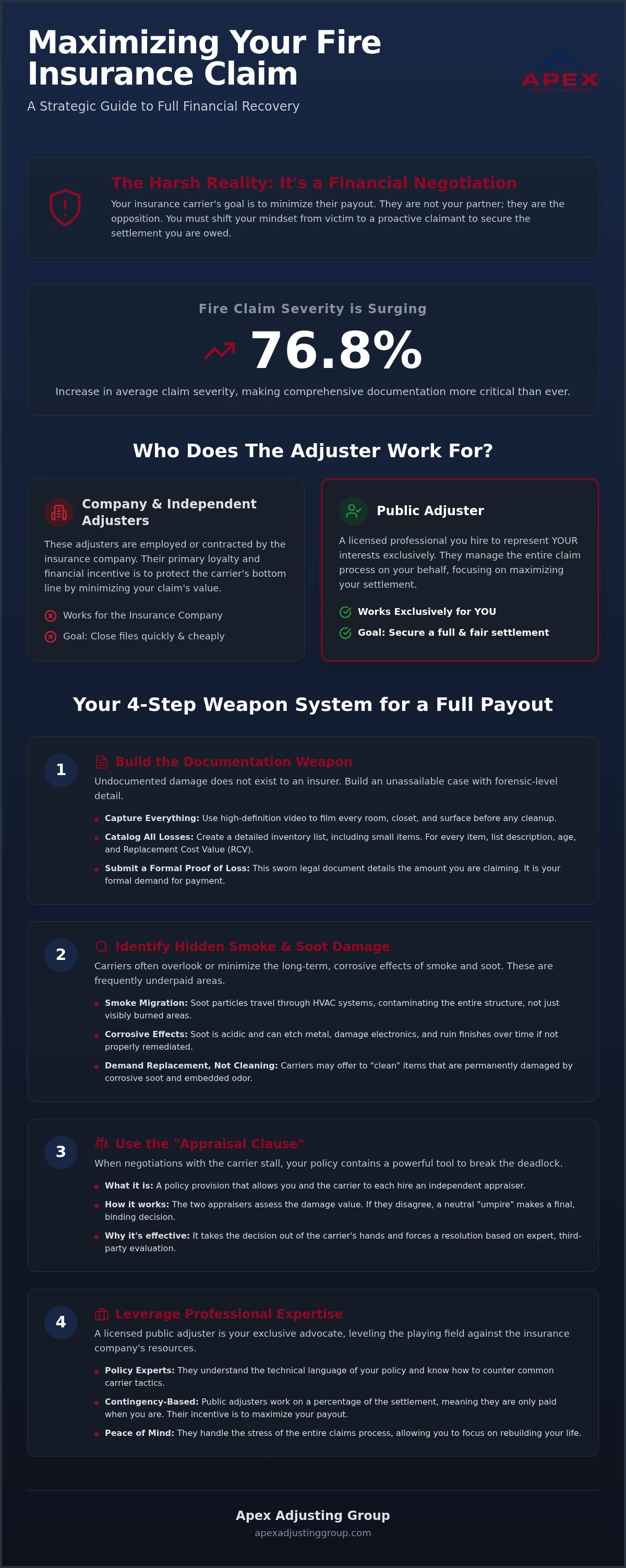
Don't assume the adjuster at your door is your advocate. There are three types of adjusters in this industry, and only one answers to you. Company adjusters are direct employees of the carrier. Independent adjusters are third-party contractors hired by the carrier. Both have a primary loyalty to the insurance company. While fire insurance policies imply a duty of good faith, the reality is that carriers are profit-driven entities. They often use "friendly" tactics to build false trust. They may discourage you from seeking outside help or pressure you to sign documents before you understand your rights. This is a strategic move to close the file before the true scope of damage is revealed. Only a licensed public adjuster works exclusively for the policyholder's interests.
Why Fire Claims are Frequently Underpaid
Fire claims are the most complex property losses in existence. They involve more than just visible charring; they involve chemical reactions and structural compromises. In 2025, fire and lightning claim severity rose by 67.3%, yet many policyholders still receive lowball offers. Carriers frequently use the "partial loss" trap. They offer to clean items that should be replaced or ignore smoke migration that has compromised the HVAC system. These hidden costs can surface years later, long after you've signed away your right to more money.
Adjusters face internal pressure to close files quickly and cheaply. They often rely on "Actual Cash Value" (ACV) calculations that heavily depreciate your property, rather than the "Replacement Cost Value" (RCV) you need to actually rebuild. If you remain passive, you'll be underpaid. You must transition from a victim to a proactive claimant who understands the technical nuances of the policy. This guide provides the high-stakes strategies used to force insurance companies to pay every dollar you're owed. Don't settle for "fair" when you're entitled to a full recovery. Use how to maximize fire insurance claim strategies to ensure your settlement covers the real cost of your loss.
Building the Documentation Weapon: How to Prove Your Loss
Documentation isn't just a chore; it's your primary offensive weapon. In the eyes of the carrier, undocumented damage is non-existent. To master how to maximize fire insurance claim payouts, you must present a case that is impossible to ignore. This requires more than a simple list of charred furniture. It demands a forensic-level catalog of your entire life before the fire. You are building a technical dossier that forces the insurance company to acknowledge every dollar of loss.
The Comprehensive Fire Loss Inventory
- Step 1: Capture the evidence. Walk through every room with a high-definition camera before any cleanup begins. Film the ceilings, the floors, and the inside of every closet. High-resolution video provides undeniable proof of the condition and quality of your belongings.
- Step 2: Catalog the "invisible" losses. Don't forget high-end electronics, designer apparel, and the contents of your pantry. While some policies or specific circumstances might offer limited contents coverage without a full inventory, for most claims, a detailed list is the only way to get paid.
- Step 3: Use real-world data. Don't guess at prices. Use current market data to establish value. Replacement Cost Value is the price to buy the item new today.
If the technical burden of cataloging thousands of items feels impossible, seeking professional fire damage claim assistance can ensure no detail is overlooked. Professional adjusters use specialized software to ensure your inventory matches the current inflation-adjusted costs of 2026.
The Proof of Loss Statement: Your Formal Demand
The Proof of Loss is a sworn statement of the amount you are claiming. This document is legally significant. It must include the date of loss, the cause, and the total value of the damaged property. Accuracy is non-negotiable. Any discrepancy here can be used by the carrier to allege fraud or stall your payment.
Deadlines are lethal. Many policies require this document within 60 days of the carrier's request. Missing a filing date can kill your claim entirely. Always leave room for supplemental claims. Fire damage is progressive. Hidden soot or structural issues often surface weeks after the initial filing. Ensure your initial demand preserves your right to adjust the total as new evidence emerges. This proactive stance is essential for how to maximize fire insurance claim results.
Maintain a meticulous chronological log. Record every phone call, email, and site visit from the carrier. Note the date, the time, and exactly what was promised. Carriers rely on your memory fading as the process drags on. Don't give them that advantage. A clear record of communication prevents the adjuster from "forgetting" verbal agreements or shifting their story later in the process.
Identifying Hidden Fire and Smoke Damage
Your insurance carrier's favorite tactic is to ignore what they can't see. They'll tell you that if there isn't a charred hole in the wall, the room is fine. That's a dangerous lie. Fire damage is rarely limited to the point of ignition. Smoke and soot are corrosive, invasive, and toxic. Learning how to maximize fire insurance claim settlements requires you to look beyond the visible flames and demand payment for the invisible destruction left behind. If you don't fight for a forensic inspection, you'll be left living in a toxic environment while the carrier keeps your money.
Beyond the Char: Soot, Ash, and Chemical Residue
Smoke is a pressurized gas. During a fire, it forces its way into every crack, crevice, and wall cavity. Your HVAC system often acts as a delivery vehicle, pushing microscopic soot particles into rooms the fire never touched. These particles aren't just "dirty." They're chemically reactive. When fire retardants or plastic materials burn, they create acidic residues that can etch glass, pit metal, and degrade structural wood over time. Surface cleaning is often a temporary fix for a permanent problem.
- Porous materials are sponges. Insulation, drywall, and unfinished wood trap odors and carcinogens deep within their fibers.
- Chemical degradation. Soot combined with atmospheric humidity creates an acidic compound that eats away at electrical wiring and plumbing.
- Health risks. Inadequate remediation leaves behind particulates that trigger chronic respiratory issues long after the "cleanup" is done.
Demand that the carrier follows the 2024 edition of NFPA 921. This standard requires a systematic, science-based analysis of the fire's impact. Don't let them skip the lab tests for soot and char just to save a few dollars on your settlement.
The "Line of Sight" and Matching Principle
Insurance companies love "patch and paint" offers. They'll try to replace a single charred kitchen cabinet or a small patch of siding, leaving you with a mismatched, devalued home. You have a right to a "uniform and consistent appearance." This is the matching principle. If the carrier can't find the exact 15-year-old siding to match the repair, they may be on the hook to replace the entire exterior.
Force the issue. If smoke damaged the ceiling in an open-concept living area, they don't just paint a square around the damage. They must paint the whole continuous surface to ensure a match. This is a critical component of how to maximize fire insurance claim payouts. You aren't just restoring a building; you're restoring your property's market value. Never accept a repair that leaves your home looking like a patchwork quilt. Demand a full replacement that returns your property to its pre-loss condition, both structurally and aesthetically.
Strategic Negotiation and the Appraisal Clause
Negotiation is not a polite conversation. It's a high-stakes confrontation where the carrier expects you to blink first. If you want to know how to maximize fire insurance claim settlements, you must stop "asking" for what's fair and start demanding what's contractual. When the carrier presents an offer that doesn't align with reality, you move from negotiation to formal dispute resolution. You need to leverage the technical evidence you've gathered to make their lowball offer look like the bad faith tactic it is.
How to Counter the "Standard" Lowball Offer
Carriers rely on standardized software to generate estimates. These programs frequently use outdated "market rates" for labor and materials that don't reflect the 25.9% spike in all-peril claim severity seen in 2025. Don't accept their numbers as gospel. Secure independent, detailed bids from licensed contractors who understand the current local rebuilding environment. Use these bids to challenge the carrier's line items. Force them to provide a written explanation for every discrepancy. If they claim a roof can be patched for a specific price, demand they name a contractor willing to do the work for that amount. This shift in burden puts the carrier on the defensive.
Invoking the Appraisal Clause to Break a Deadlock
When a carrier refuses to budge on the value of your loss, you have a powerful tool: the Appraisal Clause. This is a contractual right found in most standard policies. It bypasses the adjuster entirely. In this process, you hire an independent appraiser, the carrier hires theirs, and the two appraisers select a neutral "Umpire." A decision by any two of the three is binding. This process focuses strictly on the dollar amount of the loss, not policy coverage. It's faster and often more effective than filing a lawsuit. If you're stuck in a stalemate, you need professional insurance appraisal services to break the deadlock and secure your recovery.
Appraisal is the nuclear option for value disputes. It levels the playing field by removing the carrier's ability to stall through their internal adjusters. By invoking this clause, you force a professional evaluation of the damage. This ensures your settlement reflects the actual cost of restoration, which is a core strategy in how to maximize fire insurance claim payouts when the carrier remains obstinate. Don't let a lowball offer be the final word in your recovery. You have the right to a settlement that covers the full cost of rebuilding, and the appraisal clause is the mechanism that forces the carrier to honor that right.
Why a Public Adjuster is the Key to Maximizing Recovery
You are outmatched. The insurance company employs teams of adjusters, engineers, and accountants to protect their interests. Attempting to handle a complex fire loss alone is like walking into a courtroom without a lawyer. To understand how to maximize fire insurance claim settlements, you must recognize that you need a professional advocate who is legally licensed to represent you. A public adjuster is the only professional in the industry with the authority to manage your claim and negotiate directly with the carrier on your behalf. We level the playing field by turning the carrier's technical complexity into your greatest advantage.
Leveling the Playing Field with Expertise
Hiring a public adjuster triggers a psychological shift in the carrier. When they realize you have professional representation, the "standard" lowball offers often disappear. We don't rely on the carrier's experts to tell us the extent of the damage. Instead, we deploy our own network of structural engineers and building consultants to prove the full scope of your loss. This technical precision makes it impossible for the insurance company to ignore legitimate damage.
Our interests are aligned with yours through a contingency-based model. This means there is no recovery, no fee. You don't pay out of pocket for our expertise. Instead, we earn a small percentage of the final settlement we secure for you. This "no-fee" approach ensures we are aggressive in our pursuit of every dollar you are owed. We handle the overwhelming paperwork, the inventory requirements, and the constant back-and-forth with the carrier so you can focus on your life.
The Apex Advantage: Your Champion in the Fire
Apex Adjusting Group is not a passive service provider. We are your champions in a high-stakes environment. We specialize in catastrophic fire damage and structural collapse claims, areas where the financial stakes are highest. Our team provides the specialized knowledge required to navigate complex commercial and residential policies. When a claim moves toward a formal dispute, we offer expert witness services to provide a steady, authoritative presence that carriers respect.
Don't let the insurance company dictate the terms of your recovery. Use the strategies in this guide and bring in a professional force to manage the process. We understand how to maximize fire insurance claim payouts because we know the system from the inside. We take the burden off your shoulders and put the pressure back on the carrier where it belongs. Secure your future by choosing an advocate who knows how to win.
Don't settle for less. Get your free fire claim evaluation from Apex Adjusting Group today.
Reclaim Your Future and Your Settlement
The carrier has a team of experts working to minimize your loss. You deserve a team working to maximize it. You've learned that documentation is your primary weapon and that hidden damage like corrosive soot can destroy your property's value from the inside out. Understanding how to maximize fire insurance claim payouts means moving from a passive claimant to an empowered advocate who refuses to accept lowball offers.
Apex Adjusting Group stands as your champion in this high-stakes environment. As a licensed public adjusting firm and expert witness and appraisal specialists, we provide the technical precision needed to force carriers to honor their contracts. We operate on a no recovery, no fee guarantee, ensuring our interests are perfectly aligned with yours. You've endured the trauma of the fire; don't let the insurance company add to that burden.
Maximize your recovery-get a free fire claim evaluation now. Take the first step toward a full rebuild and the peace of mind you deserve. You have the right to be made whole, and we have the grit to make it happen.
Frequently Asked Questions
Can I reopen a fire insurance claim if I already accepted a check?
Yes, you can typically reopen a claim unless you signed a document specifically releasing the carrier from all future liability. Accepting an initial check is often considered a partial payment toward the total loss. If you discover hidden soot or structural damage later, you can file a supplemental claim. You must act quickly and stay within your policy's reporting deadlines to ensure you don't lose your right to additional recovery.
How much does a public adjuster charge for a fire claim?
Public adjusters generally operate on a contingency basis, meaning they only get paid if you do. Their fee is a small percentage of the final settlement they recover from the insurance company. This "no recovery, no fee" model ensures that your advocate is highly motivated to secure every dollar you are owed. You don't pay anything out of pocket upfront for their specialized expertise or negotiation skills.
What should I do if the insurance company denies my smoke damage claim?
Demand a written explanation for the denial immediately. Carriers often claim smoke damage is merely "cosmetic" or "pre-existing" to avoid paying for expensive remediation. You should counter this by securing an independent forensic soot test. Use these lab results to prove the presence of carcinogens and corrosive particles. If the carrier still refuses to pay, hiring a professional advocate is the most effective way how to maximize fire insurance claim results.
How long does the fire insurance claim process usually take?
The timeline varies significantly based on the complexity of the damage and the carrier's responsiveness. While simple claims might resolve in a few months, catastrophic fire losses can take a year or longer. You can speed up the process by providing a detailed, unassailable Proof of Loss statement early. Proactive documentation prevents the carrier from using "missing information" as a stalling tactic to delay your much-needed settlement funds.
Is it worth hiring a public adjuster for a small kitchen fire?
It's often worth it because even small fires create invasive smoke that travels through HVAC systems and settles in wall cavities. A "small" loss can easily involve tens of thousands of dollars in hidden remediation costs. If your carrier's offer feels low or doesn't account for professional deodorization, an advocate can help. They ensure you aren't paying for the long-term effects of smoke damage out of your own pocket later.
What is the difference between a company adjuster and a public adjuster?
The difference is loyalty. A company adjuster is an employee of the insurance carrier and works to protect their employer's profit margins. A public adjuster is a licensed professional who works exclusively for you. They have a fiduciary duty to represent your interests alone. While the company adjuster looks for ways to save the carrier money, the public adjuster focuses on how to maximize fire insurance claim payouts for the policyholder.
Can the insurance company cancel my policy if I hire a public adjuster?
No, the insurance company cannot legally cancel your policy or retaliate against you for hiring a licensed public adjuster. You have a contractual and legal right to professional representation during the claims process. Carriers may prefer dealing with unrepresented policyholders who don't know the rules, but they cannot penalize you for leveling the playing field. Hiring an expert is a standard business practice that protects your financial interests after a disaster.
What is the appraisal clause in my fire insurance policy?
The appraisal clause is a formal dispute resolution tool used when you and the carrier disagree on the value of the loss. When invoked, both parties hire an independent appraiser, and those two select a neutral umpire. A decision by any two of these three individuals is binding. This process is designed to resolve dollar-amount disputes quickly and efficiently without the need for expensive litigation or a lengthy battle in the court system.
Need Help with Your Insurance Claim?
Our licensed public adjusters can help you get the maximum settlement you deserve. Contact us today for a free claim evaluation.
Related Articles