The insurer’s first estimate may not include the full cost of restoring damaged property. For owners figuring out how to calculate actual cash value vs replacement cost in Arizona, the first step is to separate the repair scope from the policy’s payment terms. The estimate shows the work and costs included; the policy explains how covered damage is valued.
Actual cash value is commonly calculated as replacement cost minus applicable depreciation. Replacement cost coverage may allow withheld depreciation to be recovered after repairs, subject to the policy’s requirements. The policy wording, estimate details, and claim documentation determine how the calculation applies to a particular loss. An example can clarify the math, but it cannot predict a specific payment.
This guide explains how to compare ACV and replacement cost, review depreciation and estimate line items, and organize records that support the repair scope. It also covers Arizona claim considerations and what to examine when an estimate appears incomplete. Apex Adjusting Group reviews first-party property claims on behalf of property owners, not insurance companies.
Key Takeaways
- Use the estimate and applicable policy terms to calculate actual cash value vs replacement cost in Arizona.
- Compare the estimated repair scope with documented damage before relying on the totals.
- Review depreciation, the deductible, and policy provisions separately to understand payment amounts and conditions.
- Keep dated photos, videos, receipts, repair records, and written claim communications together.
- A claim review may help clarify depreciation, omitted damage, or differences between the estimate and repair scope.
Why ACV and Replacement Cost Can Produce Different Arizona Claim Payments
An Arizona property estimate may show covered repairs at replacement cost even when the initial claim payment is lower. The difference may reflect depreciation, the deductible, or policy conditions that affect when replacement-cost benefits are paid. The estimate total and the payment are related, but they are not necessarily the same figure.
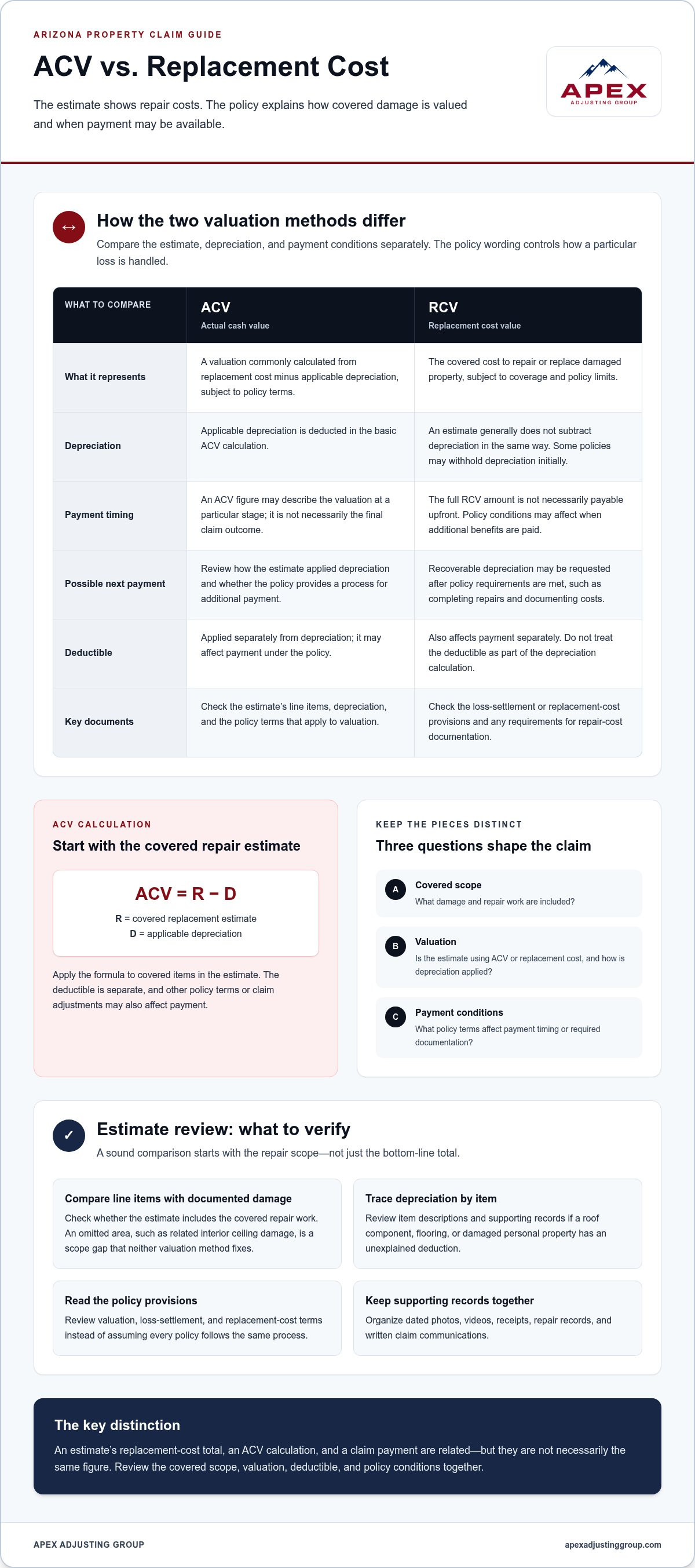
Understanding how to calculate actual cash value vs replacement cost in Arizona starts with separating three questions: What damage is covered? How does the policy value that damage? What conditions apply to payment? The estimate total alone does not answer all three.
What ACV means in a property damage estimate
Actual cash value (ACV) is commonly calculated as the replacement value of covered damaged property minus applicable depreciation, subject to the policy’s terms. Depreciation adjusts the value assigned to damaged property. The deductible is the portion of a covered loss the owner is responsible for under the policy, so it affects payment separately.
For a foundational overview, see Actual Cash Value (ACV) on Wikipedia. In a claim estimate, an ACV figure may describe the valuation at a particular stage, not the final claim outcome. Check which items are included, how depreciation was applied, and whether the policy provides a process for additional payment.
What replacement cost means under a policy
Replacement cost value (RCV) refers to the covered cost to repair or replace damaged property, subject to the policy’s coverage and limits. Unlike an ACV calculation, an RCV estimate generally does not subtract depreciation in the same way. That does not mean the full RCV amount is payable upfront.
Some policies make replacement-cost benefits conditional on steps such as completing repairs or submitting documentation of costs. Other policies may define coverage or payment differently. The policy controls, so review its valuation, loss-settlement, and replacement-cost provisions rather than assuming every policy works alike.
For example, a storm-damaged roof estimate may include removing damaged materials and installing replacements, while the initial payment reflects an ACV calculation and the deductible. If the estimate omits related covered work, such as damage to an interior ceiling, neither valuation method corrects that gap. The repair scope still needs to be reviewed.
Keep these parts distinct when evaluating the claim:
- Covered scope: The damage and repair work accepted for consideration under the policy.
- Valuation: Whether the estimate uses ACV or replacement cost, and what depreciation is applied.
- Deductible: The policy amount that affects payment separately from depreciation.
- Payment conditions: Policy provisions that may affect the timing or documentation required for replacement-cost benefits.
Use the policy, estimate, and claim records together. The same damage can produce different payment calculations depending on the covered scope and policy wording. Before treating an estimate’s ACV figure as final, identify what it includes and what terms govern any additional replacement-cost payment.
How to Calculate ACV and Replacement Cost from the Estimate
A useful calculation starts with the covered repair scope, not just the estimate’s bottom-line total. To understand how to calculate actual cash value vs replacement cost in Arizona, separate replacement cost, depreciation, and the deductible, then compare each figure with the policy and claim records. The formula is straightforward; confirming that the right work and adjustments are included takes closer review.
Apply the ACV formula to a line-item estimate
For each covered item, the basic formula is ACV = covered replacement estimate − applicable depreciation. The replacement estimate represents the covered repair or replacement cost listed in the estimate. Depreciation is deducted to calculate ACV when the policy and claim circumstances call for that adjustment.
These variables show the calculation sequence without predicting a payment:
- R = covered replacement estimate
- D = applicable depreciation
- Deductible = the policy amount applied separately to the covered loss
- ACV = R − D
The deductible is not part of depreciation. After ACV is calculated, the deductible may affect the payment, along with other policy terms or claim adjustments. Keep it separate from the ACV formula and trace each figure through the estimate or payment summary before comparing totals.
Depreciation may be assessed differently across materials, contents, and other property items. Age, condition, and the estimate’s item descriptions can affect how a line is treated, while the policy controls the applicable method. If a roof component, flooring, or damaged personal property has an unexplained deduction, compare that line with supporting records and policy language.
Separate the initial payment from potential recoverable depreciation
Some replacement-cost policies initially pay an ACV amount and withhold some depreciation. If the policy allows it, the owner may later request recoverable depreciation after meeting the stated requirements. These may include completing repairs and documenting costs. The amount potentially available depends on the covered work and policy terms, not simply the difference between estimate totals.
The policy’s loss-settlement or replacement-cost provisions explain what documentation is required and what submission conditions apply. There is no universal deadline or guarantee that every deducted amount is recoverable. Payment conditions, limits, and the actual repair scope can affect what remains payable.
Reconcile the math with the claim file
Compare the estimate line by line with documented damage. Confirm that the replacement-cost figure includes the necessary covered work and that depreciation is tied to the relevant items. If the scope or calculation remains unclear, Apex Adjusting Group can review the estimate and applicable policy provisions on the property owner’s behalf.
ACV vs. Replacement Cost: What the Policy and Estimate Actually Show
An estimate may list a replacement-cost total that is higher than the amount currently offered. That difference alone does not show whether there is an error or establish what remains payable. To understand how to calculate actual cash value vs replacement cost in Arizona, compare the estimate’s valuation and scope with the policy terms and claim documentation.
The comparison below is a guide, not a payment promise. The policy determines how covered property is valued, what conditions apply, and how the deductible affects payment.
Valuation basis
ACV: covered replacement value adjusted for applicable depreciation.
Replacement cost: covered cost to repair or replace, subject to policy terms.
Depreciation
ACV: applicable depreciation may be deducted.
Replacement cost: depreciation may be withheld initially when the policy provides for that process.
Payment timing
ACV: may be part of the initial payment calculation.
Replacement cost: additional benefits may depend on policy conditions and required documentation.
Policy dependence
Both: definitions, endorsements, covered scope, limits, and deductible provisions can affect the calculation.
Which policy provisions control the comparison?
Start with the declarations page to identify the insured property, applicable coverage, and deductible. The valuation terms and loss-settlement provisions explain how the policy treats damaged property and replacement-cost benefits. Relevant endorsements may also change how particular property is valued or settled.
A provision may not apply identically to every building, roof, or personal property item. Compare the exact wording with the estimate’s categories and line items. If a disagreement concerns a policy-defined valuation process, the policy terms can help clarify whether an appraisal provision is relevant.
Why an estimate may not match the full repair scope
Valuation and scope are separate questions. An estimate may use a valuation method correctly while leaving out work, quantities, or materials needed to address documented damage. The repair scope may also be agreed upon while the parties differ over depreciation treatment.
Compare each estimate item with the property records. Check the work listed, quantities and materials specified, and whether photos, inspection notes, or repair records show additional damage. For example, a water-damage estimate might list removal and replacement in one room while documentation shows damage to adjacent materials. Record that scope difference separately from any question about depreciation.
Written claim communications can keep the issues distinct. Identify omitted or mismatched work and provide supporting documentation, then separately ask how the estimate calculated depreciation and which policy provision applies. If the estimate or payment appears incomplete, the claim file and supporting records can clarify what needs review.
How Arizona Property Owners Can Check the ACV Calculation
A careful estimate review connects policy language to the damage record, line by line. For Arizona property owners, the goal is not just to repeat the ACV formula. Confirm that the estimate reflects the covered work, explains depreciation, and applies the deductible consistently with the claim file.
An ordered review can help uncover gaps and keep questions specific. Save copies of documents and note when each was received or created, so estimate revisions can be compared against the same record.
Documents to gather before checking the numbers
Gather the declarations page, full policy, endorsements, and latest estimate. Dated damage photos and videos, mitigation records, invoices, repair records, contractor scope documents, and written claim communications can complete the file. Retain originals where possible, and label files by date and affected area so the evidence can be matched to estimate items.
- Policy review: Identify the applicable coverage, valuation, loss-settlement, and deductible provisions. Note any endorsements that may change how specific property is valued or settled.
- Estimate review: Mark each damaged room, building component, or item of personal property. Note the listed work, quantities, materials, replacement-cost figures, depreciation, and any deductible entry.
- Damage record comparison: Compare photos, videos, mitigation records, and repair documents with the estimate. For example, check images of water staining and removed materials against the rooms and work listed.
- Separate review of depreciation and deductible: Check whether depreciation is itemized and its application explained. Compare the deductible shown with the policy information available to the owner.
- Open questions: Separate missing damage or repair tasks from questions about depreciation or policy treatment. Tie each issue to the relevant estimate line and supporting record.
Review depreciation, deductible, and missing scope
A depreciation entry should be traceable to the affected item and the estimate’s valuation method. If a deduction is unclear, record the item, the amount shown, and the specific question that needs an answer. The same depreciation approach may not apply to every item, because policy wording and property details matter.
Compare the deductible shown on the estimate or payment summary with the declarations and applicable policy terms. Keep it distinct from depreciation. The deductible is applied separately, and confusing the two can make a calculation seem inconsistent when the estimate lists them in different places.
Compare the documented property condition with the repair scope. Check affected rooms, materials, and tasks, including removal, cleaning, or replacement work shown in supporting records. For property owners in Phoenix and Tucson, Arizona claim records and policy terms are central to reviewing the calculation. Apex Adjusting Group’s Arizona claim adjusting services support property owners with first-party claims in the state. Verify any Arizona-specific rule or deadline against current authoritative information before relying on it.
Apex Adjusting Group works with property owners across Southern California, Arizona, Spokane, San Jose, Phoenix, San Francisco, Las Vegas, Oakland, Tucson, Seattle, Orange County, Idaho, Sacramento, Los Angeles, and Reno. If the estimate, depreciation, or supporting scope remains difficult to reconcile, the firm can review the claim file. Its public adjusters represent property owners in first-party property claims and can examine the estimate, damage scope, and applicable policy provisions.
When an Arizona Claim Review Can Help Clarify ACV and RCV
A second review may help when an estimate lists depreciation without explaining how it was applied, leaves documented damage out of the scope, or describes repairs that do not match the property condition. These are separate issues. Distinguishing them helps show whether a question concerns valuation, covered damage, or the work included in the estimate.
Owners researching how to calculate actual cash value vs replacement cost in Arizona can use a claim review to connect the figures with the policy and supporting records. Apex Adjusting Group is licensed in Arizona and represents property owners, not insurance companies, in first-party property claims.
What a public adjuster reviews in a property claim
A public adjuster can review documented damage, the estimate’s repair scope, relevant policy provisions, and claim calculations. The review may compare room-by-room damage records with listed work, check whether depreciation is clearly identified, and note questions about how the estimate treats particular materials or property.
A public adjuster is not an attorney or a repair contractor. The assessment depends on the policy language, available evidence, and claim circumstances. It does not guarantee a changed estimate or a particular payment. The goal is to give the property owner a clearer, file-based understanding of what the documents show and where questions remain.
A review may be especially useful if:
- Depreciation appears unclear or does not correspond to identifiable estimate items.
- Photos, mitigation records, or other documentation show damage that the estimate does not address.
- The listed quantities, materials, or repair tasks appear inconsistent with the documented property condition.
- The policy’s valuation or replacement-cost provisions are difficult to match to the payment calculation.
What to expect from a free claim review
Gather the declarations page, full policy and endorsements, current estimate, payment information, and dated photos or videos. Include mitigation invoices, repair records, contractor scope documents, and written claim communications. An organized file helps the reviewer compare the estimate with both the policy and the evidence instead of relying on a single total.
Apex offers free claim evaluations. If the owner chooses representation, the firm works on a contingency basis tied to recovery. A review does not promise a particular outcome or timeline; any assessment depends on the claim, its documentation, and applicable policy terms.
Property owners who want help making sense of an estimate and claim file can request a free review without pressure to proceed.
Move Forward With a Clear Claim File
Before taking the next step, turn unresolved estimate questions into a short written list. Identify the specific item, the record that supports the concern, and the clarification needed. This keeps the discussion focused on the claim file and makes it easier to track whether each issue has been addressed.
Understanding how to calculate actual cash value vs replacement cost in Arizona is useful, but the numbers only make sense alongside the policy and documented loss. If a payment still appears incomplete, do not rely on a single total or an unexplained deduction. A closer review may identify what needs clarification and what documentation supports the question.
Apex Adjusting Group represents property owners in first-party property claims. A claim review can provide another perspective on the estimate and policy terms without promising a particular outcome.
Clear records and focused questions help property owners approach the next claim discussion with a stronger understanding of the file.
Frequently Asked Questions
Is ACV always replacement cost minus depreciation?
No. Replacement cost minus applicable depreciation is a common way to express ACV, but it may not be the only method that applies. The policy’s definition of “actual cash value,” any valuation endorsement, and the facts about the damaged property can affect the calculation. If the estimate does not explain its method, compare it with the policy wording and identify the provision used for the valuation.
Can depreciation be recovered after an ACV payment in Arizona?
Sometimes, if the policy provides replacement-cost coverage and its requirements are met. A policy may allow an owner to request withheld depreciation after completing covered repairs and providing acceptable documentation. An ACV-only settlement generally does not include a later replacement-cost payment. Review the loss-settlement terms for required proof, eligible expenses, and submission conditions before assuming a withheld amount can be recovered.
How much depreciation can an insurer subtract from a claim?
There is no single amount that applies to every Arizona claim. The calculation depends on the policy language, the property or material involved, and the estimate’s itemized basis for depreciation. In Walker v. Auto-Owners, the Arizona Supreme Court’s 2022 ruling concerned the specific policy language before it, so it should not be treated as a blanket rule for every policy. Review the wording and calculation together.
What happens if the replacement-cost estimate is missing damaged work?
The listed total may not reflect the full repair scope if documented damage or necessary covered work is absent. Identify the affected area and missing task, then connect them to dated photos, inspection notes, mitigation records, or a repair scope. Send a focused written request for review and retain the response. Keep omitted-work questions separate from disagreements about depreciation so each issue has clear supporting evidence.
Does replacement-cost coverage pay the full estimate upfront?
Not necessarily. Some policies initially calculate payment using ACV and make some replacement-cost benefits available only after specified conditions are met. The owner may need to complete covered repairs and provide documentation, but requirements vary by policy. A replacement-cost estimate does not prove that its full total is immediately payable. Review the loss-settlement provision and payment summary to understand what has been paid and what may remain conditional.
Can a property owner challenge an ACV calculation in Arizona?
Yes. An owner can identify a calculation or documentation concern by pointing to the estimate line, explaining the discrepancy, and providing relevant records. To understand how to calculate actual cash value vs replacement cost in Arizona, compare the policy’s valuation language with the estimate’s item descriptions and depreciation entries. A public adjuster can review the first-party claim on the owner’s behalf; that adjusting support is not legal representation.
Does ACV apply to both a home and personal belongings?
It can, but a policy may treat the home structure and personal belongings differently. Some standard homeowners policies cover personal property on an ACV basis, while dwelling coverage may have separate replacement-cost terms. Contents categories or endorsements can also affect valuation. Check the policy’s coverage sections for each type of property, then compare those terms with how the estimate lists building materials, furniture, clothing, or other damaged belongings.
Need Help with Your Insurance Claim?
Our licensed public adjusters can help you get the maximum settlement you deserve. Contact us today for a free claim evaluation.
Related Articles