An initial settlement offer on your property damage claim is never the final word. When an adjuster provides an estimate that falls far short of local contractor bids or overlooks hidden smoke and moisture damage, you don't have to absorb the loss out of pocket. Understanding how to dispute insurance claim settlement decisions gives property owners the leverage needed to challenge incomplete scopes and undervalued line items.
Policy jargon, rigid carrier timelines, and complex estimating software often make the dispute process feel like an uphill struggle. Overcoming an inadequate offer isn't about getting into an emotional argument; it's a tactical battle fought with objective physical evidence, detailed estimates, and specific policy provisions.
This guide delivers the exact steps to reopen an underpaid claim, document structural damage thoroughly, and pursue a payout that covers your real-world repair costs. You'll discover how to identify omitted losses, invoke policy rights like the appraisal clause, and determine when partnering with an independent claim advocate can shift the advantage back in your favor.
Key Takeaways
- Cashing an initial payment check rarely waives your rights unless you signed a formal liability release.
- Learning how to dispute insurance claim settlement offers begins by comparing your contractor's line-item estimate against carrier omissions and local building code upgrades.
- Filing a supplemental claim enables you to reopen a file to demand coverage for concealed structural, water, or smoke damage.
- Constructing a formal dispute letter that cites specific policy sections compels the insurer to address documented valuation differences directly.
- Hiring a licensed public adjuster brings dedicated claims advocacy to your side, handling scoping and negotiations on a contingency fee basis.
Understanding Your Right to Dispute a Low Settlement
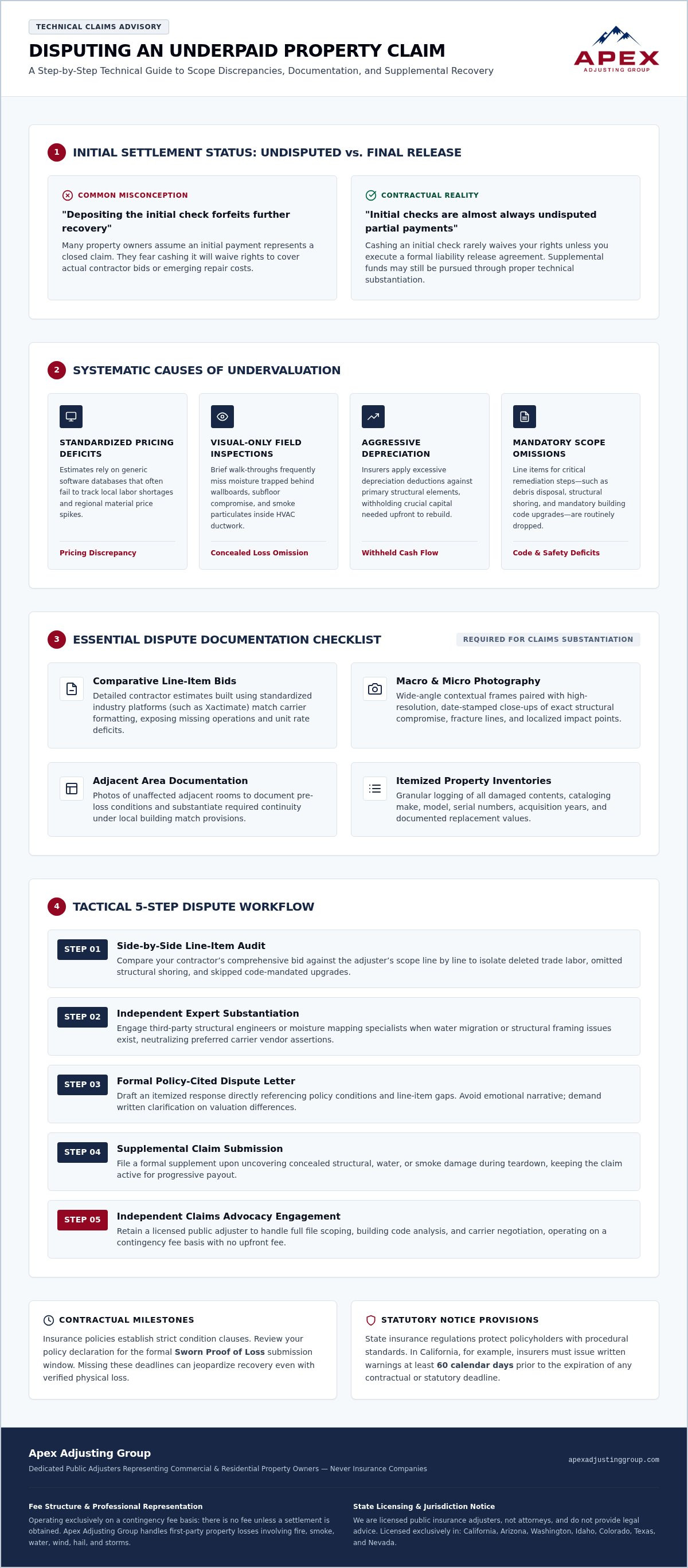
Receiving an insurance settlement check that fails to cover real repair estimates is frustrating. Many policyholders assume that depositing this initial payment closes the claim forever. In first-party property losses, an initial check is almost always an undisputed payment rather than a final release of liability. Unless you sign a formal release agreement, cashing that check doesn't forfeit your ability to pursue supplemental funds.
Mastering how to dispute insurance claim settlement numbers requires knowing why the insurer's initial calculation missed the mark. Insurers frequently issue partial payouts based on incomplete scopes of loss, aggressive depreciation calculations, or overlooked sub-surface damage. Understanding your rights under the policy allows you to challenge these discrepancies systematically.
Why Insurance Adjuster Offers Often Fall Short
Carrier estimates frequently fall short of actual contractor bids due to systematic scoping issues. Desk adjusters routinely calculate estimates using standardized software databases that fail to reflect current local labor rates and material shortages. Field inspections also tend to be visual-only visits that miss hidden water intrusion behind drywall or pervasive smoke particulates inside HVAC ductwork. Adjusters may also apply excessive depreciation to structural elements, improperly withholding funds you need up front to begin restoration work.
Identifying the Deadline to Dispute Your Claim
Every commercial and homeowner policy contains strict condition clauses governing the dispute timeline. Review your policy declarations and conditions for the formal Proof of Loss requirement, which typically gives you a limited window to submit a sworn statement of damages upon request. Missing these contractual milestones can jeopardize your ability to recover funds, even when the property damage is undeniable.
State insurance regulations establish specific timelines for claim disputes. In California, for example, state regulations require insurers to issue written warnings at least 60 calendar days before any contractual or statutory deadline expires. While the legal duty prohibiting insurance bad faith establishes that carriers must process claims fairly, delaying your dispute until the final weeks leaves little time to collect contractor estimates or engineering reports. Whether managing commercial losses or residential property claims, starting the dispute process promptly preserves your rights and gives you the time required to build a solid physical record.
Reviewing the Evidence and Finding Policy Gaps
Winning a settlement dispute depends on uncovering the technical omissions hidden in the carrier's paperwork. Comparing your independent contractor's estimate side by side with the adjuster's line-item breakdown is the first essential step. Carriers routinely drop vital steps from their scopes, such as hazardous waste disposal, structural shoring, or mandated code upgrades under Law and Ordinance provisions. Building a technical line-by-line comparison proves that the payout gap stems from missing scope rather than unreasonable contractor rates.
Hidden destruction often accounts for the largest funding shortfalls in property claims. Smoke particulates travel deep into insulation cavities, while water can wick behind baseboards and compromise subflooring weeks after an incident. If your property suffered structural movement or extensive moisture intrusion, bringing in independent structural engineers or moisture mapping specialists neutralizes the findings of carrier-preferred vendors.
The Essential Documentation Checklist for Disputes
A successful dispute requires comprehensive proof that substantiates every claimed dollar. Organize your documentation using this targeted checklist:
- Comparative Line-Item Bids: Secure detailed contractor scopes formatted in standardized estimating software like Xactimate to match carrier estimating standards.
- Macro and Micro Photography: Take wide-angle shots showing the overall context alongside high-resolution, date-stamped close-ups of specific structural failures.
- Adjacent Area Documentation: Photograph unaffected surrounding spaces to establish pre-loss condition and demonstrate matching material requirements.
- Itemized Personal Property Inventories: Document serial numbers, purchase years, manufacturer details, and current retail replacement costs for contents.
Interpreting Your Policy for Maximum Recovery
Policy language dictates how much money an insurer must disburse at each phase. Knowing how to dispute insurance claim settlement valuations requires understanding the distinction between Actual Cash Value (ACV) and Replacement Cost Value (RCV). Carriers pay ACV initially by subtracting depreciation, but you can collect the withheld depreciation once repairs are completed under an RCV policy.
Review your policy endorsements carefully for Extended Replacement Cost coverage, which adds a buffer above your dwelling limits to offset regional labor spikes. Check your Additional Living Expenses (ALE) provisions to ensure temporary housing costs match your actual displaced living standards. When policy endorsements and technical scopes conflict, policyholders often choose to hire a public adjuster to conduct a comprehensive file audit. You can request a free claim review to uncover overlooked coverages and force the carrier to address all legitimate damages.
Strategic Methods for Disputing the Settlement Offer
Phoning an insurance representative repeatedly to complain rarely shifts an inadequate offer. Real progress requires invoking structured, contractual mechanisms embedded within your coverage. Property owners looking into how to dispute insurance claim settlement determinations need tactical strategies that force formal reconsideration without taking years to resolve.
Escalating your dispute internally is the initial operational move. Request a joint conference with the adjuster's direct claims team leader or regional manager, submitting your side-by-side scope comparisons in advance. When internal company channels hit a standstill, state programs can provide non-binding intervention. For instance, the California Department of Insurance offers disaster mediation for disputed residential property claims resulting from declared states of emergency, compelling the insurer to cover mediation costs for qualifying claims.
Invoking the Appraisal Clause: How it Works
When negotiations stall over repair pricing or loss valuation, invoking the policy appraisal clause provides an effective, out-of-court remedy. Under standard commercial and homeowners forms, either party can demand appraisal in writing. Each side selects and pays an independent, competent appraiser within 20 calendar days. These two appraisers then choose a neutral third party, called an umpire, within 15 calendar days.
Agreement between any two of the three panel members creates a final, binding settlement figure. This process bypasses lengthy administrative delays and resolves pure valuation disputes cleanly. To examine the timeline, selection protocols, and panel dynamics in detail, read our breakdown of the Insurance Appraisal Process.
Filing a Supplemental Claim for Missed Damage
Demolition and initial teardowns regularly uncover damage that was completely invisible during the carrier's primary inspection. Discovered structural charring behind firewall assemblies or extensive mold growth beneath flooring warrants an immediate supplemental filing. Follow these practical steps to build a solid supplemental submission:
- Cease Alterations in the Impact Zone: Pause demolition around newly exposed damage so field adjusters can physically inspect the site.
- Compile a Formal Supplemental Request: Draft an itemized Request for Supplemental Payment that ties every newly discovered item directly to the initial covered loss date.
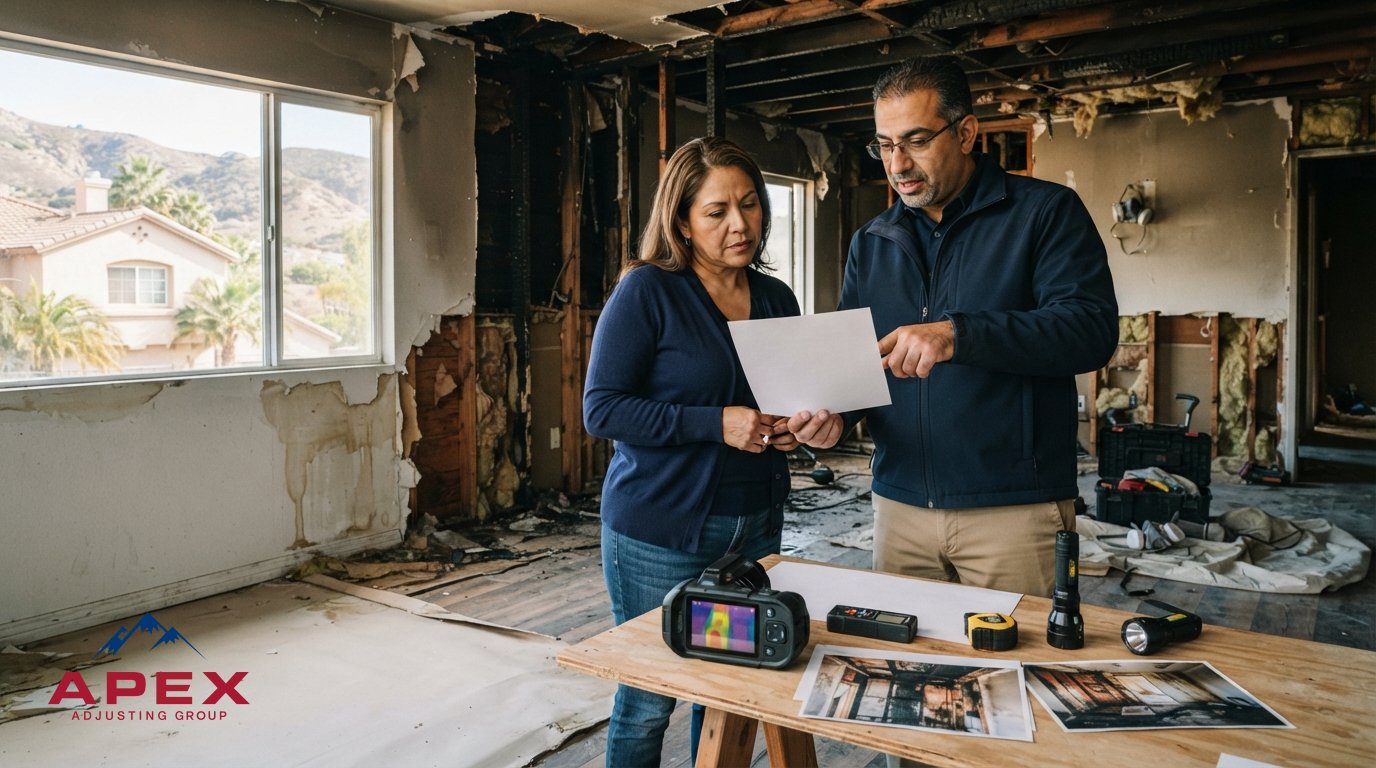
- Attach Definitive Diagnostics: Back every line item with moisture meter logs, thermal imaging captures, or structural specialist write-ups.
- Reject Blanket Waivers: Never sign a Release of All Claims document to receive interim checks, as doing so extinguishes your ability to seek supplemental funds later.
Step-by-Step Guide to Filing Your Dispute
Executing how to dispute insurance claim settlement offers successfully requires strict procedural discipline. Adjusters handle dozens of files simultaneously, so verbal objections over the phone quickly get lost or mischaracterized. You must establish a formal written record that holds the insurer accountable to policy language and physical evidence.
Start by creating a dedicated claims communications log. Document every phone call, voicemail, email, and property inspection with exact dates, times, representative names, and conversation summaries. Follow every phone conversation with a concise email confirming what was discussed, closing with a request for written confirmation if the adjuster disputes your summary.
Drafting the Demand Letter with Professional Tone
Your dispute centers on a formal demand letter. Strip all emotion, frustration, and accusations from the document, focusing solely on verifiable scope, material specifications, and localized pricing. Structure the letter with precision:
- Cite Policy Provisions: Reference specific policy sections, coverage parts, and page numbers that obligate the carrier to pay the claimed items.
- Quantify the Discrepancy: State the exact dollar variance between the carrier's initial estimate and your contractor's comprehensive scope.
- Attach Itemized Exhibits: Label your contractor bids, engineer reports, and photo logs as formal exhibits (e.g., Exhibit A, Exhibit B) for easy reference.
- Establish a Response Window: Give the insurer a clear deadline, typically 15 to 30 calendar days depending on your state's prompt payment rules, to provide a written response.
Negotiating with the Insurance Adjuster
Adjusters often declare that an initial check represents their "final offer." Treat this statement as a standard negotiating posture rather than an absolute conclusion. When a field or desk adjuster refuses to adjust line items supported by physical proof, escalate the file in writing to their direct claims supervisor or unit claims manager.
Recognize when discussions have reached a true stalemate. If carrier representatives repeat identical denials without addressing your contractor's line-item evidence, further phone calls are a waste of time. At this stage, shift from informal negotiations to contractual remedies or independent representation to protect your recovery.
How a Public Adjuster Maximizes Your Recovery
Hiring a licensed public adjuster levels the playing field against carrier claims operations. Insurance companies employ trained adjusters, engineers, and pricing specialists who protect the company's financial interests. Bringing in an independent public insurance adjuster ensures someone is actively advocating for your recovery, inspecting overlooked structural joints, identifying hidden thermal damage, and assembling comprehensive repair valuations that match true reconstruction expenses.
Public adjusting firms operate on a contingency fee model, meaning there is no fee unless a settlement is obtained. This aligns your advocate's objective directly with yours: securing the maximum rightful recovery permitted by your policy terms. When mastering how to dispute insurance claim settlement calculations feels like a second full-time job, professional representation shifts the burdensome technical scoping and paperwork onto an experienced specialist.
Public Adjuster vs. Attorney: Choosing the Right Ally
Most property claim disputes revolve around physical scope, local material pricing, and missed damage rather than complex legal interpretation. Public adjusters focus specifically on property inspections, Xactimate line-item estimates, and negotiations with company adjusters, resolving valuation deadlocks without the high fees associated with legal retention. When an insurer slashes line items or undervalues your loss, our pillar guide on Insurance Claim Settlement Too Low? outlines how to respond strategically.
Getting Started with a Free Claim Evaluation
A professional evaluation provides clear clarity on where the insurer's initial payment fell short. Apex Adjusting Group specializes exclusively in representing property owners across California, Arizona, Washington, Idaho, Colorado, Texas, and Nevada. Our adjusters conduct complete, on-site scoping and audit carrier paperwork across complex property perils, including structural collapse, fire, smoke, and extensive water intrusion.
We review files for both Residential Claims and large-scale Commercial Claims to determine if carrier adjusters applied improper depreciation or overlooked mandatory code upgrades. During an initial review, an adjuster examines your policy conditions, cross-references your contractor estimates against the insurer's itemized statement, and identifies exactly where additional funds can be claimed. Handing your dispute over to a dedicated claims professional removes the daily stress of back-and-forth negotiations while establishing the rigorous physical documentation required to reopen your file and secure full indemnification.
Take Control of Your Property Damage Recovery
Challenging an undervalued insurance offer requires strategy, organized evidence, and clear policy documentation. Cashing an initial check doesn't bar you from seeking additional funds, and discovering hidden water, smoke, or structural issues gives you clear grounds to reopen your file. Mastering how to dispute insurance claim settlement decisions shifts the balance of power back to you.
Apex Adjusting Group advocates strictly for property owners across California, Arizona, Washington, Idaho, Colorado, Texas, and Nevada. We specialize in complex fire, smoke, and water damage claims, operating on a contingency fee basis where you pay nothing unless a recovery is secured.
You don't have to accept an incomplete scope or absorb reconstruction costs out of pocket. With precise physical documentation and seasoned claims advocacy on your side, you can pursue the complete recovery your property deserves.
Frequently Asked Questions
How long do I have to dispute an insurance settlement?
Your timeframe depends on your specific policy terms and state insurance regulations. Most property policies establish a contractual deadline under the policy conditions, which frequently runs between one and two years from the initial date of loss. State rules, such as California's requirement that insurers provide written notice 60 days before deadlines expire, also govern timing. Check your policy conditions promptly so you don't run out of time to assemble estimates.
Can I dispute a claim that has already been closed?
Yes, you can reopen a closed claim if you discover additional damage or if the initial payout failed to cover your full repair scope. Unless you signed a formal release of all claims, an insurer's file closure is simply an internal administrative action. Submitting a supplemental claim with line-item contractor estimates or engineering reports allows you to reopen the file and demand the unpaid funds you are owed under your policy.
What should I do if the insurance company denies my dispute?
Request a written explanation citing the exact policy exclusions or limitations used to justify the denial. Once received, compare their reasoning directly against your policy declarations and contractor scopes. Learning how to dispute insurance claim settlement denials often means escalating the issue beyond the desk adjuster, requesting an internal supervisory review, demanding formal policy appraisal, or filing a complaint with your state insurance department in places like Texas or Washington.
Do I need a lawyer to dispute an insurance claim?
No, you do not need an attorney to dispute property claim valuation or scope differences. Most settlement disagreements center on construction pricing, missing line items, and physical damage documentation rather than legal interpretations. Licensed public adjusters specialize in handling these technical property disputes directly with carrier representatives, managing the entire negotiation on your behalf without the heavy retainers or administrative friction common to legal proceedings.
What is the difference between a public adjuster and an insurance company's adjuster?
An insurance company's adjuster works exclusively for the carrier and protects the insurer's financial interests, while a public adjuster works directly for you. Company adjusters prepare estimates based on internal insurer pricing metrics. In contrast, licensed public adjusters inspect the property independently, prepare comprehensive line-item loss valuations using local contractor market rates, and negotiate assertively on behalf of home and business owners across Western states.
Is there a fee to have my insurance claim reviewed?
No, reputable public adjusting firms like Apex Adjusting Group provide initial claim evaluations completely free of charge. Our team examines your settlement paperwork, reviews contractor estimates, and determines whether scope omissions justify reopening the claim. If you decide to retain our team, we work strictly on a contingency fee basis. You pay nothing upfront, and we collect a fee only if we successfully secure an additional recovery for your property.
How much more money can I expect from a claim dispute?
Settlement increases vary entirely based on the extent of omitted damage, localized labor costs, and your policy limits. While public adjusters cannot guarantee a specific dollar figure or outcome, understanding how to dispute insurance claim settlement figures systematically often uncovers substantial funds in overlooked repairs. Discrepancies commonly involve missed building code upgrades, concealed smoke or moisture intrusion, and excessive depreciation improperly withheld by carrier field adjusters.
What is the appraisal clause in my insurance policy?
The appraisal clause is a contractual dispute resolution mechanism designed to resolve pricing and scope disagreements without going to court. When invoked in writing by either party, you and the insurer each appoint an independent appraiser within 20 calendar days. Those appraisers then choose a neutral umpire within 15 calendar days. An agreement reached by any two members of that three-person panel sets a binding settlement amount for the loss.
Need Help with Your Insurance Claim?
Our licensed public adjusters can help you get the maximum settlement you deserve. Contact us today for a free claim evaluation.
Related Articles