A warehouse fire can stop revenue long after the flames are out. For Oakland property owners, a warehouse fire business interruption claim may cover lost income and certain extra expenses when covered physical damage disrupts operations, but policy terms control what qualifies. Coverage often has a 48-to-72-hour waiting period and may be limited to 12 to 24 months.
The gap between visible property damage and a complete interruption claim can leave businesses unsure what their policy covers and how to calculate lost income. A strong claim links the fire damage and operational shutdown to the financial impact with clear records.
This article explains how business interruption coverage works alongside a property damage claim and which financial and operational records can support a loss calculation. It also covers practical steps to take if an insurer denies the claim or offers less than the documented interruption loss.
Key Takeaways
- Review the policy’s coverage trigger, waiting period, covered expenses, limits, and restoration period to understand how interruption losses may be calculated.
- Keep the property damage and income-loss records connected, showing how fire damage affected operations and revenue.
- Compare financial records from the prior year with current records, and preserve evidence of canceled contracts, lost sales, and extra operating expenses.
- When an offer is reduced or a claim is denied, compare the insurer’s explanation with the policy terms and the supporting documents to identify disputed items.
- Organize claim materials early, including damage photographs, repair information, financial records, and a clear timeline of operational changes.
1. What Is Business Interruption Insurance?
A commercial fire can damage inventory, halt shipping, and interrupt revenue even after crews leave the warehouse. Business interruption coverage may address financial losses tied to covered physical damage that makes the insured premises unusable or significantly impairs operations. For an Oakland warehouse fire business interruption claim, the policy wording determines which losses qualify.
Businesses generally estimate the income they would have earned without the fire, then account for expenses that stopped and those that continued. A warehouse may lose sales while still owing rent and utility costs. Records of prior operations can support the estimate, while the policy governs the calculation and covered expense categories.
Coverage may include lost sales or profits, ongoing rent, and certain reasonable expenses incurred to keep operating. A business might also claim costs for a temporary location, moving operations, or advertising a new location after a fire. Keep invoices and explain how each expense relates to the interruption.
Supply-chain delays may fall under contingent business interruption coverage if a supplier’s or customer’s location is disrupted. Civil-authority provisions may also cover loss of access when an evacuation order or road closure restricts access, even without direct damage to the insured business. The policy must include the applicable coverage and conditions.
After a warehouse fire, examine both the physical-damage trigger and any access restrictions. Coverage typically requires direct physical loss or damage to insured property that makes the premises unusable or significantly impairs operations. For example, a fire-damaged loading area may disrupt shipments even if some warehouse space remains usable.
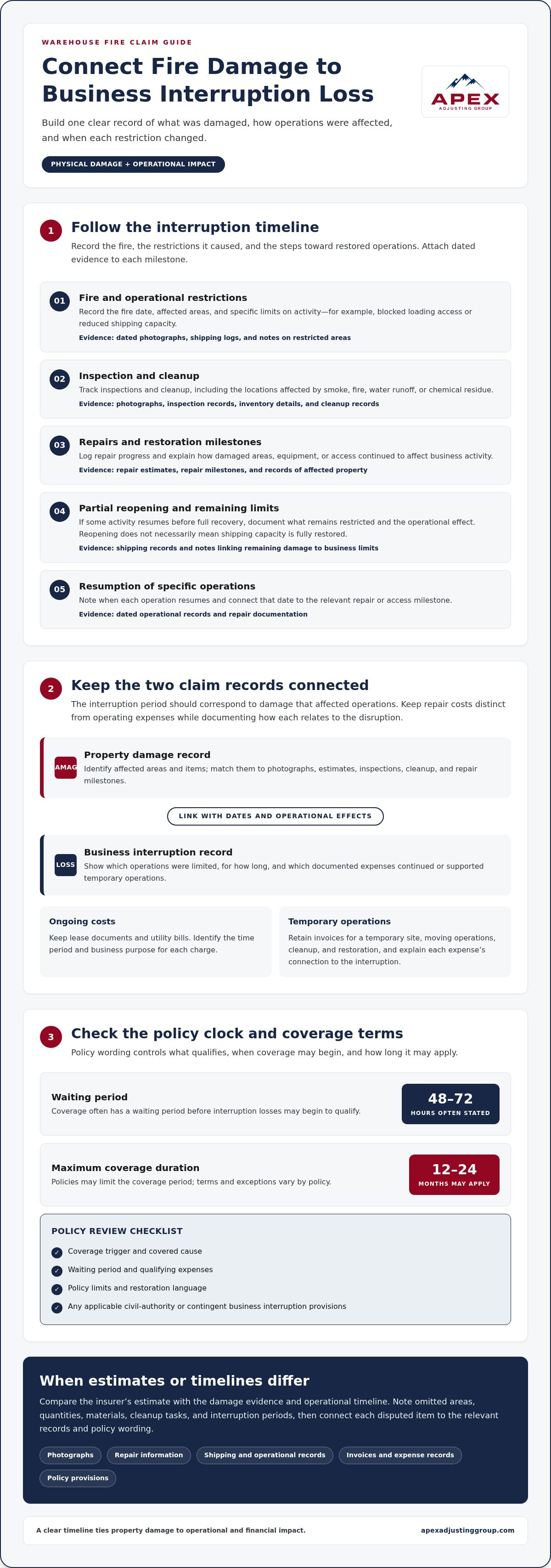
Check the waiting period before estimating covered losses. Business interruption policies often have waiting periods of 48 to 72 hours, so coverage may not begin immediately after the fire. Record when operations stopped and when the policy’s waiting period begins, using the dates and terms stated in the policy.
Next, identify the policy limit and maximum coverage duration. Policies may limit the coverage period to 12 to 24 months, while limits and exceptions vary by policy. Construction delays, repair access, and the time needed to restore operations can affect how much of that period is used.
Read the business interruption and civil-authority provisions together. Note the covered cause, waiting period, qualifying expenses, limits, and restoration language. Then match each claimed loss to dated sales records, expense documents, and operational changes. This organized evidence helps clarify what the policy may cover after an Oakland warehouse fire.
2. Coordination between business interruption and property damage claims
A warehouse fire can cause two connected losses: physical damage and disrupted business activity. Keep the repair scope and interruption calculation aligned, because the claimed shutdown period should correspond to damage that affected operations. For example, loading-area damage may restrict shipments even when other warehouse space remains usable.
Build one timeline for both parts of the claim. Record the fire date, restricted areas, inspections, cleanup, repair milestones, and dates when specific operations resumed. Link each milestone to evidence such as dated photographs, estimates, inspection records, shipping logs, or temporary-site invoices.
Separate physical repair costs from operating expenses while showing how they relate. Rent may continue while a warehouse is unusable, and utility charges may remain during cleanup or repairs. Save lease documents and utility bills, and identify the period and business purpose for each charge. The policy determines whether those expenses qualify.
Document smoke damage separately. When practical, photograph affected surfaces, equipment, inventory, and visible residue before cleaning. Review the policy’s fire, smoke, wildfire, and pollution wording together. An exclusion may address a particular cause or damage type, while another provision may apply. Both the policy language and the evidence matter.
Fire suppression can leave water damage or chemical residue on stock, equipment, and building materials. Photograph affected areas and items, note where runoff traveled, and retain cleanup records. Separate fire, smoke, water, and chemical-related damage in the inventory so each category can be compared with relevant policy provisions.
Independent damage assessments can clarify disagreements about repair scope, affected property, or restoration needs. A useful assessment identifies observed damage, the inspection method, and the basis for recommended work. Compare it line by line with the insurer’s estimate, noting omitted areas, quantities, materials, or cleanup tasks.
- Match each damaged area to photographs, estimates, and repair milestones.
- Link interruption periods to specific restrictions, such as blocked loading access.
- Keep invoices for rent, utilities, temporary operations, cleanup, and restoration organized.
- Record smoke and runoff impacts by location, material, and affected inventory.
If the repair scope and interruption dates don’t align, explain the gap with records. A warehouse may partially reopen before damaged equipment is replaced, leaving shipping capacity reduced. Document the remaining restrictions and their operational effects rather than treating reopening as full recovery.
3. Documentation of income, expenses, canceled contracts, and lost sales
An Oakland warehouse fire business interruption claim needs a financial trail linking the fire to reduced operations. Compare the business’s financial records from before and after the fire, then explain major differences. A monthly sales drop, delayed shipment, or canceled order should connect to a specific operational disruption.
Start with records showing revenue before and after the fire. Gather profit-and-loss statements, sales reports, invoices, tax records, bank deposits, and order histories. For a seasonal warehouse, compare equivalent periods and explain changes in product demand, customer volume, or inventory availability.
Separate revenue records from expense records. List continuing costs, such as rent or payroll, and extra expenses incurred to resume operations. Support each entry with invoices, receipts, payroll reports, lease documents, and a brief note explaining its business purpose.
Create a file for each canceled or delayed contract. Include the contract, customer correspondence, order details, cancellation or delay notice, and expected shipment dates. If a customer moved an order elsewhere because the warehouse couldn’t fulfill it, preserve records showing the sequence of events.
Support lost sales opportunities with more than a forecast. Match quotes, purchase orders, emails, and prior customer buying patterns to the period when the fire limited operations. Explain whether each order was canceled, postponed, partially filled, or fulfilled from a temporary location.
- Keep original files and label copies by date, category, and source.
- Maintain a running expense log with payment records and business purpose.
- Record operational changes, including reduced capacity and shipment backlogs.
- Reconcile sales reports against invoices and bank deposits.
Claim reporting and proof deadlines depend on policy terms and the stage of the claim. Review the notice, cooperation, and proof-of-loss provisions, and keep a dated record of submissions. In California, insurers have 40 calendar days after receiving proof of claim to accept or deny it, according to the California Department of Insurance.
The insurer’s decision period is separate from policy deadlines for submitting records. Track requests, responses, and delivery confirmations in one claim log, then save each version of the financial schedules. If an estimate changes, note why and retain documents supporting the revision.
Complex warehouse losses may require reviewing financial records alongside repair estimates and fire-related documentation. An economic expert may help analyze income loss, while contractors or fire experts may provide information about damage and restoration. Tie each report to the affected areas and operating dates.
A well-documented Oakland warehouse fire business interruption claim lets reviewers trace each amount to supporting evidence. Label records, explain unusual revenue changes, and identify figures that are still being updated. This helps distinguish documented interruption losses from unsupported projections.
4. Claim denials and reduced settlement offers
A denial or reduced offer calls for a clear written response tied to the policy and claim record. Start by identifying the insurer’s stated reason, then compare it with the policy provision, damage evidence, and financial support. For example, a dispute over the interruption period calls for records showing which operations remained restricted and when they resumed.
Common disputes include whether covered physical damage triggered interruption coverage, whether an exclusion applies, and how lost income or continuing expenses were calculated. After a fire, the parties may also disagree about the waiting period, policy limit, restoration period, or whether smoke, water, or chemical runoff affected the property. The policy wording and documented facts shape each issue.
Read the denial or estimate line by line. Mark each excluded, reduced, or unsupported item, and request the specific policy language and calculation behind it. If the offer omits a documented expense, such as rent during a covered shutdown, provide the lease, payment records, and relevant dates.
- Compare the decision letter with the coverage grant, exclusions, limits, and endorsements.
- Match disputed repair items to photographs, inspection notes, and estimates.
- Reconcile claimed income with sales records and the interruption period.
- Identify missing documents and submit a dated, organized response.
Keep your response focused. If the insurer disputes projected sales, provide prior-year records, current orders, and customer communications that support the calculation. If it shortens the restoration period, link repair milestones and operational restrictions to dated records rather than relying on a broad estimate.
Ask for clarification if the explanation doesn’t identify the disputed provision or calculation. Preserve each letter, estimate, and submission with its date, and maintain a running list of unresolved items. This makes it easier to see whether the disagreement concerns coverage, damage scope, or the amount of the business loss.
An attorney handles legal questions; claim documentation supports the policy adjustment and evidence. Keep those roles distinct when reviewing a denial. A public adjuster can review property damage estimates and commercial loss documentation, but cannot promise a particular decision.
For an Oakland warehouse claim, a structured review can reveal whether a reduced offer accounts for every documented loss category. Organize the policy, decision letter, estimates, and financial records before seeking a free claim review. The central task is to show, item by item, how the evidence supports the disputed amount.
5. How can an Oakland business file a business interruption claim after a fire?
Start with the policy and fire record. Locate the commercial property policy, declarations, endorsements, and claim-reporting instructions. Record the fire date, affected warehouse areas, operational shutdowns, and insurer contact. Use one timeline to connect the physical damage with the business interruption.
Report the loss using the method stated in the policy. Describe what burned or suffered smoke, water, or suppression-related damage, and explain how each condition affected operations. If the warehouse can operate only partially, identify the limited functions, such as receiving, storage, picking, or shipping.
When safe and practical, preserve evidence before cleanup or construction changes the scene. Photograph affected inventory, equipment, building areas, loading access, and visible residue. Keep the original images with their dates, and record who took them. Save cleanup, inspection, and repair records as work proceeds.
Open separate but connected files for property damage and lost income. Track damaged building components, equipment, inventory, and repair estimates in the property file. Show how those conditions reduced operations, revenue, or capacity in the interruption file. Cross-reference both files so each claimed period aligns with documented damage.
- Gather operating records. Collect sales reports, invoices, order histories, payroll records, and prior-year financial statements.
- Track continuing and extra expenses. Save rent, utility, temporary-location, relocation, and other interruption-related invoices.
- Document customer impacts. Preserve canceled orders, delayed contracts, lost sales opportunities, and customer communications.
- Submit a supported calculation. Explain assumptions, show supporting records, and separate actual results from projections.
- Maintain a claim log. Record submissions, requests, meetings, estimates, and responses with their dates.
Review policy notice and proof-of-loss provisions before setting internal deadlines. Calendar each stated date and retain delivery confirmations for submitted materials. If figures change as records arrive, send a dated revision explaining the change instead of silently replacing an earlier calculation.
Expect the adjustment to examine both property scope and interruption evidence. The insurer may inspect the warehouse, review estimates, request financial records, and ask how operations continued elsewhere. Respond to each request with organized documents and identify any information still being assembled.
Before accepting a reduced offer, compare its calculation with the policy, repair scope, and documented operational impact. Identify omitted damage, expenses, or restricted functions, then provide supporting records for each disputed item. A complete Oakland warehouse fire business interruption claim keeps the physical loss and income interruption connected throughout the review.
Apex Adjusting Group: Fire Damage Claims
Apex Adjusting Group represents property owners in first-party fire damage claims, not insurance companies. For an Oakland warehouse owner, that can include reviewing building and inventory damage alongside documented interruption losses. Its commercial claims service may help when a claim is delayed, denied, or appears to understate the damage or business impact.
Apex Adjusting Group can review the policy, estimates, repair scope, and supporting financial records as part of its claim work. The firm works on a contingency basis: no recovery, no fee. It is not the right fit for businesses seeking policy sales, legal representation, or construction and repair work.
Contact Apex Adjusting Group for a free claim review to discuss the claim without pressure.
Move the Claim Forward With a Clear Next Step
An Oakland warehouse fire business interruption claim can shape recovery decisions long after operations resume. Keep a current record of outstanding claim issues, important insurer communications, and business changes that affect the loss. A concise, organized file helps clarify what remains unresolved and what needs attention next.
Apex Adjusting Group handles fire damage, water damage, and commercial claims for property owners. If a claim is delayed, denied, or appears to leave out documented damage or business losses, an independent review can help identify issues that deserve closer examination.
When you’re ready, request a free claim review from Apex Adjusting Group to discuss your fire damage and business interruption claim.
Frequently Asked Questions
What Is Business Interruption Insurance?
Business interruption insurance addresses certain financial effects of a covered disruption, rather than paying to rebuild the warehouse itself. It is commonly included with commercial property insurance, but its terms may appear in a separate coverage form or endorsement. For a business with several revenue streams, policy wording and financial records help distinguish income affected by the fire from income generated by unaffected operations.
What caused the Oakland warehouse fire, and when and where did it occur?
The Ghost Ship warehouse fire occurred in Oakland on December 2, 2016, at 1305 31st Avenue. It began at 11:20 p.m. Pacific Standard Time. Electrical problems were alleged at the warehouse, but that allegation does not establish the ignition source. The City of Oakland confirmed the building’s permits allowed warehouse use only, a detail relevant to understanding the property’s documented use.
What does business interruption insurance cover after a warehouse fire?
Coverage depends on the policy’s insuring agreement, exclusions, and endorsements. Some forms may address a shutdown caused by covered damage, while others may extend to access restrictions or disruption at a supplier’s or customer’s location. Those extensions have their own triggers and conditions. Identify the exact provision you rely on and connect the loss to it, rather than assuming every operational disruption qualifies.
What evidence and records are needed to support a fire-related business interruption claim?
Beyond financial statements, preserve operational records showing how the warehouse functioned before and after the fire. These may include inventory movement reports, warehouse management system exports, production schedules, carrier pickup logs, and records of available alternate sites. Keep original electronic files and note which system or employee generated them. These materials can reveal capacity changes that a revenue summary alone may not show.
What are the deadlines and notice requirements for California commercial property insurance claims?
There is no single policy-submission deadline that applies to every California commercial property claim. Check the specific policy for notice, sworn proof-of-loss, document production, and examination requirements, then calendar each stated deadline separately. Send notice using the method specified in the policy and retain a copy with delivery confirmation. California Department of Insurance rules address insurer claim handling, while policy terms govern the insured’s reporting obligations.
How can businesses challenge a denied or underpaid business interruption claim in California?
Request a written explanation identifying the policy provision and calculation behind each disputed item. Then respond to specific gaps, such as an omitted operating function, an unsupported assumption about alternate capacity, or a repair milestone that doesn’t match actual access. A request for reinspection or a supplemental estimate may help resolve factual disagreements. A public adjuster can help present the property claim; legal advice belongs with an attorney.
Need Help with Your Insurance Claim?
Our licensed public adjusters can help you get the maximum settlement you deserve. Contact us today for a free claim evaluation.
Related Articles