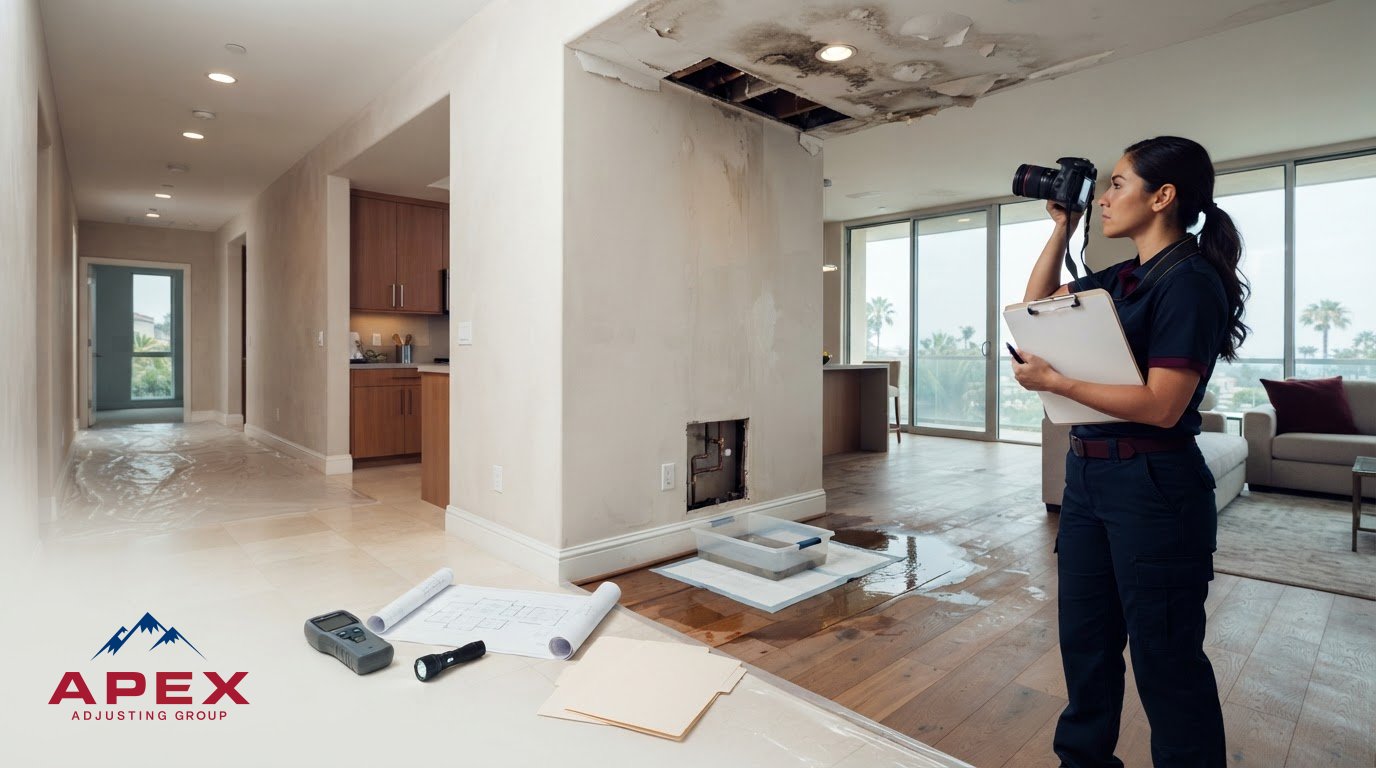
Your insurance company is not your friend. Their first offer is almost always a lowball designed to protect their bottom line, not your property. You pay your premiums every month with the expectation that they'll be there when disaster strikes. But when you're standing in two inches of water, the reality of the burst pipe insurance claim process feels more like a battle than a benefit.
You're likely feeling the weight of jargon-heavy policies and the anxiety that a "wear and tear" clause will leave you footing the bill for massive structural repairs. We're here to change that dynamic. This guide will show you how to master the claim process and force your insurer to pay every dollar you are owed for your recovery. We'll break down the exact steps to document damage, decode complex policy language, and leverage expert advocacy to restore your property to its pre-loss condition without the stress of fighting alone. Stop playing by their rules and start demanding the full payout you deserve.
Key Takeaways
- Identify the "sudden and accidental" trap and learn how to prove your claim fits the criteria for full coverage.
- Navigate the burst pipe insurance claim process with a step-by-step roadmap designed to protect your interests from the first call to the final payout.
- Expose the hidden structural and electrical damages that insurance companies frequently overlook to minimize their liability.
- Force your insurer to look beyond lowball software estimates by identifying the specific tactics they use to underpay water damage claims.
- Leverage expert advocacy to shift the power dynamic and ensure your property is restored to its true pre-loss condition.
Does Homeowners Insurance Cover Water Damage from Burst Pipes?
Most residential property owners carry an HO-3 policy. This is an "all-risk" contract that covers your home against every peril except those specifically excluded in the fine print. A pipe that shatters due to freezing or internal pressure is almost always a covered event. However, the burst pipe insurance claim process often stalls because carriers try to reclassify a sudden event as a long-term maintenance issue. They want to turn your emergency into a "wear and tear" exclusion to save their shareholders money. Don't let them. Your policy is a binding agreement, and if the damage was sudden, they're legally obligated to pay for the recovery.
Sudden vs. Accidental: The Coverage Threshold
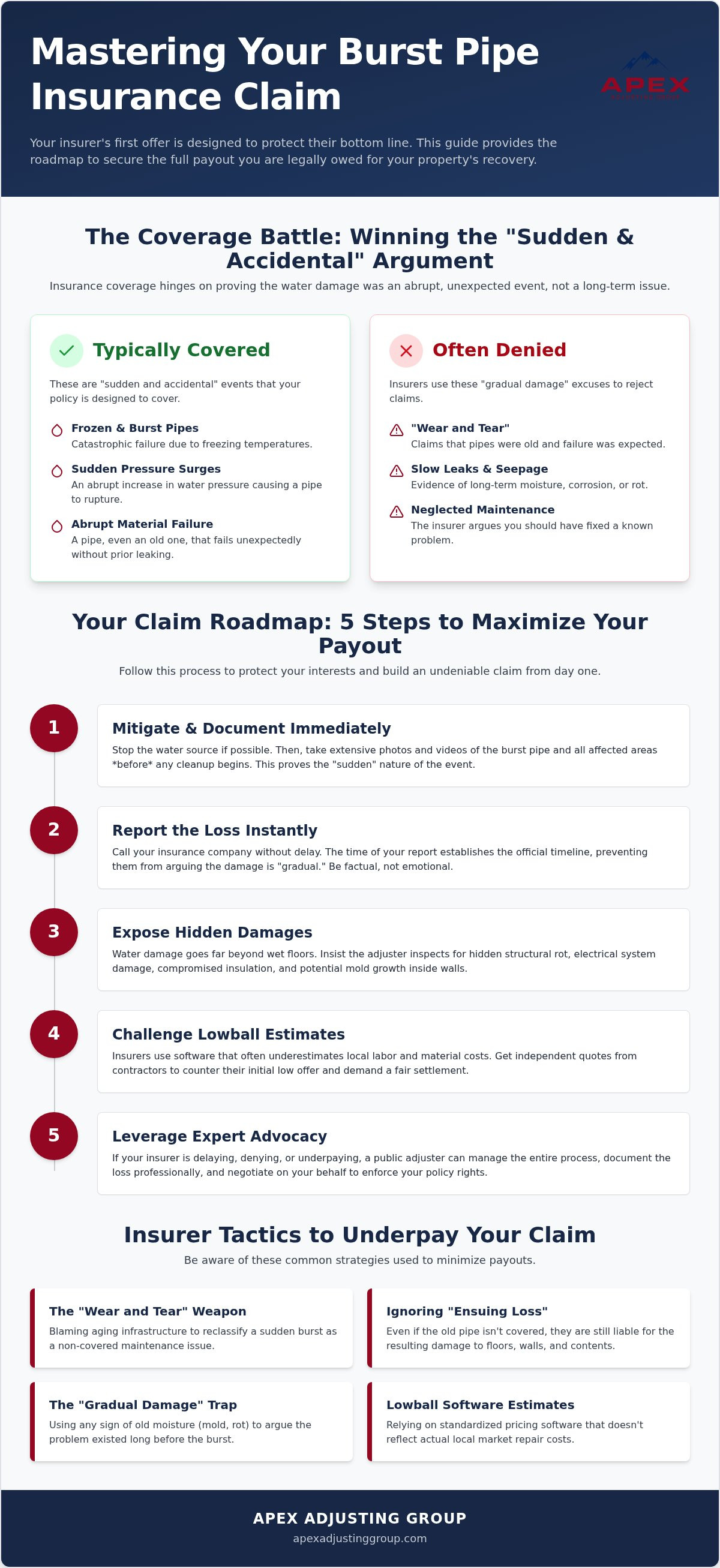
Coverage hinges on two words: sudden and accidental. If a pipe fails in an instant, it's covered. If it leaks for six months, you're in trouble. Insurers look for evidence of corrosion or slow rot to deny your claim. Standard ISO forms define sudden discharge as an abrupt and unexpected release of water from within a plumbing, heating, or air conditioning system. This definition is your primary weapon. Freezing temperatures, material failure, or sudden pressure surges all qualify as sudden events. You must document the failure immediately to prove the timeline. When a pipe explodes, the clock starts ticking on your recovery. Proving that the event was an accident, rather than neglect, is the first battle in securing your payout.
What is Typically Excluded in Water Damage Claims?
Carriers weaponize the "Wear and Tear" exclusion more than any other clause. They'll claim you should've known a pipe was old, even if it's buried behind three layers of drywall. This is why distinguishing between a burst and seepage is critical. Seepage occurs over weeks; a burst happens in seconds. You also need to watch for regional traps. Standard water damage coverage does not include flooding from rising groundwater or sewer backups unless you have a specific endorsement. Always check your declarations page for a "Sewer or Drain Backup" rider. Even if the pipe itself is excluded due to age, you may still be covered for "ensuing loss." This doctrine ensures that while the old pipe might not be paid for, the resulting damage to your floors, walls, and furniture must be covered. Demand that your adjuster accounts for every inch of secondary damage, including mold and structural rot that follows the initial burst.
The "Sudden and Accidental" Rule: Winning the Coverage Battle
Winning the burst pipe insurance claim process requires more than just showing a wet floor. You must define the event before the insurance adjuster does. From an advocate's perspective, "accidental" means the loss was unforeseen and unintended. It doesn't matter if your plumbing is 30 years old. If that pipe was functioning yesterday and failed today, it's a sudden event. Carriers love to point at a speck of rust and scream "neglect." We don't let them. Refuting these denials often requires expert testimony from engineers or master plumbers who can prove that the failure was a result of pressure or temperature, not years of ignoring a leak.
Identifying Sudden Failures in Aging Infrastructure
Old infrastructure is a favorite target for insurance companies. They assume every old pipe has been leaking for years. This is a tactic, not a fact. Even an aging copper line can suffer a sudden, catastrophic split due to a minor pressure surge. To win, you need documentation that isolates the event. Take high-resolution photos of the pipe's interior and the surrounding dry materials. This proves the water hasn't been sitting there. Insurers rely on "seepage and leakage" clauses to minimize payouts; however, these clauses shouldn't apply to a pipe that quite literally exploded. If you're facing a wall of jargon, a water damage claims specialist can help you decode their tactics and fight back.
The "Gradual Damage" Trap and How to Avoid It
The "Gradual Damage" trap is the most common reason for denial. Adjusters look for mold spores, rotted wood, or mineral deposits to argue the damage happened over time. If they find a single damp stud, they may try to void your entire coverage. Reporting the loss immediately is non-negotiable to preserve the "sudden" status of the event. A tiny, ignored slow drip can jeopardize a $50k claim by giving the insurer the "long-term neglect" evidence they crave. Don't give them that ammunition. If you suspect an adjuster is twisting the facts to fit a denial, you need a fighter in your corner. Consider a free claim evaluation to see where your coverage actually stands and how to protect your payout.
The Burst Pipe Insurance Claim Process: A Step-by-Step Roadmap
The burst pipe insurance claim process is a strategic operation, not a casual request for help. You must approach it with the precision of a builder and the mindset of a negotiator. Success begins the moment you discover the water. Start by stopping the flow and calling your insurer to report the loss. When you speak to the carrier, stick to the facts. Don't speculate on the cause or admit fault by saying you "should have" checked the plumbing. In Western states like CA, AZ, and WA, the way you frame the initial report can determine your eligibility for a full payout. State clearly that a pipe burst and water is discharging into your property. That is all they need to know initially.
Mitigation: Protecting Your Property and Your Claim
Your policy contains a "duty to protect" clause. This means you must take reasonable steps to prevent secondary damage, like mold or structural rot. If you fail to mitigate, the insurer will use that neglect to slash your settlement. Skip the DIY efforts with a shop-vac and hire a professional water extraction company. They have the industrial-grade dehumidifiers and moisture meters required to dry the structure properly. Keep every receipt and invoice. Every dollar you spend on emergency repairs is part of your claim. If you're in a high-humidity area like Seattle or a flash-flood zone in Arizona, fast mitigation is the only way to preserve the integrity of your home and your insurance case.
Documentation: The Key to a Maximum Payout
Documentation is your primary weapon against a lowball offer. We call this the "Apex Method" of evidence gathering: over-document everything before the cleanup starts. You need to prove the extent of the damage before it's hauled away in a dumpster. For more detailed strategies on handling these hurdles, see our guide on Water Damage Insurance Claim Help. Capture high-resolution photos and video of the burst pipe, the standing water, and every affected item. Create a line-item inventory of damaged property, including the age and replacement cost of each item. Don't forget the hidden losses; water travels behind baseboards and under subfloors where the eye can't see.
The final steps involve the insurer's inspection and the subsequent negotiation. When the staff adjuster arrives, remember they work for the insurance company, not you. They'll look for reasons to under-scope the repair. Point out every damp spot and structural concern, but don't sign a final settlement on the spot. The first check they offer is rarely enough to cover a full restoration. It's an opening bid in a negotiation. You have the right to demand a payout that reflects the actual cost of materials and labor in your specific market. Hold the line until every dollar of your loss is accounted for.
Why Water Damage Claims are Underpaid (and How to Fight Back)
Insurance companies aren't in the business of charity. They're in the business of risk management, and your payout is their biggest "risk." The burst pipe insurance claim process is often undermined by the "Standardized Software" myth. Most carriers use Xactimate to calculate repair costs. While they claim this provides fair market value, the software frequently relies on outdated regional labor rates that don't reflect the reality of hiring a contractor in 2026. This creates an immediate gap between their estimate and your actual bills. If you feel your insurance claim settlement is too low, it's likely because the adjuster prioritized the company's bottom line over your property's recovery.
Another common tactic is ignoring the "Match and Uniformity" rule. If a burst pipe ruins the hardwood in your living room, the insurer might only offer to replace the damaged planks. However, if those planks don't match the rest of the continuous flooring, they may be legally required to replace the entire floor to ensure a uniform appearance. Don't settle for a patchwork home. Demand a restoration that returns your property to its true pre-loss condition, not a cheap fix that kills your resale value.
The Insurance Adjuster’s Lowball Offer: 5 Common Traps
Adjusters use specific levers to pull money out of your claim. One of the most aggressive is applying heavy depreciation to materials that should be covered at full value. They also frequently "forget" to include the cost of professional pack-out services, which involves moving and storing your furniture while repairs happen. You must understand the difference between Actual Cash Value and Replacement Cost Value: Actual Cash Value pays what your property is worth today after years of wear, while Replacement Cost Value pays the actual price to buy or build it new. If your policy is an RCV contract, don't let them pay you ACV prices. Watch for these traps in every line item they present.
Hidden Damage: What Your Insurer Hopes You Don’t Find
The damage you see is only the beginning. Water from a burst pipe migrates into wall cavities, insulation, and sub-flooring. Insurers prefer a simple "dry out" because it's cheap, but trapped moisture is a ticking time bomb for structural rot and electrical hazards. If water reached your sub-floor, a few fans won't fix the delamination of the wood. You need a thorough inspection that accounts for every hidden risk before you sign a release. If you're tired of the runaround and want a professional to force a fair settlement, request a free claim evaluation today to see what you're actually owed.
Maximizing Your Settlement with Apex Adjusting Group
The staff adjuster assigned to your case is a representative of a multi-billion dollar corporation. Their performance is measured by how much money they save the company, not how well they restore your kitchen or basement. To win the burst pipe insurance claim process, you need an advocate with the same level of technical expertise as the carrier. Apex Adjusting Group acts as your fierce ally. We are licensed professionals who specialize in Western US property damage, covering CA, AZ, WA, ID, CO, TX, and NV. We don't just ask for a fair settlement. We demand it based on hard evidence and code-compliant repair standards.
Leveling the Playing Field Against Big Insurance
Insurance carriers rely on your confusion to underpay claims. They often push "preferred vendors" who prioritize the insurer’s interests over your property’s integrity. We break that cycle. Our team takes over all communication and negotiation with your carrier from day one. You won't have to spend hours on the phone arguing about "wear and tear" or depreciation. We deploy our own network of engineers and moisture mapping experts to prove the full extent of the damage. This "champion of the underdog" mentality ensures that big insurance cannot bully you into a lowball settlement. We know their tactics. We speak their language. Most importantly, we don't back down until every dollar is on the table.
Our No-Recovery, No-Fee Promise
Many property owners hesitate to hire an expert because they fear the cost during a crisis. Our contingency-based model removes that barrier entirely. This is a risk-free partnership; we only get paid if you do. Our interests are perfectly aligned with yours because our success is tied directly to the size of your recovery. While we charge a percentage for our services, that cost is typically offset by the significantly higher settlements we secure compared to what owners get on their own. Don't wait for the carrier to deny your claim or send a lowball check. Secure a free claim evaluation within the first 24 hours of your loss to set the right trajectory for your recovery. A fast start prevents the insurer from controlling the narrative. Contact Apex Adjusting Group for a Free Claim Evaluation and take the burden of the negotiation off your shoulders today.
Secure Your Recovery and Demand Your Full Payout
You don't have to accept a settlement that barely covers the initial cleanup. The insurance company has a team of adjusters and engineers working to protect their bottom line; you deserve a dedicated team working to protect your property. By meticulously documenting every inch of damage and aggressively refuting "gradual loss" denials, you take control of your financial future. Successfully navigating the burst pipe insurance claim process is about more than just filing paperwork. It's about forcing the carrier to honor the contract you've paid for every month. Apex Adjusting Group stands as your fierce advocate to maximize payouts for residential and commercial owners alike.
We are licensed experts in California, Arizona, and across the West, operating on a strict no recovery, no fee guarantee. This means we only get paid when we win for you. Don't let a lowball offer or complex jargon stand in the way of your property's full restoration. Take the burden off your shoulders and put your claim in the hands of seasoned negotiators who understand the system. Get Your Free Burst Pipe Claim Evaluation Now and start your journey back to a pre-loss condition with confidence. You've protected your home; now let us protect your claim.
Frequently Asked Questions
Is a burst pipe considered a "sudden and accidental" loss?
Yes, a burst pipe is the definition of a sudden and accidental loss if the release of water was abrupt and unexpected. Standard policy forms are designed to cover these catastrophic plumbing failures because they are unforeseen events. However, the carrier will look for evidence of long-term corrosion to reclassify the loss. Proving the timeline is the most critical part of the burst pipe insurance claim process for owners in cities like Los Angeles or Phoenix.
Will my insurance cover mold damage caused by a burst pipe?
Mold damage is typically covered if it results directly from a covered burst pipe event. Most policies include an "ensuing loss" provision that covers secondary damage like mold; however, many carriers cap this coverage at specific limits, such as $5,000 or $10,000. In high-humidity areas like Seattle or Oakland, mold can develop within 48 hours. You must ensure your adjuster includes proper remediation costs in the final estimate to avoid future health risks and structural rot.
What should I do if the insurance company denies my water damage claim?
You should immediately request a formal denial letter that cites the specific policy language the insurer is using. Don't take their word as the final authority. Carriers in Arizona and California often use vague "wear and tear" exclusions to avoid paying for expensive structural repairs. Your next step is to contact a licensed public adjuster to perform an independent evaluation of the damage and provide a professional rebuttal to the insurance company's findings.
How much does it cost to hire a public adjuster for a burst pipe claim?
Hiring a public adjuster with Apex Adjusting Group costs nothing upfront. We operate on a contingency-based model, meaning our fee is a percentage of the total settlement we recover for you. If you don't get paid, we don't get paid. This risk-free partnership ensures our interests are aligned with yours. Our goal is to maximize your recovery so that the increased settlement more than covers the professional fee for our advocacy and expertise.
Can I still file a claim if I already started the cleanup process?
You can absolutely still file a claim, but your documentation must be flawless. Your duty to protect the property requires you to start mitigation immediately to prevent mold or rot. Take high-resolution photos and video of the burst pipe and the standing water before any extraction begins. Keep every receipt from restoration companies or equipment rentals. These expenses are part of your claim and are essential for securing a full reimbursement from your carrier.
Does homeowners insurance cover the cost of the actual pipe that burst?
Standard homeowners insurance usually excludes the cost of the actual pipe that failed. The policy covers the "ensuing loss," which includes the destruction of your walls, floors, and personal belongings. While the insurer won't pay the small plumbing bill to solder a new copper line, they are responsible for the thousands of dollars in structural drying and restoration that follow. We ensure the carrier doesn't use the pipe's age to deny the larger water loss claim.
How long does the burst pipe insurance claim process typically take?
The burst pipe insurance claim process can take anywhere from 30 days to several months depending on the extent of the damage. Simple residential claims might settle quickly if the carrier agrees on the scope. However, complex commercial losses or disputed claims in competitive markets like San Francisco or Las Vegas often require extensive negotiation. Having an expert manage the timeline prevents the insurer from using stalling tactics to force you into a low settlement.
What is the difference between an insurance company adjuster and a public adjuster?
The difference is who signs their paycheck. An insurance company adjuster is an employee of the carrier whose primary goal is to minimize the company's liability. A public adjuster is a licensed professional hired exclusively by the property owner to maximize the settlement. At Apex, we function as your private advocate. We handle the inspections, the estimates, and the intense negotiations to ensure you aren't bullied by big insurance during a high-stakes property crisis.
Need Help with Your Insurance Claim?
Our licensed public adjusters can help you get the maximum settlement you deserve. Contact us today for a free claim evaluation.
Related Articles