
When a property claim estimate differs from the documented damage, an insurance appraisal clause may offer a process for resolving a disagreement about the value or scope of covered damage. It generally does not decide whether the policy covers the loss or what caused it. Understanding that distinction is an important first step before considering appraisal.
Appraisal has its own process: each side selects an appraiser, and an umpire may participate if the appraisers cannot agree. The specific policy determines how that process works. Invoking appraisal may also leave coverage questions and other claim issues unresolved, so it helps to identify exactly what the disagreement is about before taking action.
This guide explains what appraisal may address, what it may not settle, and how appraisers and an umpire can participate. It also covers which policy provisions and claim records to review, including estimates, damage photos, and coverage correspondence, before considering a written demand. With a clearer view of the dispute and the process, property owners can better assess whether appraisal fits or whether independent claim support may help clarify their options.
Key Takeaways
- An insurance appraisal clause may apply when the disagreement concerns the amount or scope of covered damage, not every unresolved claim issue.
- Before considering appraisal, review the full policy, endorsements, claim correspondence, and estimates to identify what remains disputed.
- Organize dated photos, invoices, and repair records so disputed areas and related documents are easy to compare.
- Compare appraisal with continued claim discussions, a supplemental estimate, or a claim review. The right path depends on the dispute and policy wording.
- An appraiser evaluates the loss for appraisal, while a public adjuster can support a property owner’s broader first-party claim. Their roles are distinct.
What an Insurance Appraisal Clause May Resolve
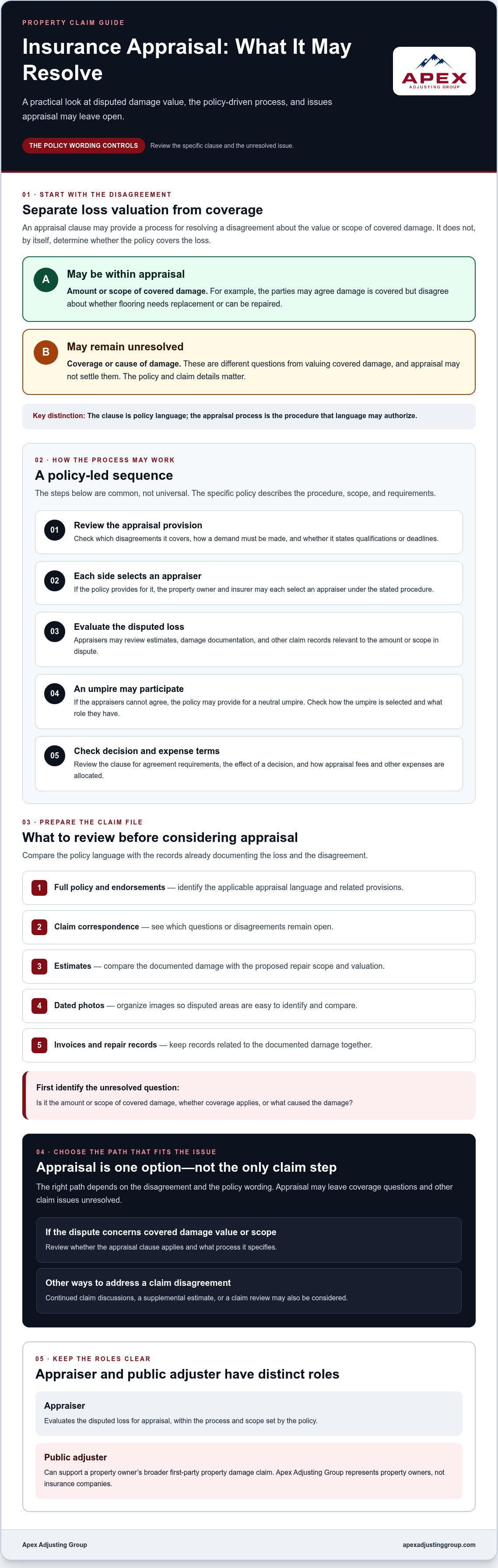
A property owner and insurer may agree that damage is covered but disagree about how much repair work it requires or how the loss should be valued. An insurance appraisal clause is policy language that describes a process that may address certain claim disagreements. Its scope depends on the specific policy.
Concise definition: An appraisal clause may provide a way to determine the value or scope of a covered loss. It does not, by itself, determine whether the policy covers that loss.
Appraisal is one type of Alternative Dispute Resolution, a broad category of processes for addressing disagreements outside a court proceeding. In property claims, appraisal commonly focuses on the amount of loss. The policy wording matters, and appraisal may not decide disputes about coverage, exclusions, or what caused the damage.
How the appraisal clause differs from the appraisal process
The clause is the provision in the policy. The appraisal process is the set of steps that provision may authorize, such as each side selecting an appraiser and a neutral umpire participating if the appraisers cannot agree. Policies can differ in the steps they describe and the issues within scope. For a process overview, see Insurance Appraisal Process: Breaking the Claim Deadlock. Review the actual policy rather than assuming its wording matches another policy.
Which disagreements may fall within appraisal
Consider a hypothetical water-damage claim. The parties agree that part of a building sustained covered damage but disagree about whether a section of flooring needs replacement or can be repaired. Depending on the policy’s appraisal language and the details of the dispute, this may be a question about repair scope or the amount of loss.
Now consider a different disagreement: the insurer questions whether the policy covers the water damage, or the parties disagree about its cause. Those are coverage or causation questions, not simply differences in valuation. Appraisal may not resolve them. The clause’s wording and the details of the claim determine whether a particular issue fits.
Before treating a disagreement as an appraisal issue, identify what remains unresolved: the amount or scope of covered damage, whether coverage applies, or the cause of the damage. That distinction helps a property owner review the relevant policy language and avoid assuming appraisal can decide every part of a claim.
How the Insurance Appraisal Clause Process Typically Works
Once a property owner identifies a disagreement about the amount of a loss, the policy can show whether appraisal is available and what steps may apply. The sequence below is common, not guaranteed. IRMI’s definition of appraisal clause provides additional industry context, but the wording in the specific policy controls.
- 1. Review the provision. Locate the appraisal language and check which disagreements it covers, how a demand must be made, and whether the policy specifies qualifications or deadlines.
- 2. Select appraisers, if the policy provides. The property owner and insurer may each select an appraiser under the stated procedure. Check for requirements about qualifications, selection, or communication.
- 3. Evaluate the disputed loss. The appraisers may review estimates, damage documentation, and other claim records relevant to the amount or scope in dispute. The policy defines their role and the issues they may consider.
- 4. Consider an umpire, if the clause calls for one. If the appraisers cannot agree, the policy may provide for a neutral umpire. Check how that person is selected and what role they have in the decision.
- 5. Confirm how a decision is reached and handled. Check the clause for agreement requirements, the effect of a decision, and how appraisal fees and other expenses are allocated.
What the appraisers and umpire may do
Appraisers may assess the disputed loss amount within the process set by the policy. An umpire may participate as a neutral if the clause provides for one. Check the policy for the umpire’s appointment and decision-making role. In short, appraisers evaluate the disputed loss, and an umpire may help address differences between them, subject to the policy’s terms.
Don’t assume appraisal participants decide whether a loss is covered or what caused it. Those issues may fall outside appraisal. The policy language and claim circumstances matter.
What the policy may say about decisions and costs
Read the provision for terms describing how appraisers or an umpire reach a decision, whether that decision is binding or has another effect, and who pays each fee or expense. These details can vary by policy and applicable requirements, as can deadlines and qualifications. Don’t assume an award is always final or that costs are divided a particular way.
For legal questions about how a clause applies in a specific state, consult a qualified state-specific professional. A claim review may help clarify which documents and policy language need closer attention.
Appraisal vs. Other Ways to Address a Claim Disagreement
A difference in estimates doesn’t automatically make appraisal the next step. First identify what’s disputed: the amount or scope of covered damage, whether the policy covers the loss, or what caused it. A fire damage claim review, for example, may involve questions about which areas need repair as well as separate questions about coverage. Keep those issues distinct when considering options.
These options aren’t a ranking. Appraisal isn’t automatically faster, less costly, or more effective than continued discussion or submitting additional documentation. The legal analysis of the insurance appraisal clause provides scholarly context on appraisal’s role, but the policy wording and details of the claim remain central.
When the disagreement is about the amount of loss
If estimates differ on damaged rooms, materials, or repair scope, organize the documents before discussing next steps. Compare the estimates item by item, mark disputed entries, and gather dated photos, invoices, and repair records related to those items. If you are dealing with property damage and need professional remediation scoping, check out Fire Industry Restoration Experts. The guide Insurance Claim Settlement Too Low? How to Fight Back offers related context for reviewing a claim estimate.
When the disagreement concerns coverage or cause
A disagreement about whether an exclusion applies or what caused the damage may not be a valuation issue that appraisal can address. List each unresolved question separately and note the policy provision or claim correspondence connected to it. For questions requiring legal interpretation, consult a qualified professional. A claim review can help organize the file and clarify what remains disputed.
What to Review Before Invoking an Appraisal Clause
Before acting on an insurance appraisal clause, identify the exact disagreement and check the policy procedure that may apply. A clear file helps separate a dispute about damage scope or value from questions about coverage or cause. Start with the complete policy, not just the declarations page or a single appraisal provision.
Documents that can help explain the disagreement
Gather the records that show what was reported, inspected, estimated, and repaired. Organize them by date and mark the specific items that remain disputed.
- Full policy and endorsements: Include the appraisal clause and any endorsements that may change or clarify policy terms.
- Claim estimates: Collect the insurer’s estimate and any contractor estimates. Note differences in rooms, materials, repair methods, or listed damage.
- Dated photographs: Include clear views of each disputed area. Wider shots can show location, while closer images can show visible damage.
- Inspection notes and correspondence: Save inspection records, claim letters, emails, and other communications related to disputed items or the insurer’s claim position.
- Invoices and repair records: Include available invoices, work descriptions, and repair documentation connected to the damage in question.
Missing documents don’t automatically determine the outcome. Record what’s unavailable and note whether another document may help explain the same issue. Avoid treating an estimate or photograph as proof of a coverage decision. Each record has a specific role in documenting the claim.
Questions to ask before choosing a next step
Write a short issue list before discussing appraisal or another claim step. Keep each question separate so a valuation disagreement doesn’t get mixed up with a coverage or cause question.
- Which damage items or parts of the estimate remain disputed?
- Is the disagreement about repair scope or value, or does it concern coverage, an exclusion, or the cause of damage?
- Which policy provision describes the proposed process, and what does it say about requesting it?
- Does the policy state deadlines, appraiser qualifications, required procedures, or responsibility for fees and expenses?
- Have applicable deadlines and procedural requirements been checked against the policy and reliable, state-specific sources?
Policy terms and requirements can vary. For state-specific legal questions, consult a qualified professional rather than relying on a general explanation to interpret the policy.
A free claim review can help organize unresolved issues and identify which claim documents may need closer attention. Learn about requesting a free claim review.
When Professional Claim Support May Help With Appraisal
A claim can involve more than one unresolved issue. A property owner may need help organizing the overall claim while also assessing whether a specific disagreement fits the policy’s appraisal process. Those are distinct roles, and neither should be assumed to resolve every question in the file.
How a public adjuster and an appraiser differ
A public adjuster supports the property owner’s first-party insurance claim. That work may include reviewing claim documents and organizing information about reported damage and the claim amount. An appraiser’s role is narrower: appraisal work addresses the disputed loss within the process described by the applicable policy. The two roles aren’t interchangeable, and an appraiser doesn’t automatically handle the entire claim.
Apex Adjusting Group is a licensed public adjusting firm that helps property owners with first-party property damage claims and offers public adjusting and insurance appraisal services. Whether either service is suitable depends on the claim, policy wording, and applicable requirements. Public adjusting and appraisal don’t provide legal representation, and appraisal participants shouldn’t be assumed to decide coverage or cause-of-damage questions.
Choosing a next step for a property claim
Before discussing options, gather the policy and endorsements, claim estimates, relevant photos, and correspondence. Then write down the unresolved issue in plain terms. For example, identify whether the disagreement concerns specific repair items, the value of covered damage, or a separate question about coverage or cause. A clear issue list can help determine what kind of support may be relevant.
Check the appraisal provision for its stated process and review applicable requirements using reliable, state-specific sources. Apex Adjusting Group serves property owners in California, Arizona, Washington, Idaho, Colorado, Texas, and Nevada, including Southern California, Orange County, Los Angeles, San Jose, San Francisco, Sacramento, Phoenix, Tucson, Las Vegas, Reno, Oakland, Seattle, Spokane, and Idaho. A free claim review may help clarify what the file shows and what questions remain, without assuming appraisal is the right next step or promising a particular result or timeline.
Property owners who want to discuss their claim concerns can request a free claim review.
Choose Your Next Step With a Clear Claim File
Before invoking an insurance appraisal clause, identify whether the unresolved issue concerns the amount or scope of covered damage, or instead involves coverage, an exclusion, or the cause of the loss. Appraisal may address certain valuation disputes, but its scope and effect depend on the policy wording and applicable requirements. Review the full policy and endorsements alongside estimates, photographs, correspondence, invoices, and repair records.
Keep the roles clear. An appraiser evaluates a disputed loss within the applicable appraisal process; a public adjuster supports the property owner’s broader first-party claim. A careful file review may help clarify what remains disputed and which next steps are worth considering. It doesn’t guarantee a particular outcome.
Apex Adjusting Group offers insurance appraisal services, public adjusting, and free claim evaluations to help property owners discuss their claim concerns and possible options.
With the policy and claim records organized, property owners can approach the next conversation with greater clarity. To discuss a property claim, request a free claim review.
Frequently Asked Questions
What is an insurance appraisal clause?
An insurance appraisal clause is policy language that may provide a process for addressing certain disagreements about a property loss. It commonly focuses on the amount or scope of damage, but the specific policy defines what the process covers. Appraisal may not resolve whether the policy covers the loss, whether an exclusion applies, or what caused the damage. Read the clause and related provisions before assuming appraisal fits the dispute.
When should a property owner consider invoking an appraisal clause?
A property owner may consider reviewing the clause when the main unresolved issue appears to be the amount or scope of covered damage. First, compare the estimates and identify the specific items in dispute. Gather relevant photographs, invoices, and repair records. The policy and applicable requirements determine the process and timing. If the disagreement involves coverage or legal questions, seek qualified guidance rather than assuming appraisal can resolve those issues.
Does an insurance appraisal clause decide whether damage is covered?
Not necessarily. Appraisal commonly addresses the amount of loss, while coverage, exclusions, and cause of damage may be separate questions. The clause’s wording and applicable requirements determine the boundaries for a particular claim. List each unresolved issue separately, then review the policy provisions connected to it. Starting appraisal should not be assumed to resolve every part of an insurance claim or settle a coverage question.
Who selects the appraiser and umpire in an insurance appraisal?
The policy may describe how each side selects an appraiser and how an umpire is chosen if the appraisers cannot agree. It may also set qualifications, deadlines, and the umpire’s role in reaching a decision. These terms vary, so check the actual appraisal provision and related instructions. If a requirement is unclear, seek qualified, state-specific guidance instead of relying on a general description of the process.
Is an appraisal decision binding on the property owner and insurer?
The effect of an appraisal decision depends on the policy language and applicable requirements. Don’t assume every decision is binding, final, or broad enough to resolve coverage questions. Review the appraisal provision and related terms to understand what issues the process addresses and how a decision may affect the claim. For questions about legal effect, consult a qualified professional authorized to provide advice in the relevant jurisdiction.
What documents should I gather before an insurance appraisal?
Gather the complete policy and endorsements, claim correspondence, insurer estimates, repair estimates, photographs, invoices, and relevant inspection or repair records. Make a short list of disputed damage items and note why each remains unresolved. Organize copies by date so the claim history is easier to follow. The documents needed depend on the property, claim, and policy process, so also check for any specific requirements or requests.
Can a public adjuster help with an insurance appraisal clause?
A public adjuster can support a property owner’s first-party claim, while appraisal is a distinct process governed by the policy. Apex Adjusting Group represents property owners, offers public adjusting and appraisal services, and provides free claim evaluations. Service suitability depends on the claim, policy wording, and applicable requirements. Apex serves property owners in California, Arizona, Washington, Idaho, Colorado, Texas, and Nevada, including Los Angeles, Phoenix, Seattle, Spokane, and Reno.
Need Help with Your Insurance Claim?
Our licensed public adjusters can help you get the maximum settlement you deserve. Contact us today for a free claim evaluation.
Related Articles