A Sacramento restaurant fire loss of income claim may include covered damage to the building, equipment, and inventory, as well as lost business income and qualifying extra expenses caused by a shutdown. The policy wording and records linking each loss to the fire determine what may be covered. Smoke, soot, and firefighting water can also damage areas beyond the visible burn.
Canceled reservations and a closed dining room can sharply reduce revenue, but the claim should account for more than sales that never happened. Identify affected inventory, essential payroll, and expenses incurred to maintain limited operations or prepare to reopen.
Use this guide to assess which losses to document, what records and photographs may support the claim, and how policy terms and responsibilities can affect payment. It also explains how Sacramento claim support may fit into the process of presenting the restaurant’s losses.
Key Takeaways
- Separate physical damage from lost income and extra expenses so each part of the restaurant’s fire loss is accounted for.
- Build a clear record of damaged property and inventory with photographs, item details, and supporting business records.
- Review the policy’s business income, property, and code-upgrade provisions to understand what coverage may apply and what exclusions could limit payment.
- Notify the insurance carrier promptly, protect the property from further damage, and preserve evidence for inspection.
- Compare the claimed income loss with the restaurant’s operating records and the policy’s calculation terms before submitting the claim.
What Damages Can Be Claimed After a Restaurant Fire?
A restaurant fire claim may include covered property damage, lost business income, and qualifying extra expenses. For a Sacramento restaurant fire loss of income claim, document how the fire interrupted operations and connect each claimed loss to the policy.
-
Identify Business Interruption and Lost Income
Track income lost while fire damage prevents normal operations. Compare sales records, reservations, canceled events, and revenue from similar operating periods. Include days when the restaurant resumes only some services. For example, if takeout continues while the dining room remains closed, record takeout sales separately from the income claimed as interrupted.
Record the dates and operating limits behind each loss. Separate the fire’s effects from normal sales changes, such as a seasonal dip or an event canceled for an unrelated reason. Payroll for essential staff and additional expenses may also matter if the policy covers them.
-
Review Business Income Insurance Coverage
Review the business income provision and identify its covered trigger, calculation terms, limits, and exclusions. This coverage may help with income losses when fire damage forces a restaurant to close, but the policy wording determines which losses qualify. California disputes depend on the applicable policy and claim facts, so no single rule applies to every dispute.
Restaurant fire claims in California can take different amounts of time because damage, inspections, and documentation needs vary. Keep dated records of submitted materials, inspections, and unanswered requests. Reopening approvals and inspections in Sacramento also depend on the damage and proposed work, so document directions or inspection requirements received from local authorities.
-
Calculate Lost Income and Extra Expenses
Build a Sacramento restaurant fire loss of income claim from business records, the interruption period, and the policy’s calculation terms. Compare sales reports, reservations, payroll, and earlier operating records to estimate income that would otherwise have been earned. Account for revenue from limited operations so the claim reflects actual activity, not an assumed full shutdown.
List extra expenses separately from lost income. Temporary kitchen arrangements, relocation, or costs to maintain limited operations may qualify if the policy covers them and they relate to the fire. Keep invoices, payment records, dates, and a brief explanation of how each expense helped continue service or reduce the interruption.
For example, record which meals were prepared at a temporary kitchen and which sales came from that setup. Compare those receipts with the restaurant’s usual records, and avoid counting an expense twice. Match each claimed amount to supporting documentation, then compare the finished schedule with the policy provisions.
Claim documentation and loss inventories
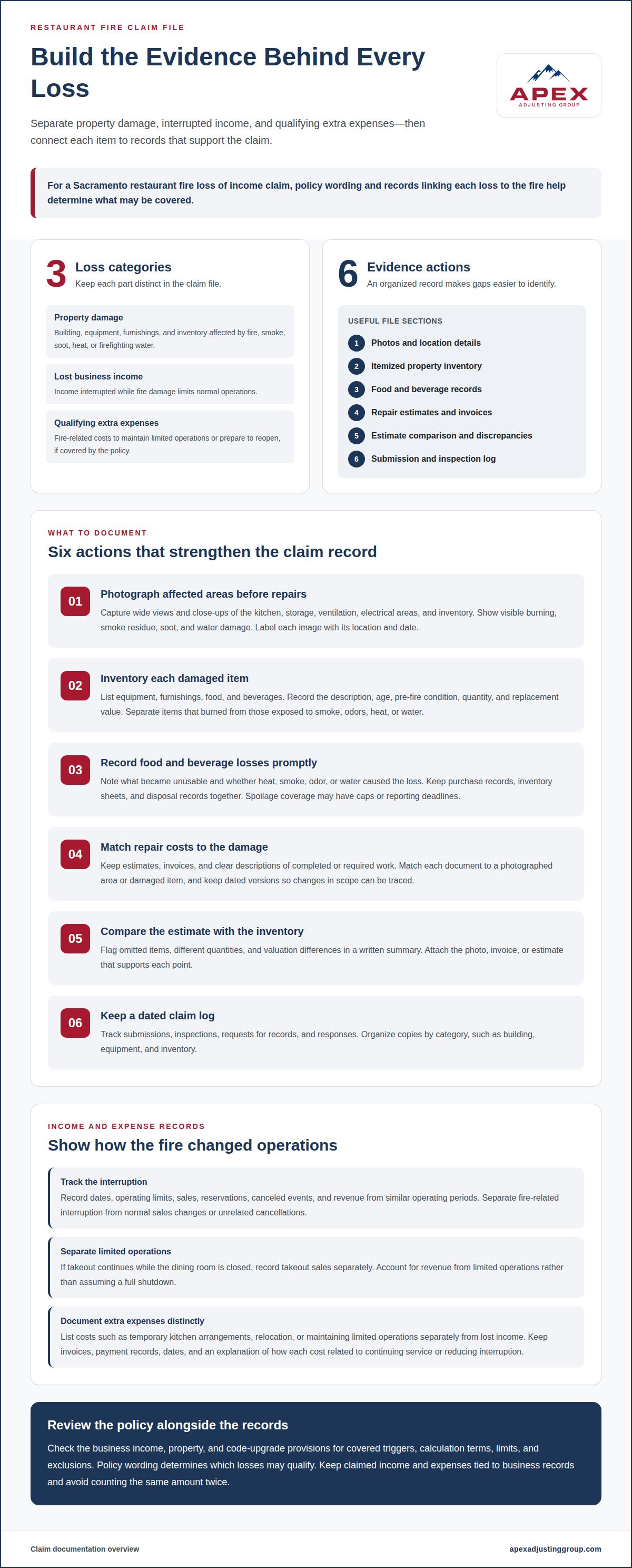
Build a file linking each damaged item, repair, and business loss to the fire. Organized records make the loss easier to review and help you respond clearly when an estimate leaves items out.
- Photograph every affected area before repairs change the evidence. Take wide views of the kitchen, storage rooms, ventilation, electrical areas, and inventory, then close-ups of visible burning, smoke residue, soot, and water damage. Label each image with its location and date. For example, photos of a damaged refrigerator can show both its condition and where it stood.
- Create an itemized inventory of equipment, furnishings, food, and beverages. For each item, record its description, age, pre-fire condition, quantity, and replacement value. Separate items that burned from those exposed to smoke, odors, heat, or water. Listing a damaged fryer separately from affected stored ingredients gives reviewers a clearer basis to evaluate each loss.
- Record food and beverage losses promptly, and preserve purchase records when available. Spoilage coverage may have caps or reporting deadlines, so identify affected stock and its cause without delay. Note whether heat, smoke, odor, or water made items unusable. Keep invoices, inventory sheets, and disposal records together to support the contents claim and their stated value.
- Support repair costs with estimates, invoices, and clear descriptions of completed or required work. Match each document to a photographed area or damaged item. If an estimate covers kitchen equipment but omits smoke damage in storage, identify the gap and gather records showing which materials were affected. Keep dated versions so changes in scope are traceable.
- Organize submissions by category, then compare the insurer’s estimate with the restaurant’s inventory and repair documentation. Flag omitted items, different quantities, and valuation differences in a written summary. Attach the photo, invoice, or estimate supporting each point. This makes claim discussions more focused than sending a large, unlabeled file without explaining the discrepancies.
- Keep a running claim log with submission dates, inspection notes, requests for records, and responses. Save copies of every document in a consistent folder structure, such as “equipment,” “building,” and “inventory.” If the claim remains underpaid or difficult to document, a free claim review can help assess the file and its supporting records.
Keep records of food and beverage losses separate from other damaged property, and note whether heat, smoke, odors, or water caused each loss. Restaurant fire claims may include food spoilage from these exposures. Document affected stock immediately: coverage may be capped or subject to reporting deadlines, so prompt records keep loss details together for review. For each damaged item, include its age, condition, and replacement value alongside the inventory description.
Restaurant owners may involve a public adjuster early to help document losses and coordinate with vendors. A public adjuster documents, prepares, and negotiates a restaurant fire insurance claim on the policyholder’s behalf. This can help organize records for damaged items and food losses while vendor coordination is underway. Keep relevant inventory and supporting documents organized for claim preparation and negotiation.
Insurance policy review and exclusions
A restaurant property policy may cover fire damage to the building, equipment, furnishings, and inventory. Coverage depends on the policy wording, including covered causes, exclusions, limits, and endorsements.
- Locate the declarations page, coverage forms, endorsements, and exclusions. Match the insured restaurant, address, and operating entity to the business that suffered the loss. A policy issued while a restaurant is under construction may not cover losses after it begins operating, so compare the policy period and described use with the fire date.
- Identify which fire causes the policy covers before assuming every fire-related loss qualifies. Some basic commercial fire policies may cover only fires caused by electrical malfunction or lightning strikes. Compare the cause described in the fire documentation with the policy wording, then note any exclusion or condition that could affect the building, contents, or resulting interruption.
- Separate property categories when reviewing the coverage forms. Building coverage concerns the structure; business personal property may address equipment, furnishings, and stock. For example, list a damaged hood system separately from spoiled food, then match each item to the relevant coverage section, limit, deductible, and any special restriction.
- Check how the policy treats smoke, soot, and firefighting water. A fire can cause damage outside the visibly burned area, such as smoke residue on stored goods or water in adjoining spaces. Compare those documented conditions with the policy’s covered property and loss language. Don’t assume an unburned room or item is undamaged.
- Review valuation terms before accepting a repair or replacement estimate. Actual cash value and replacement cost provisions can produce different payment calculations. If the commercial policy does not provide recoverable depreciation, the restaurant may receive only actual cash value for fire losses rather than replacement cost. Identify the applicable valuation wording for each claimed item.
- Look for ordinance or law coverage when repairs involve current building codes. Restaurant fire losses may include code upgrades required to resume operations. Ordinance or law coverage may help pay to repair a restaurant structure to meet code requirements. Compare the proposed work with the code-related scope and the specific endorsement’s terms.
- Prepare a coverage comparison before responding to an estimate or reservation of rights. List each claimed damage category, the policy provision that may apply, and any stated exclusion or limit. For example, separate fire-damaged equipment from smoke-affected inventory. This helps identify unanswered coverage questions and gaps in the insurer’s written estimate.
Policyholder responsibilities and claim denials
After a restaurant fire, prompt notice and reasonable steps to protect the property matter. In California, notify the insurance carrier as soon as possible and follow the policy’s deadlines for required claim documents.
-
Meet Policyholder Responsibilities
Notify the carrier promptly, then record the report date, claim number, and contact. Take reasonable steps to protect the restaurant from further damage, such as securing an opening exposed by the fire. Keep receipts and photographs of these measures. Avoid discarding damaged property or beginning nonessential cleanup before documenting affected areas.
-
Check Filing Deadlines and Denials
Review the policy and claim correspondence for notice, inventory, and proof-of-loss deadlines. Submit required information by the stated dates, and keep delivery confirmations in the claim file. Do not assume one deadline applies to every restaurant policy. A late claim can contribute to denial, so report the fire promptly and track each requested document.
- Preserve the scene for inspection while addressing urgent safety needs. Photograph damaged rooms, equipment, stock, and visible smoke or water effects before cleanup changes them. If immediate work is needed to prevent further damage, record what was done, when, and why. Keep removed materials or damaged items available for inspection when practical.
- Separate emergency protection from permanent repairs. For example, document temporary covering of a roof opening separately from roof replacement. Save vendor notes, invoices, and before-and-after photographs. These records help explain which work prevented further damage and which repaired the original fire loss.
- Respond to carrier requests with organized records and retain copies of every submission. If asked for equipment details, provide the item description, age, condition, and supporting purchase or maintenance records. If a requested document does not exist, say so clearly and provide the closest available business record, such as an inventory sheet.
- Read a denial or reservation of rights carefully, then compare its stated reasons with the policy and submitted evidence. Mark the cited policy wording, disputed damage category, and any missing record. For example, if the decision excludes smoke damage but the restaurant has photographs and cleaning records, organize those materials around the specific issue.
- Keep a dated claim log from the first report through each inspection and response. Record calls, emails, requested documents, and the date each item was sent. This timeline can help reveal an unanswered request or overlooked submission as the restaurant’s fire claim moves through review.
How is business interruption insurance calculated for a restaurant?
There is no single calculation for every restaurant policy. Compare expected business results, actual operations, and the policy’s calculation terms, and document how they relate.
- Start with the policy’s business income wording. Identify how it defines covered income, the interruption period, and any conditions affecting payment. Then match each term to the restaurant’s records. For example, if the policy refers to income the business would have earned, gather sales reports and financial statements showing its operating pattern before the fire.
- Establish a reasonable baseline using comparable periods in the restaurant’s records. Review point-of-sale reports, tax records, reservations, and event bookings. A restaurant with strong weekend dining and weekday catering should distinguish those revenue streams. Explain unusual changes, such as a previously booked event, rather than relying on one recent sales report.
- Track revenue earned while the restaurant is closed or operating differently. A temporary kitchen, takeout service, or limited dining room can generate sales while fire repairs continue. Record receipts by date and channel, then compare them with the baseline. This avoids treating a partial interruption as a complete shutdown.
- Map the interruption period to documented fire damage and restoration activity. Keep inspection notes, repair estimates, work schedules, and reopening records together. If the dining room reopens before the kitchen, identify which services remain unavailable. The records should show how each operating limitation affected the restaurant’s ability to serve customers.
- Separate income loss from expenses that continued during the closure. Payroll records, rent statements, utility bills, and supplier invoices can show costs that persisted despite reduced operations. Check how the policy treats these expenses before including them. For example, distinguish scheduled wages from one-time costs to move equipment to a temporary location.
- List extra expenses separately and explain how they relate to maintaining or resuming operations. Attach invoices for temporary kitchen space, equipment rental, or delivery changes when those costs apply. Note what each expense allowed the restaurant to do. The policy determines how these costs fit into the calculation and whether they affect the claimed income loss.
- Reconcile the calculation before submitting it. Compare claimed figures with sales reports, payroll, deposits, tax records, and receipts from reduced operations. Flag assumptions, explain unusual entries, and avoid counting the same cost in multiple categories. A clear worksheet lets a reviewer trace each figure to a dated restaurant record and policy provision.
Apex Adjusting Group: Fire Damage Claims
Apex Adjusting Group represents property owners in first-party fire damage claims, including restaurant losses involving building damage, contents, and business interruption. Its adjusters document the claim, review the policy, and address gaps between supported losses and the insurer’s assessment. Restaurant owners can explore fire damage claim support when a claim appears delayed, denied, or underpaid.
For a commercial restaurant loss, organized records of damaged property, operating income, and extra expenses help establish the claim’s scope. Apex Adjusting Group also handles commercial property claims, representing property owners in first-party claims.
Restaurant owners can contact Apex Adjusting Group or visit apexadjustinggroup.com for a free claim review, without pressure.
Keep the Claim Focused on the Restaurant’s Recovery
A Sacramento restaurant fire loss of income claim should connect documented damage to the restaurant’s return to operations. Assess whether the claim file and insurer’s evaluation account for the restaurant’s actual commercial losses, not just visible fire damage.
Apex Adjusting Group handles Fire Damage Claims, Water Damage Claims, and Commercial Property Claims. The firm represents property owners in first-party claims, helping organize the loss and address gaps in the claim assessment. A review can be useful when the estimate, payment, or claim status doesn’t reflect the restaurant’s documented losses.
Keep the next conversation focused: identify what remains unresolved, which records support the disputed items, and how the fire affected operations. This gives the restaurant owner a clear starting point for deciding what claim support makes sense.
With organized records and appropriate claim support, restaurant owners can move toward reopening with greater clarity.
Frequently Asked Questions
What losses can a restaurant claim for lost income after a fire?
A restaurant may claim covered business income losses and qualifying extra expenses tied to the fire interruption. For a Sacramento restaurant fire loss of income claim, separate income lost during a full closure from losses during limited service. If delivery resumes before the dining room reopens, for example, distinguish those sales channels. Policy terms determine which resulting losses and expenses qualify.
What documentation is needed to prove a restaurant fire loss-of-income claim?
Use business records that connect the restaurant’s normal operations with its post-fire activity. Financial statements, point-of-sale exports, tax records, deposits, payroll reports, and event contracts can help establish the comparison. Add correspondence showing canceled bookings or changed service arrangements. If a record covers several locations, separate the affected Sacramento restaurant’s figures and label the dates clearly.
What should a Sacramento restaurant do if its insurer delays or denies a business interruption claim?
Request a claim status update or written explanation, then compare it with the policy and materials already submitted. For a Sacramento restaurant fire loss of income claim, identify unanswered requests, disputed categories, or calculation issues, and organize supporting records around them. Keep dated copies of communications and submissions. A licensed public adjuster can help prepare and negotiate a first-party property claim.
How can a Sacramento restaurant estimate lost revenue during fire-related closure?
To estimate a Sacramento restaurant fire loss of income claim, compare the affected period with similar operating periods in the restaurant’s records. Account for seasonality, booked events, changes in hours, and revenue from alternate services such as takeout. Use sales reports and reservations to explain projections, and distinguish canceled demand from sales earned during partial operations.
What Sacramento restaurant fire caused the business interruption claim?
The claim followed the fire at The Porch Restaurant and Bar in Sacramento, which temporarily disrupted operations and left more than 30 employees out of work.
Need Help with Your Insurance Claim?
Our licensed public adjusters can help you get the maximum settlement you deserve. Contact us today for a free claim evaluation.
Related Articles