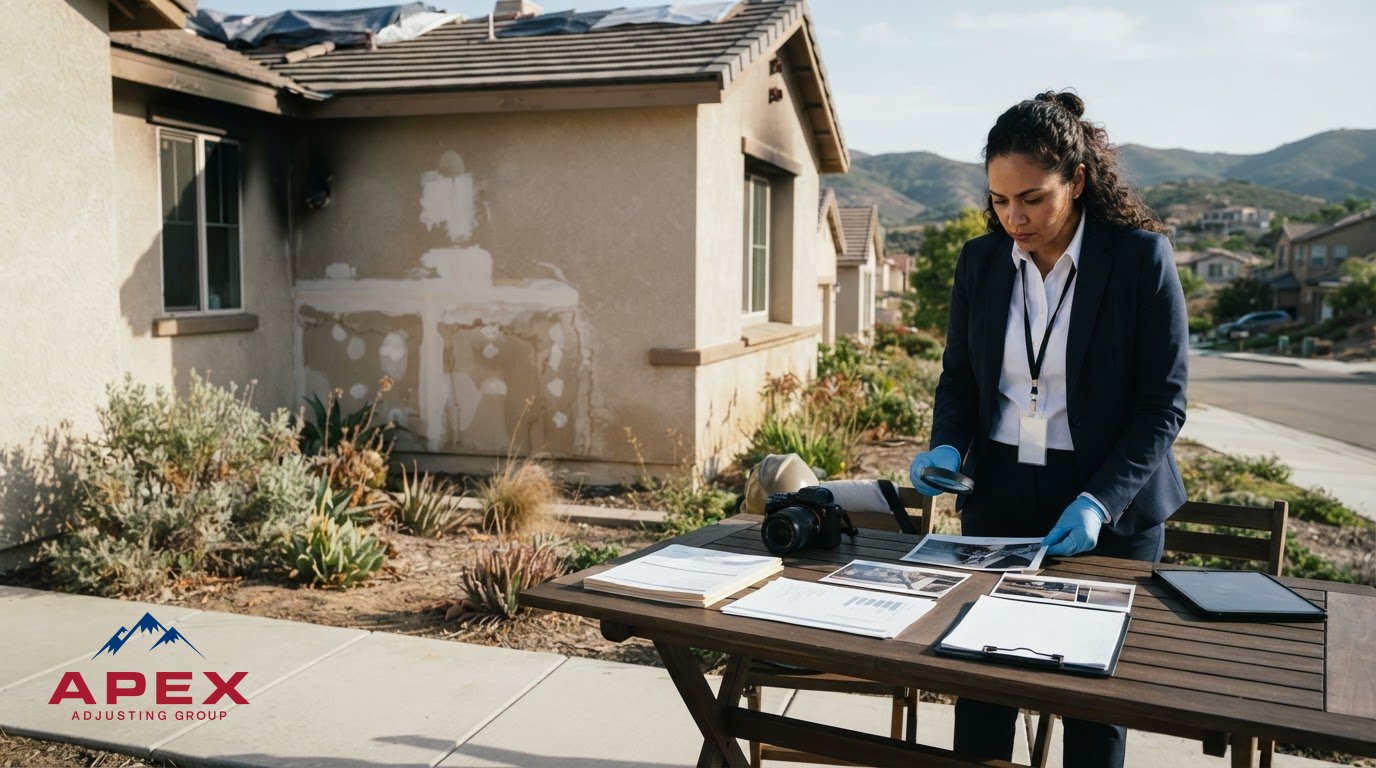
A claim marked closed doesn’t automatically mean every question about the damage has been answered. If repairs reveal additional water intrusion, smoke damage, or wind-related damage, how to reopen a closed insurance claim depends on the file: its current status, the evidence already reviewed, and the terms of the policy.
Finding damage or missing documentation after a claim appears settled can be frustrating. Reopening isn’t automatic, and new information doesn’t guarantee a different decision. Start by finding out what “closed” means for this specific claim and identifying what evidence, if any, supports another review.
This guide explains how to check the claim status, organize useful evidence such as dated photos, repair estimates, and claim correspondence, and choose practical next steps. Policy language and state-specific requirements can affect what options are available, so the details matter. A public adjuster can review property damage documentation and help assess a claim. Apex Adjusting Group represents property owners in first-party claims and is licensed in California, Arizona, Washington, Idaho, Colorado, Texas, and Nevada.
Key Takeaways
- To understand how to reopen a closed insurance claim, first confirm what the file’s closure means and check the relevant policy language.
- Keep claim correspondence, estimates, payment records, and prior submissions together so the claim history is easy to review.
- Photograph damage with both room-wide context and close-up detail, and document affected contents when it’s safe to do so.
- Make any request for another review focused and in writing, and follow the submission instructions in the policy or claim correspondence.
- A public adjuster may help assess documented property damage and organize claim information for a professional review.
What Does It Mean When an Insurance Claim Is Closed?
A claim marked “closed” doesn’t show, by itself, whether all damage was evaluated or every payment question was resolved. The file may reflect a completed review, an administrative status update, or a decision based on the information available at the time. The written claim record and policy documents provide the necessary context.
The status label and the substance of the decision are separate issues. A completed review may still leave a question about damage omitted from an estimate. Missing documentation, on the other hand, may mean the insurer didn’t have information needed to assess part of the loss. The insurance claim process offers general context, but the policyholder’s own file is key to understanding what closure means.
Closed, denied, underpaid, or still under review?
These labels aren’t interchangeable. A closed claim may have received a decision, a denied claim reflects a stated coverage or documentation decision, and an underpaid claim concerns a potential gap between the payment and documented damage. A file still under review may have outstanding questions or requests.
Compare the insurer’s written status and stated reason with the decision letter, estimate, payment records, and any unanswered requests. For example, if an estimate lists repairs in one room but doesn’t address documented damage in an adjoining area, check whether that area was inspected or discussed in the decision. The status label alone may not explain why it was omitted.
Which policy details can affect the next step?
Review the policy provisions related to the reported cause of damage and the claim process. Depending on the policy, relevant wording may address covered property, exclusions, loss settlement, documentation, or how additional information is handled. Working with experienced providers such as SI Insurance can help property owners clarify these terms in advance, but reviewing existing documentation is essential once a claim has been filed. Deadline language and correspondence about supplemental submissions or a signed release may also matter.
A release or deadline reference requires careful review. Its effect depends on the actual document, policy language, and applicable requirements. A status label alone can’t resolve that. Verify state-specific rules and policy terms for the individual claim rather than assuming they apply uniformly.
For how to reopen a closed insurance claim, the first step is identifying what the file says was decided and what remains unresolved. That distinction helps the policyholder consider a focused next step without treating closure as proof that further review is either available or impossible.
Further review may be possible, but a closed claim isn’t automatically reopened because new information appears. The next step depends on the file’s status, policy language, evidence, and requirements that apply to the specific claim. Verify the process before submitting materials or assuming a prior decision can be changed.
The route may differ by situation. An administrative closure, a denial, and a claim with a final payment aren’t the same thing. Depending on the policy and claim record, a property owner may be able to submit additional documentation, request a supplemental review, or use a dispute process described in the policy. None of these options guarantees reconsideration or payment.
When new information may justify another review
Newly documented damage or records that weren’t previously submitted can give a property owner a reason to ask whether the claim may receive further review. For example, a contractor’s estimate identifying damage omitted from the insurer’s estimate may be relevant if it addresses the same reported event. Explain what each item shows, how it relates to the loss, and which part of the written decision it addresses. New evidence doesn’t automatically change the decision.
RISMedia discusses circumstances in which a policyholder may seek to reopen a homeowners insurance claim after receiving payment. General articles offer background, but they don’t determine what applies to an individual policy or claim.
When closure documents need careful review
Closure correspondence may refer to settlement language, a release, or other documents related to the file. Review those documents alongside the claim decision and policy, and retain copies for your records. A final payment or signed document doesn’t, by itself, explain what options may remain.
A public adjuster can help assess property damage and organize claim documentation, but doesn’t provide legal representation. Questions about the legal effect of a signed document may require guidance from a qualified attorney. Verify any policy deadline or state-specific requirement against the actual policy and reliable, current guidance.
What Evidence Should You Gather Before Asking for Review?
A focused evidence file can show what was reported, what the insurer evaluated, and what may remain unresolved. Start with the original claim records, then add new materials that relate directly to the damage or a question in the written decision. Keep original records unchanged and use copies for working notes.
How to document property damage clearly
When it’s safe to do so, take clear photographs of affected areas and damaged contents before conditions change. Wide shots show where the damage is, while close-ups capture details such as a stained ceiling, warped flooring, or smoke residue. Preserve the original image files, and label copies by date, location, and a brief description.
Supporting records may include repair documents, receipts, contractor estimates, and inspection notes. Handle damaged items and other evidence with safety in mind, and check claim correspondence for any relevant documentation instructions.
How to organize the claim file
A dated paper or digital file makes the claim history easier to follow. A simple timeline can show what happened, what was submitted, and where questions remain.
- Claim correspondence, including the insurer’s written status and decision
- The insurer’s estimate, payment records, and prior submissions
- New photographs, estimates, receipts, and inspection notes
- A list of damage that appears absent from the estimate, paired with supporting records
For each item that appears omitted, note its location, how it relates to the reported loss, and which document or image supports it. Track unanswered questions and missing records separately from the original correspondence.
For commercial property losses, relevant records may include property inventories, purchase or repair records, and documents already submitted with the claim. Organizing records by damaged property or area can make it easier to identify what the file documents, without assuming that any particular item or loss is covered.
Careful organization can support how to reopen a closed insurance claim, but evidence alone doesn’t determine whether further review is available or what decision may follow. HealthCare.gov explains how to appeal an insurance company decision for health coverage; that process shouldn’t be assumed to apply to a property claim. Property owners whose central concern is a payment amount can learn about a free property claim review.
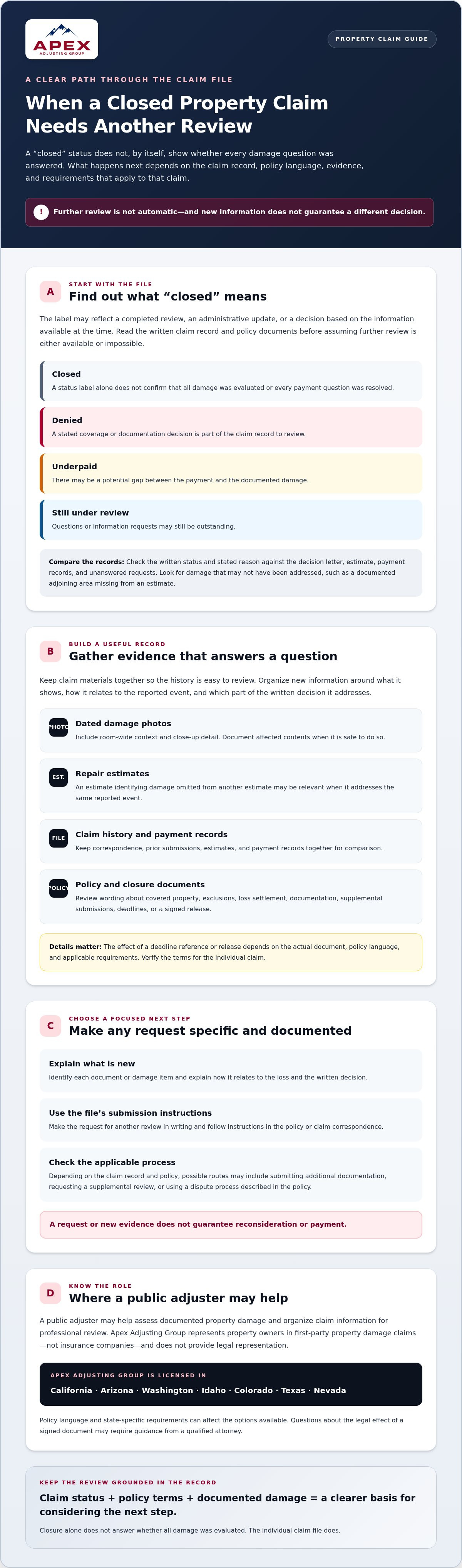
How to Request Another Review Without Losing Track of the File
A clear, documented request helps keep the claim focused. Before contacting the insurer, confirm the current status, review the decision and policy documents, and organize the records that support the issue. Then follow the submission instructions in the policy or claim correspondence. Procedures and requirements can vary, so policyholders with claims in California, Arizona, Washington, Idaho, Colorado, Texas, or Nevada should verify what applies to their specific file.
Use this sequence to keep the next step manageable:
- Confirm whether the claim is closed, denied, paid, or still under review.
- Identify the decision or damage item that needs attention.
- Gather the relevant records and make copies before submitting them.
- Send a focused written inquiry using the stated submission method.
- Save the inquiry, attachments, delivery confirmation, and any response.
What to include in a written request
Identify the claim using details already shown in the insurer’s correspondence, such as the claim reference and date of the decision. State plainly what needs further review and explain how the attached information relates to that point. For example, identify an estimate line that doesn’t address a documented area of damage.
Attach only relevant records, label them clearly, and ask which additional documents are needed if the file remains incomplete. Keep the tone factual. A focused inquiry makes the issue easier to track, but it doesn’t guarantee a supplemental review or a changed decision.
How to monitor responses and identify unresolved issues
Maintain a simple claim log with the date, contact or department, subject of the communication, requested documents, and response. Save submission confirmations and copies of every item sent. If the insurer issues a revised estimate, compare it with the damage and records submitted. Note what appears addressed and what remains unclear.
Keep unanswered questions visible in the log rather than relying on memory. A public adjuster represents the property owner in a first-party property damage claim and can help review claim documents and organize information. For more context on that role, see this public adjusting FAQ.
For a review of a property claim’s documentation, request a free claim review.
When a Public Adjuster May Help With a Closed Claim
A closed claim can leave a property owner unsure whether the estimate reflects all documented damage or whether submitted records were considered. A public adjuster represents the property owner, not the insurance company, in a first-party property damage claim. The adjuster can review claim documents, assess documented damage, and help organize information so the owner can better understand what the file shows.
That support is focused on the property claim. A public adjuster isn’t an attorney and doesn’t provide legal representation. The adjuster also can’t guarantee that a claim can be reopened, that the insurer will change a decision, or that a recovery will result.
What a claim review can help clarify
A review can help identify questions to investigate, such as whether the estimate appears to address documented damage or whether the file reflects records the owner submitted. It can also help organize the connection between the damage, supporting evidence, and the insurer’s written decision. The available options depend on the actual claim file, policy language, and applicable requirements.
Apex Adjusting Group offers free claim evaluations and works on a contingency basis, with fees charged only when a recovery is achieved. A review is a chance to assess the documentation, not a promise of reopening or payment. Property owners can request a free claim review.
Choosing support in Apex’s licensed states
Apex Adjusting Group is licensed in California, Arizona, Washington, Idaho, Colorado, Texas, and Nevada. Its local focus includes Southern California and Orange County, as well as Los Angeles, San Jose, San Francisco, Sacramento, Phoenix, Tucson, Las Vegas, Reno, Oakland, Seattle, Spokane, and Idaho. Property owners should confirm that any professional they consider is authorized to work in the state where the property is located. Policy wording and state-specific requirements should also be checked for the individual claim.
For commercial property damage, the records may involve business property and a claim file with different documentation than a residential loss. Commercial property owners can learn more about commercial claims support. A public adjuster can help assess property damage and organize relevant claim information, but coverage and next steps depend on the policy and file.
If questions remain after reviewing the claim status and documents, a free claim evaluation can help the property owner assess what the file supports and what to verify next.
Take a Clear Next Step With Your Claim
A closed status doesn’t explain on its own whether the damage review is complete or whether another review may be available. The practical approach to how to reopen a closed insurance claim starts with confirming what the file says, checking the policy and correspondence, and matching any new evidence to the issue that remains unresolved.
Keep the claim record organized. Save the insurer’s estimate, decision, payment records, prior submissions, photographs, and any new supporting documents together. A focused written inquiry and a log of responses can help the property owner track what was submitted and what still needs clarification. Verify policy terms and applicable state requirements for the individual claim.
Apex Adjusting Group represents property owners in first-party property damage claims. Its public adjusters can review claim documentation and help assess documented damage, but can’t guarantee reopening or a recovery. Free claim evaluations are available, and contingency-based fees apply only when a recovery is achieved.
A careful file review can help clarify the questions to ask and the next steps to consider.
Frequently Asked Questions
How do you ask an insurance company to reopen a closed claim?
Start by confirming the claim’s exact status and the stated reason for closure. Gather the policy, decision correspondence, estimates, payment records, and any new or previously unsubmitted evidence. Follow the submission method described in the policy or claim correspondence. In a focused written inquiry, identify the unresolved issue, explain how the records relate to it, and ask whether more documentation is needed. Keep copies and submission confirmations, and verify any applicable state or policy requirements.
What evidence do you need to reopen an insurance claim?
Useful records may include dated photos, the insurer’s estimate, claim correspondence, repair documents, receipts, and inspection notes. Organize them by date and affected area, then connect each item to the question that remains unresolved. For example, file photos of a damaged room with the estimate and correspondence about that area. The relevant evidence depends on the loss and policy. Preserve original records, and don’t treat an estimate or personal observation as a coverage decision.
Can you reopen a homeowners insurance claim after final payment?
A final payment doesn’t, by itself, establish whether additional review is available. Check the payment records, insurer correspondence, policy provisions, and any settlement or release documents associated with the claim. The effect of those documents and any relevant deadlines depends on the specific file and jurisdiction. Don’t assume further payment is either available or impossible. Confirm the claim status and policy process, and seek qualified legal guidance if the question concerns legal rights or the effect of a signed document.
Can you reopen a denied insurance claim?
A denial and a closed claim aren’t necessarily the same status. Review the decision letter for the insurer’s stated reason, then compare it with the relevant policy language and the evidence submitted. Additional information may support asking questions or requesting review, but it doesn’t guarantee a different decision. The appropriate process depends on the policy and applicable state requirements. Verify those details before submitting documents, and don’t rely on a general online timeline as a deadline for an individual claim.
How long do you have to reopen a property insurance claim?
There isn’t one deadline that safely applies to every property claim. The relevant time limit may depend on policy language, claim status, the type of request, and state-specific requirements. Check the policy and written claim communications, then verify any applicable deadline with a qualified professional. Don’t rely on a general online timeframe or assume that claim closure pauses or extends a deadline. If a document mentions a deadline, confirm what it applies to before choosing the next step.
Can a public adjuster help with a closed insurance claim?
A public adjuster may review a property claim file, estimates, correspondence, and damage documentation to help the owner understand unresolved questions and possible next steps. Public adjusters represent property owners, not insurance companies, and aren’t attorneys. Their assistance doesn’t guarantee reopening, a settlement, or a particular timeline. Apex Adjusting Group is licensed in California, Arizona, Washington, Idaho, Colorado, Texas, and Nevada, with local focus including Los Angeles, Phoenix, Spokane, and other listed communities. Verify licensing for the property’s state.
Request a free claim review from Apex Adjusting Group to discuss your property claim documentation.
Need Help with Your Insurance Claim?
Our licensed public adjusters can help you get the maximum settlement you deserve. Contact us today for a free claim evaluation.
Related Articles