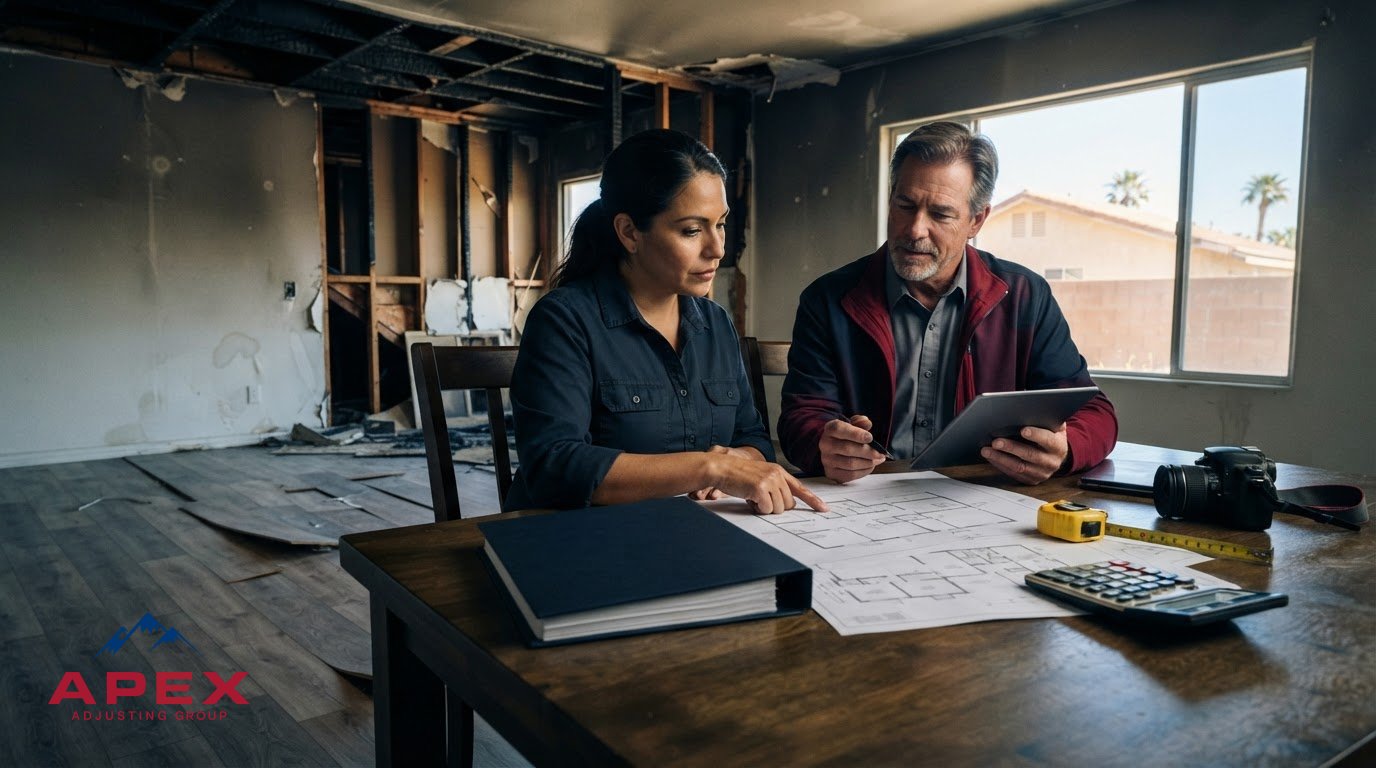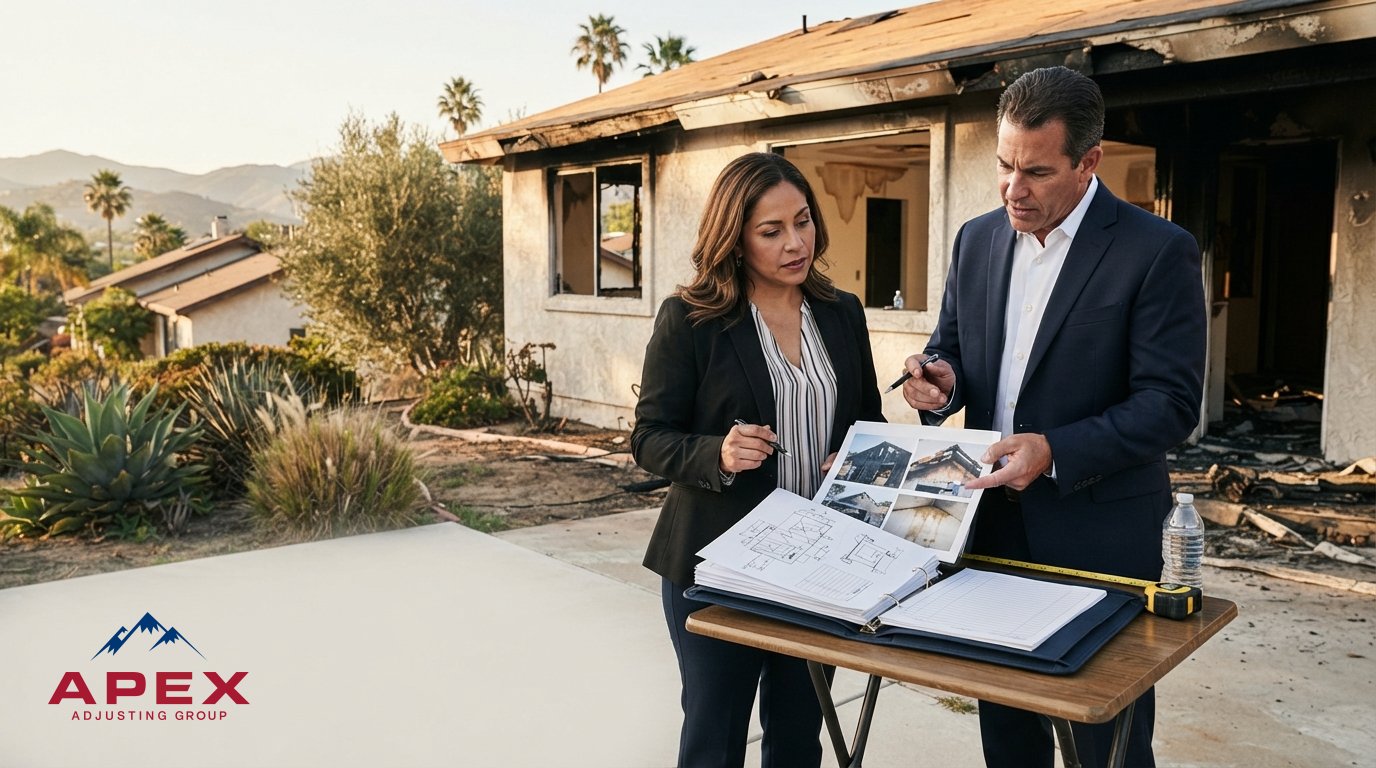
An insurer’s estimate can appear complete while leaving important damage or documentation questions unresolved. A free claim evaluation property damage review can help a property owner compare the estimate with photos, repair estimates, claim correspondence, and other records, then identify what may need clarification.
It’s reasonable to want a clear account of what the review includes before sharing a claim file or considering professional support. Apex Adjusting Group represents property owners, not insurance companies, and offers free claim evaluations for active or recent residential and commercial property claims. A public adjuster can assess claim documentation and policy provisions; that role is different from legal representation.
This article explains what an evaluator may review, which records and photographs can make the discussion more useful, and how to spot gaps or questions in the file. It also clarifies what to ask about fees before choosing a next step. Apex’s fee model is contingency-based, with no fee unless a settlement is obtained. The review can help a property owner decide whether public adjusting support may fit the claim, without assuming a particular outcome.
Key Takeaways
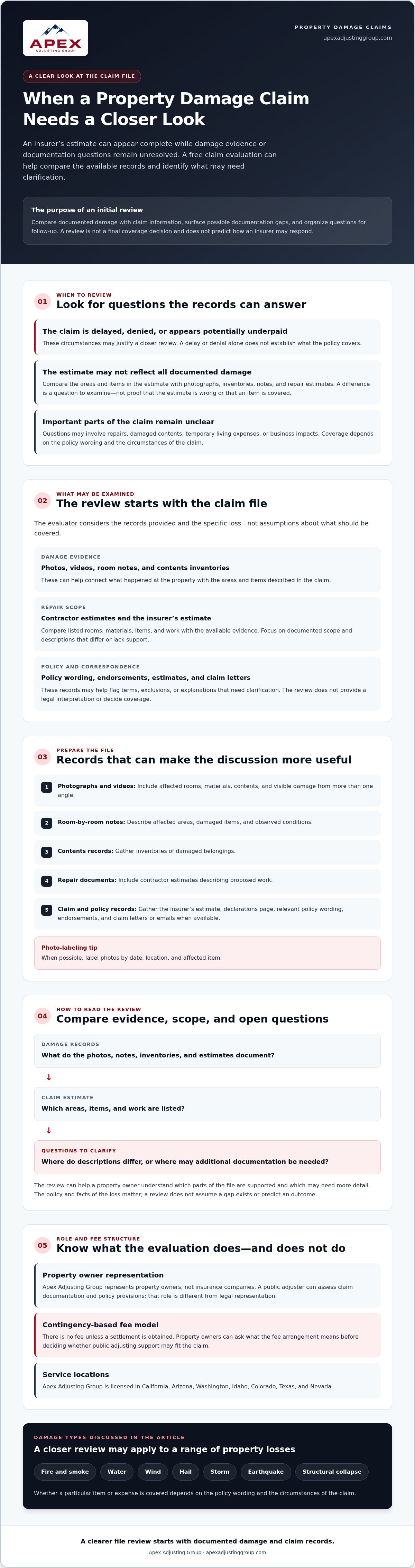
- A free claim evaluation property damage review may help clarify next steps when a first-party claim is delayed, denied, or appears underpaid.
- Compare documented damage with the claim file to identify missing information and questions that may need clarification.
- Organize records and label photos by date, location, and affected item when possible to make the loss easier to review.
- Learn what to expect after sharing claim details with Apex and how its contingency fee model works before deciding whether to seek public adjusting support.
When a property damage claim may need a free evaluation
The property is damaged, an insurer’s estimate is on file, and it’s unclear whether the estimate accounts for everything the records show. A free claim evaluation property damage review can help compare the documented loss with the claim information and identify questions that may need clarification. It does not guarantee that a gap exists or predict how the insurer may respond.
A free claim evaluation is an initial review of available damage evidence and claim information to help identify issues or unanswered questions. The policy and the facts of the loss matter. For background on property insurance terms such as replacement cost and actual cash value, see Property insurance basics.
Claim signs that may justify a closer review
Start with what can be documented. Compare visible damage, photographs, inventories, and repair estimates with the areas and items described in the insurer’s estimate. For example, if photos show water damage in a room that isn’t clearly addressed in the estimate, that difference may be worth asking about. It is a point to examine, not proof that the policy covers the item or that the estimate is wrong.
A review may also help organize unresolved questions about repairs, damaged contents, temporary living expenses, or business impacts. Whether any of these items are covered depends on the policy wording and claim circumstances. A delay or denial alone doesn’t establish what the policy covers; the written decision, supporting records, and applicable policy provisions need to be considered together.
Property owners may request a closer look after fire, smoke, water, wind, hail, storm, earthquake, or structural-collapse damage. For example, an owner with a water loss can review the scope of the claim through water damage claim support.
Who can request a property damage claim evaluation?
Homeowners and commercial property owners with active or recent first-party claims may seek an evaluation when a claim is delayed, denied, or appears potentially underpaid. Apex Adjusting Group represents property owners, not insurance companies. Its role as a public adjusting firm is to assess and support the property owner’s claim, not to provide legal representation.
Service is limited to property owners in California, Arizona, Washington, Idaho, Colorado, Texas, and Nevada. A review can help clarify what the available file shows and what questions remain. The next step depends on the claim records, the policy, and the owner’s goals.
What a free claim evaluation for property damage examines
A useful review starts with the claim file, not assumptions about what should be covered. A free claim evaluation for property damage is an initial review of available damage evidence and claim information. The evaluator considers the records provided and the specific loss; the review is not a final coverage decision or a prediction of how the insurer may respond.
An evaluation can identify documentation gaps and questions for follow-up. That can help a property owner understand which parts of the file are supported, which need more detail, and what may be worth clarifying.
Damage evidence and estimates
Damage records help connect what happened at the property with the scope described in the claim. An evaluator may review:
- Dated photographs and videos showing affected rooms, materials, contents, and visible damage from more than one angle.
- Room-by-room notes describing affected areas, damaged items, and observed conditions.
- Inventories of damaged contents and contractor estimates describing proposed work.
- The insurer’s estimate, to compare its listed areas and work with the evidence and other estimates.
The comparison should focus on documented scope: which rooms, materials, items, and tasks appear in each record, and where descriptions differ or lack support. It should not rely on unsupported price benchmarks. For fire or smoke damage, property owners can review Apex’s fire damage claims service.
Policy documents and claim correspondence
Policy language and claim letters provide context for the file. When available, gather the declarations page, relevant policy wording, endorsements, insurer estimates, and letters or emails about the claim. These materials can help an evaluator flag terms, exclusions, or explanations that may need clarification, without offering a legal interpretation or deciding coverage.
For a water loss, the policy wording and claim correspondence may help frame questions about how the reported damage was assessed. Apex’s water damage claims service provides information about its work on these claims.
Completeness matters. If records are missing, the review can only address what the available file supports; an evaluator may note what additional documentation could help clarify an issue. Property owners who want to discuss their claim file can request a free claim review.
How to assess review findings and decide on claim support
A review is most useful when its observations are separated from assumptions. It may point to a difference between the damage records and an estimate, but that difference is a question to examine, not proof of a coverage error or a promise of additional payment.
Use a simple comparison to organize what the file shows and what still needs attention:
| Evidence already documented | Information still needed | Questions requiring clarification |
|---|---|---|
| Photos, inventory, or repair estimate describe the affected area or item. | A room, damaged item, or repair task has little or no supporting detail. | Does the estimate address the documented area and work? |
| Claim correspondence records a decision or request for information. | A related letter, estimate, or referenced document is missing from the file. | What does the letter identify as the reason for a delay or denial? |
| Policy documents contain relevant wording or endorsements. | The applicable provision or endorsement is not clear from the available records. | Which policy language is relevant to the unresolved claim item? |
What a review finding can and cannot establish
A finding should identify its basis: a photograph, estimate, inventory, letter, or policy document. An assumption is not the same as a documented observation, and an estimate is not confirmation that every listed item is covered. Policy application and claim decisions depend on the file and relevant policy language.
A free evaluation is not a legal opinion, a coverage ruling, or a promised recovery. Requesting a free review does not guarantee a settlement or predetermine what the property owner should do next. It can help clarify inconsistencies and missing support so the owner can consider an informed next step.
Public adjuster support versus legal representation
A public adjuster assists property owners with first-party property damage claims and represents the property owner’s interests in the claim process. Apex Adjusting Group is not an attorney and does not provide legal representation. A public adjuster’s claim-file review has a different scope from legal advice; property owners seeking an overview of the role can look for a separate guide titled “What Is a Public Adjuster?”
If a review could help clarify the claim file, property owners can request a free claim review and decide on next steps after discussing the available information.
How to prepare documents and photos for a claim review
A clear file makes it easier to connect the reported damage, supporting records, and claim correspondence. For a free claim evaluation property damage review, the owner doesn’t need to resolve every open question before sharing documents. The goal is to give the evaluator an organized account of what happened and what has already been submitted.
Organized, dated evidence can make a claim-file review clearer by showing what was damaged, where it occurred, and how the records relate.
Build a concise claim file
- Gather the core claim details. Collect available policy documents, the claim number, the date of loss, submitted forms, and correspondence about the claim. Include insurer estimates and letters that explain decisions or request information.
- Sort repair and payment records. Keep contractor estimates, bids, invoices, and receipts together, but separate documents by source and date. Detailed drying logs and repair invoices from specialists like dryriteaz.com provide crucial documentation of initial mitigation efforts. Preserve the original files and label copies clearly so an evaluator can distinguish an estimate from completed work or an expense already paid.
- Organize contents and communication records. Add inventories of damaged belongings and relevant emails or messages. Keep a record of who sent each communication and when, where that information is available.
- Prepare a brief loss summary. Note the type of event, affected areas or property, steps already taken, and the main questions the owner wants reviewed. For business property, gather records showing which operations or areas were affected, but don’t present unsupported loss estimates as established amounts.
Document damage without disturbing evidence
Photograph each affected area before repairs when it’s safe to do so. Take wide views to show the room or overall location, then closer images of visible damage and affected contents. Record temporary protective measures already taken, such as covering an opening or moving items away from a damaged area. Don’t delay necessary safety measures to obtain photos.
Preserve original photographs, videos, estimates, receipts, and correspondence. When possible, label each image with its date, location, and affected item, such as “kitchen ceiling” or “office flooring.” If the date isn’t known, don’t guess; identify the location and item instead. Keep a copy of anything submitted and note what was sent.
Commercial property owners can organize records by affected location or operation, keeping supporting documents together without estimating losses that aren’t documented. Residential property owners can use the same approach for rooms, structures, and personal belongings. In both cases, a simple, consistent filing system makes it easier to trace each record to the relevant damage.
Once records are gathered, submit the available documents with the short loss summary. Missing information can be identified during the review, so the file doesn’t need to be perfect before the owner asks for an evaluation.
Property owners can request a free claim review when they’re ready to discuss the available file.
What happens after an Apex free property damage claim review
After requesting a review, the property owner can expect a focused discussion of the claim file and the questions it raises. The review is a practical way to consider whether additional claim support may be appropriate, not a promise of a particular finding or outcome.
- Submit the claim details. Share the basic information about the loss and claim, including the claim status and the main issues the owner wants reviewed.
- Provide available documents. Send relevant estimates, photographs, inventories, policy documents, and claim correspondence. The review depends on the information provided, so the owner can ask which additional records may be useful.
- Discuss observations. Review any documented inconsistencies, missing information, or questions that may need follow-up. The discussion can help clarify what the file currently shows and what remains uncertain.
- Consider next steps. Ask what support is proposed, what it covers, and what responsibilities the owner would have before deciding whether to proceed.
Understand the service scope and fee arrangement
Apex Adjusting Group represents property owners in first-party property damage claims. It does not sell insurance policies or perform repair work. Its public adjusting services focus on the property owner’s claim, a different role from legal representation.
Apex states that it operates on a contingency fee basis, meaning there is no fee unless a settlement is obtained. Before deciding to proceed, the property owner should review the written engagement terms and ask questions about the proposed scope and fee arrangement. The free evaluation itself does not establish that a settlement will be obtained.
If insurance appraisal may be relevant to the claim, the related guide “Insurance Appraisal Process: Breaking the Claim Deadlock” may offer additional context. A claim with a low estimate may also raise questions for the guide “Insurance Claim Settlement Too Low? How to Fight Back.” Those topics do not replace a review of the specific claim file or policy language.
Choose a practical next step for the claim
Before agreeing to representation, the owner can ask which documents are needed, what the proposed review or support includes, and which questions remain unresolved. Clear answers make it easier to decide whether public adjusting support fits the claim. There’s no need to decide before understanding the scope and terms.
Turn the claim file into a clearer next step
A careful review starts with the evidence: photographs, estimates, inventories, policy documents, and claim correspondence. Organizing these records can help show what the file supports, where information may be missing, and which questions deserve follow-up. A free claim evaluation property damage review can provide perspective on an active or recent claim without guaranteeing a finding or settlement.
Apex Adjusting Group offers free claim evaluations and represents property owners in first-party property damage claims, not insurance companies. Its public adjusting role is distinct from legal representation. Apex states that its fee is contingent on obtaining a settlement, meaning there is no fee unless a settlement is obtained. Property owners can review the written engagement terms and ask questions before deciding whether to proceed.
A clear understanding of the records, review scope, and fee arrangement can help owners choose a next step with confidence. The decision remains theirs.
With the right questions and an organized claim file, property owners can move forward with greater clarity.
Frequently Asked Questions
Is a free property damage claim evaluation really free?
Yes. Apex offers free claim evaluations, and a free claim evaluation property damage review does not itself create a service fee. Apex’s stated arrangement is contingency-based, meaning there is no fee unless a settlement is obtained. The evaluation doesn’t promise recovery. Before deciding whether to proceed with representation, the property owner should read the written engagement terms and ask what work is included and how the fee arrangement applies.
What documents should I prepare for a property damage claim review?
Gather available policy documents, claim correspondence, insurer and contractor estimates, photographs, inventories, receipts, and invoices. A short timeline of the loss and claim communications can help show how the file developed. Keep original records and note which documents are missing. Don’t delay solely because the file is incomplete; tell the evaluator what isn’t available and ask what additional information may help clarify the claim.
Can a free evaluation help with a denied, delayed, or underpaid claim?
It can help identify questions or documentation gaps in the available claim file. An evaluator may examine damage evidence, estimates, policy documents, and claim history, but the review can’t guarantee a different claim decision or resolve every coverage issue from limited information. Apex evaluates first-party property damage claims for property owners. It is a public adjusting firm, not a law firm, and does not provide legal representation or legal advice.
What happens during a free claim evaluation?
The property owner shares information about the loss and claim, along with available photographs, estimates, policy documents, and insurer communications. The evaluator can review the materials, discuss observations, and identify possible questions or next steps. The review’s scope depends on the information available. It doesn’t guarantee a settlement, a particular amount, or a timeline. Owners can ask what documents may be useful and what the review covers.
Does requesting a free claim review mean I have to hire a public adjuster?
No. Requesting a review gives the property owner a chance to understand what an evaluator sees in the available claim information. It doesn’t require the owner to proceed with representation. Before deciding, ask about the proposed scope, responsibilities, written engagement terms, and fee arrangement. Then consider whether the service fits the claim and the owner’s needs. The decision to proceed remains with the property owner.
Is a public adjuster the same as an insurance attorney?
No. A public adjuster assists property owners with first-party property damage claims, while an attorney provides legal representation. Apex Adjusting Group is a public adjusting firm, not a law firm, and does not provide legal advice. A claim review can help organize damage evidence and identify claim questions, but it isn’t a legal opinion or a coverage ruling. The roles are different, so owners should be clear about the support they’re seeking.
What states can Apex review property damage claims in?
Apex states that it is licensed in California, Arizona, Washington, Idaho, Colorado, Texas, and Nevada. Its local focus includes Southern California, Los Angeles, Orange County, Sacramento, San Jose, San Francisco, and Oakland, as well as Phoenix, Tucson, Las Vegas, Reno, Spokane, Seattle, and communities in Idaho. Confirm availability for the property’s location and claim circumstances before proceeding. Apex does not represent owners nationwide.
Need Help with Your Insurance Claim?
Our licensed public adjusters can help you get the maximum settlement you deserve. Contact us today for a free claim evaluation.
Related Articles